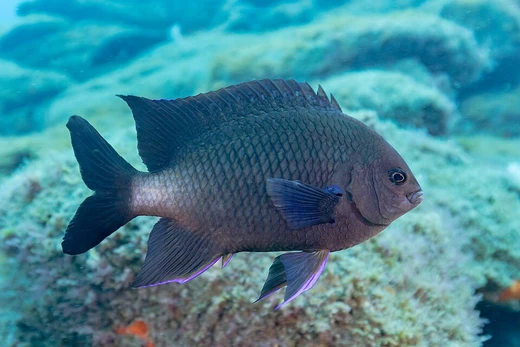
Tomato clownfish
A Western Pacific clownfish with immunity to Marine Velvet disease.
Last updated

Diego Delso · via Wikipedia: Tomato clownfish · CC BY-SA 4.0
The species forms symbiotic mutualisms with sea anemones and is unaffected by their stinging tentacles.[1] Belonging to the Pomacentridae family, the marine species known as the tomato clownfish carries the scientific name Amphiprion frenatus.[2]
Scientific classification
- KingdomAnimalia
- PhylumChordata
- ClassActinopterygii
- DivisionTeleostei
- OrderBlenniiformes
- FamilyPomacentridae
- GenusAmphiprion
- SpeciesAmphiprion frenatus
Named by Brevoort, 1856
Close relatives
Other species of Amphiprion with a Codexery entry.
- Cinnamon clownfish Amphiprion melanopus
- Amphiprion akallopisos Amphiprion akallopisos
- Amphiprion akindynos Amphiprion akindynos
- Amphiprion barberi Amphiprion barberi
- Amphiprion chagosensis Amphiprion chagosensis
- Amphiprion chrysogaster Amphiprion chrysogaster
- Amphiprion latezonatus Amphiprion latezonatus
- Amphiprion latifasciatus Amphiprion latifasciatus
Sources: Wikipedia taxobox: Tomato clownfish (CC BY-SA 4.0) · differs from this box at order: WoRMS AphiaID 278394 (CC BY 4.0)
Conservation status
Least Concern (LC)
- LC▲ this species
- NT
- VU
- EN
- CR
- EW
- EX
Source: IUCN Red List assessment · GBIF copy of the Red List category
How big is it?
Largest length in the source, 0.14 m, next to a 1.8 m person.
Diagram: drawn by Codexery, schematic shapes to scale (not a likeness). Length: Wikipedia: Tomato clownfish
Where the tomato clownfish has been recorded
Each dot is a place where the species has been observed and reported (1,186 records, half-degree grid) — not a modelled range. 20 inland records left out (institution coordinates). 3 isolated far-off records not drawn.
Map: drawn by Codexery. Data: GBIF occurrence search (records CC0 / CC BY) · Natural Earth basemap (public domain)
Biology and range
Adults are bright orange-red with a white head bar behind the eyes that has a distinctive black outline.[3] This immunity involves production of specific antibodies with a heavy chain of 70 kD and light chains of 32 kD.[4] All clownfish are born male.[5] The sides of female tomato clownfish are predominantly blackish, whereas males are smaller and exhibit a completely red coloration.[3]
Younger individuals display a deeper red hue and are marked by either two or three white bars.[3] According to some sources, this fish forms symbiotic relationships with the bubble-tip anemone (Entacmaea quadricolor), while other authorities mention associations with the sebae anemone (Heteractis crispa).[6] A robust and enduring resistance to Marine Velvet disease, which is triggered by the dinoflagellate Amyloodinium ocellatum, is a characteristic of the tomato clownfish.[7]
What the specialist sources record
The World Register of Marine Species lists Amphiprion frenatus Brevoort, 1856 as an accepted species in the family Pomacentridae.[8] GBIF holds 1,657 occurrence records for this taxon as of October 2026.[9] A 2006 buyer's guide indicates that this fish does well even when no host anemone is present.[10] If a host is unavailable, it might choose to inhabit corals within an aquarium setting.[10]
That same guide notes that upon reaching maturity, the tomato clownfish displays aggressive and territorial behavior, sometimes directed at other clownfish species.[10]
References
- Wikipedia, "Tomato clownfish" (CC BY-SA 4.0), which cites: "Clown Anemonefish", Nat Geo Wild : Animals (we also read that source) en.wikipedia.org
- Wikipedia, "Tomato clownfish" (CC BY-SA 4.0), which cites: Froese, R. and D. Pauly, Editors. Amphiprion frenatus. FishBase. 2015.; Common names of Amphiprion frenatus. FishBase. 2015. (original not read by us) en.wikipedia.org
- Wikipedia, "Tomato clownfish" (CC BY-SA 4.0), which cites: Fautin, "Field Guide to Anemone Fishes and Their Host Sea Anemones", Western Australian Museum, 1992, p. 78; Froese, R. and D. Pauly, Editors. Amphiprion frenatus. FishBase. 2015.; Fautin, "Field Guide to Anemone Fishes and Their Host Sea Anemones", Western Australian Museum, 1992, p. 78 (we also read that source) en.wikipedia.org
- Wikipedia, "Tomato clownfish" (CC BY-SA 4.0), which cites: Cobb, "Acquired immunity to amyloodiniosis is associated with an antibody response", Diseases of Aquatic Organisms, 1998-10-08, p. 125–133 (original not read by us) en.wikipedia.org
- "Clown Anemonefish", Nat Geo Wild : Animals. facts only, no text reused. animals.nationalgeographic.com
- Wikipedia, "Tomato clownfish" (CC BY-SA 4.0), which cites: Fautin, "Field Guide to Anemone Fishes and Their Host Sea Anemones", Western Australian Museum, 1992, p. 78; Fautin, "Field Guide to Anemone Fishes and Their Host Sea Anemones", Western Australian Museum, 1992, p. 78; Lougher, "What Fish?: A Buyer's Guide to Marine Fish", Interpet Publishing, 2006, p. 14 (we also read that source) en.wikipedia.org
- Wikipedia, "Tomato clownfish" (CC BY-SA 4.0), which cites: Cobb, "Development of Immunity by the Tomato Clownfish Amphiprion frenatus to the Dinoflagellate Parasite Amyloodinium ocellatum", Journal of Aquatic Animal Health, 1998, p. 259–263 (original not read by us) en.wikipedia.org
- World Register of Marine Species, Amphiprion frenatus (AphiaID 278394). CC BY 4.0. marinespecies.org
- GBIF Backbone Taxonomy and occurrence index, Amphiprion frenatus (taxon key 5212111). CC BY 4.0 (backbone); counts are facts. gbif.org
- Wikipedia, "Tomato clownfish" (CC BY-SA 4.0), which cites: Lougher, "What Fish?: A Buyer's Guide to Marine Fish", Interpet Publishing, 2006, p. 14; Lougher, "What Fish?: A Buyer's Guide to Marine Fish", Interpet Publishing, 2006, p. 14 (we also read that source) en.wikipedia.org
Each numbered sentence above was checked against the source it cites before publication. Sentences citing Wikipedia adapt text from the English Wikipedia article Tomato clownfish (contributors), used under CC BY-SA 4.0; this entry is available under the same licence. Other sources were used for facts only; no text or images are copied from them.
More in Clownfish and Damselfish
Sources
Compiled from Wikipedia and the sources listed below. Text from Wikipedia is available under CC BY-SA 4.0; this entry is adapted from it.
- Wikipedia: Tomato clownfish (CC BY-SA 4.0).
- Classification: the source article's taxobox; compare WoRMS, the World Register of Marine Species (CC BY 4.0).
- Conservation status: IUCN Red List assessment.
- Occurrence records: GBIF (CC0 / CC BY). Basemap: Natural Earth (public domain).
Spotted an error? Know more?
Reader corrections go straight into our review queue. Suggest an edit · How this site is sourced