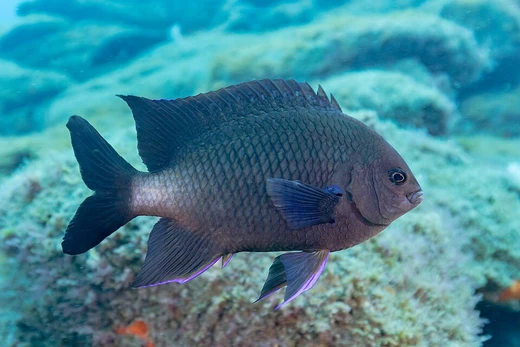
Green damselfish
A Hawaiian reef fish known for polygamous breeding and egg-guarding males.
Last updated
Maximum total length for this species reaches 30 cm.[1]
Scientific classification
- KingdomAnimalia
- PhylumChordata
- ClassActinopterygii
- DivisionTeleostei
- OrderBlenniiformes
- FamilyPomacentridae
- GenusAbudefduf
- SpeciesAbudefduf abdominalis
Named by (Quoy & Gaimard, 1825)
Close relatives
Other species of Abudefduf with a Codexery entry.
- Abudefduf notatus Abudefduf notatus
- Abudefduf saxatilis Abudefduf saxatilis
- Abudefduf septemfasciatus Abudefduf septemfasciatus
- Abudefduf sexfasciatus Abudefduf sexfasciatus
- Abudefduf sordidus Abudefduf sordidus
- Abudefduf troschelii Abudefduf troschelii
- Abudefduf vaigiensis Abudefduf vaigiensis
Sources: Wikipedia taxobox: Green damselfish (CC BY-SA 4.0) · differs from this box at order: WoRMS AphiaID 254879 (CC BY 4.0)
Conservation status
Least Concern (LC)
- LC▲ this species
- NT
- VU
- EN
- CR
- EW
- EX
Source: IUCN Red List assessment · GBIF copy of the Red List category
How big is it?
Largest length in the source, 0.3 m, next to a 1.8 m person.
Diagram: drawn by Codexery, schematic shapes to scale (not a likeness). Length: Wikipedia: Green damselfish
Where the green damselfish has been recorded
Each dot is a place where the species has been observed and reported (1,918 records, half-degree grid) — not a modelled range. 14 inland records left out (institution coordinates). 1 isolated far-off record not drawn.
Map: drawn by Codexery. Data: GBIF occurrence search (records CC0 / CC BY) · Natural Earth basemap (public domain)
Biology and range
Juveniles may sometimes be found in surge pools.[2] Inshore and offshore reefs with rocky bottoms and quiet waters at depths between 1 and 50 m are the typical habitat for adult individuals.[2] Algae and zooplankton make up the diet of this species.[2] Food availability influences the timing of breeding cycles.[3]
Hybridization occurs between Abudefduf abdominalis and the introduced species Abudefduf vaigiensis in Hawaiian coastal waters.[3] Spawning can happen throughout the year, but peak activity occurs from mid-December through July.[3]
What the specialist sources record
The "Underwater guide to Hawaiian reef fishes" notes these fish nibble on zooplankton, usually copepods, and occasionally eat algae.[4][5] The same source reports the rear fin has a black marking, and during breeding males turn blue with black bars fading to gray.[6][7] That appendix also notes Hawaiian sergeant eggs provide a significant food source for other fish.[8] The appendix lists milletseed butterflyfish, raccoon butterflyfish, and black triggerfish as predators of this species.[8]
The appendix notes that humans and the green sea turtle consume this species.[8]
References
- Wikipedia, "Green damselfish" (CC BY-SA 4.0), which cites: Gosline, "Handbook of Hawaiian Fishes", University of Hawaii Press, 1965, p. 209–210; Jenkins, A., "Abudefduf abdominalis", 2010 (original not read by us) en.wikipedia.org
- Wikipedia, "Green damselfish" (CC BY-SA 4.0), which cites: ; Jenkins, A., "Abudefduf abdominalis", 2010 (original not read by us) en.wikipedia.org
- Wikipedia, "Green damselfish" (CC BY-SA 4.0), which cites: Tyler III, William A., "Potential influence of food abundance on spawning patterns in a damselfish, Abudefduf abdominalis", Bulletin of Marine Science, November 1995, p. 610-623; Karen P. Maruska, "Interspecific Spawning between a Recent Immigrant and an Endemic Damselfish (Pisces: Pomacentridae) in the Hawaiian Islands", Pacific Science, 1 April 2007, p. 211–221; "Underwater guide to Hawaiian reef fishes", Treasures of Nature, 1981 (we also read that source) en.wikipedia.org
- Open Library record, ISBN 9780915180073 ("Guide to Hawaiian reef fishes"). CC0 (metadata); book content not read. openlibrary.org
- Wikipedia, "Green damselfish" (CC BY-SA 4.0), which cites: "Underwater guide to Hawaiian reef fishes", Treasures of Nature, 1981; Mahaney, "Hawaiian Reef Fish", Island Heritage, 1998, p. 35 (we also read that source) en.wikipedia.org
- Open Library record, ISBN 0896101088 ("Hawaiian Reef Fish"). CC0 (metadata); book content not read. openlibrary.org
- Wikipedia, "Green damselfish" (CC BY-SA 4.0), which cites: Mahaney, "Hawaiian Reef Fish", Island Heritage, 1998, p. 35; "Underwater guide to Hawaiian reef fishes", Treasures of Nature, 1981 (we also read that source) en.wikipedia.org
- "Appendix 21-A", HAZARD EVALUATION & EMERGENCY RESPONSE (HEER) OFFICE. facts only, no text reused. health.hawaii.gov
Each numbered sentence above was checked against the source it cites before publication. Sentences citing Wikipedia adapt text from the English Wikipedia article Green damselfish (contributors), used under CC BY-SA 4.0; this entry is available under the same licence. Other sources were used for facts only; no text or images are copied from them.
More in Clownfish and Damselfish
Sources
Compiled from Wikipedia and the sources listed below. Text from Wikipedia is available under CC BY-SA 4.0; this entry is adapted from it.
- Wikipedia: Green damselfish (CC BY-SA 4.0).
- Classification: the source article's taxobox; compare WoRMS, the World Register of Marine Species (CC BY 4.0).
- Conservation status: IUCN Red List assessment.
- Occurrence records: GBIF (CC0 / CC BY). Basemap: Natural Earth (public domain).
- Word definitions: the Codexery glossary, each quoted from its Wikipedia article.
Spotted an error? Know more?
Reader corrections go straight into our review queue. Suggest an edit · How this site is sourced