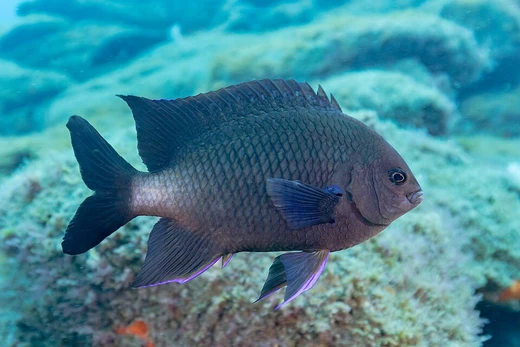
Amblyglyphidodon flavilatus
A reef-dwelling damselfish with yellow sides, native to the western Indian Ocean.
Last updated

Diego Delso · via Wikipedia: Amblyglyphidodon flavilatus · CC BY-SA 4.0
Amblyglyphidodon flavilatus is a ray-finned fish in the family Pomacentridae, which includes damselfish and clownfish.[1] It is known by common names including yellow damselfish, yellowfin damselfish, and yellow-sided damselfish.[1][2] Allen and Randall provided the initial description of this species in 1980.[3][4]
Scientific classification
- KingdomAnimalia
- PhylumChordata
- ClassActinopterygii
- DivisionTeleostei
- OrderBlenniiformes
- FamilyPomacentridae
- GenusAmblyglyphidodon
- SpeciesAmblyglyphidodon flavilatus
Named by Allen & Randall, 1980
Sources: Wikipedia taxobox: Amblyglyphidodon flavilatus (CC BY-SA 4.0) · differs from this box at order: WoRMS AphiaID 218778 (CC BY 4.0)
Conservation status
Least Concern (LC)
- LC▲ this species
- NT
- VU
- EN
- CR
- EW
- EX
Source: IUCN Red List assessment · GBIF copy of the Red List category
Where the amblyglyphidodon flavilatus has been recorded
Each dot is a place where the species has been observed and reported (216 records, half-degree grid) — not a modelled range. 5 inland records left out (institution coordinates). 1 isolated far-off record not drawn.
Map: drawn by Codexery. Data: GBIF occurrence search (records CC0 / CC BY) · Natural Earth basemap (public domain) · place coordinates: Wikipedia (CC BY-SA 4.0)
Biology and range
It occurs only at depths between 12 and 20 meters.[5] Amblyglyphidodon flavilatus is non-migratory and prefers water temperatures from 72 to 78 °F.[5] It is native to the western Indian Ocean, from the Red Sea and Gulf of Aden, in countries including Djibouti, Egypt, Eritrea, Israel, Jordan, Saudi Arabia, Somalia, Sudan, and Yemen.[5] Its overall color is pearly white with a grayish anterior half, a pearly white chest, and a yellowish posterior half.[6]
The eggs are demersal and adhere to the substrate, and males guard and aerate the eggs.[7][8] This fish inhabits coastal fringing reefs and reef slopes, making its home in reef environments.[5] As an oviparous species, Amblyglyphidodon flavilatus reproduces via eggs that hatch after being laid.[9] Zooplankton constitutes the primary food source for these fish.[8]
What the specialist sources record
The World Register of Marine Species lists Amblyglyphidodon flavilatus as an accepted species in the family Pomacentridae, described by Allen and Randall in 1981.[10] Some authors suggest that the reproductive activities of damselfishes are influenced by the lunar cycle.[11] According to GBIF, the species is accepted, was described by Allen and Randall in 1980, and as of October 2026 there are 262 occurrence records.[4] The species holds a "least concern" conservation status and its population is considered stable.[8]
References
- Wikipedia, "Amblyglyphidodon flavilatus" (CC BY-SA 4.0), which cites: Allen, G., "Amblyglyphidodon flavilatus", 2017; "The Yellow-sided Damselfish - Whats That Fish!", www.whatsthatfish.com (we also read that source) en.wikipedia.org
- "The Yellow-sided Damselfish - Whats That Fish!", www.whatsthatfish.com. facts only, no text reused. whatsthatfish.com
- Wikipedia, "Amblyglyphidodon flavilatus" (CC BY-SA 4.0), which cites: Choi, "Annual reproductive cycle of female staghorn damselfish Amblyglyphidodon curacao in the Chuuk Lagoon, Micronesia", Ichthyological Research, 2013, p. 198–201; Bailly, Nicolas, "Amblyglyphidodon flavilatus", 2021 (original not read by us) en.wikipedia.org
- GBIF Backbone Taxonomy and occurrence index, Amblyglyphidodon flavilatus (taxon key 2398501). CC BY 4.0 (backbone); counts are facts. gbif.org
- Wikipedia, "Amblyglyphidodon flavilatus" (CC BY-SA 4.0), which cites: ; Allen, G., "Amblyglyphidodon flavilatus", 2017; ; Bailly, Nicolas, "Amblyglyphidodon flavilatus", 2021 (original not read by us) en.wikipedia.org
- Wikipedia, "Amblyglyphidodon flavilatus" (CC BY-SA 4.0), which cites: ; (original not read by us) en.wikipedia.org
- Wikipedia, "Amblyglyphidodon flavilatus" (CC BY-SA 4.0), which cites: "the definition of demersal", www.dictionary.com (original not read by us) en.wikipedia.org
- Wikipedia, "Amblyglyphidodon flavilatus" (CC BY-SA 4.0), which cites: "The Yellow-sided Damselfish - Whats That Fish!", www.whatsthatfish.com; Allen, G., "Amblyglyphidodon flavilatus", 2017 (we also read that source) en.wikipedia.org
- Wikipedia, "Amblyglyphidodon flavilatus" (CC BY-SA 4.0), which cites: "the definition of oviparous", www.dictionary.com (original not read by us) en.wikipedia.org
- World Register of Marine Species, Amblyglyphidodon flavilatus (AphiaID 218778). CC BY 4.0. marinespecies.org
- Wikipedia, "Amblyglyphidodon flavilatus" (CC BY-SA 4.0), which cites: Allen, "Damselfishes of the world", Mergus Publishers, 1991; Choi, "Annual reproductive cycle of female staghorn damselfish Amblyglyphidodon curacao in the Chuuk Lagoon, Micronesia", Ichthyological Research, 2013, p. 198–201; Stanton FG, "Potential influence of food abundance on spawning patterns in a damselfish, Abudefduf abdominalis", Bull. Mar. Sci.; Srinivasan M, "Extended breeding and recruitment periods of fishes on a low latitude coral reef", Coral Reefs, 2006; Pressley, "Lunar periodicity in the spawning of yellowtai en.wikipedia.org
Each numbered sentence above was checked against the source it cites before publication. Sentences citing Wikipedia adapt text from the English Wikipedia article Amblyglyphidodon flavilatus (contributors), used under CC BY-SA 4.0; this entry is available under the same licence. Other sources were used for facts only; no text or images are copied from them.
More in Clownfish and Damselfish
Test yourself
Three questions drawn from this entry’s sources. Pick an answer to check it.
Answers checked against the source article
Sources
Compiled from Wikipedia and the sources listed below. Text from Wikipedia is available under CC BY-SA 4.0; this entry is adapted from it.
- Wikipedia: Amblyglyphidodon flavilatus (CC BY-SA 4.0).
- Classification: the source article's taxobox; compare WoRMS, the World Register of Marine Species (CC BY 4.0).
- Conservation status: IUCN Red List assessment.
- Occurrence records: GBIF (CC0 / CC BY). Basemap: Natural Earth (public domain).
- Word definitions: the , each quoted from its Wikipedia article.
Spotted an error? Know more?
Reader corrections go straight into our review queue. Suggest an edit · How this site is sourced