Plasmo
Australian claymation series about a shape-shifting alien child.
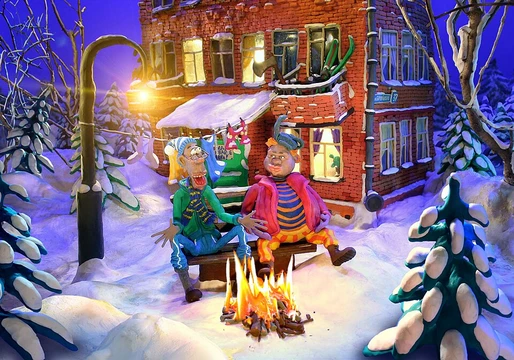
Plasmo (stylised as PLASMO) is an Australian children's science fiction claymation television series that began with a half-hour short film in 1989 and was followed by thirteen 5-minute episodes that aired on the ABC in 1997. The series was created by Anthony Lawrence, who devised, wrote, directed, co-produced and co-animated it, and was broadcast in 24 other countries. The production company Plasmo Mega Studios was founded in 1993 specifically to produce the series and closed in 2004.
Quick Facts
- Genre
- Animation
- Creator
- Anthony Lawrence
- Voices
- Abbe Holmes
- Pia Morley
- Phillip Houghton
- Vivien Davies
- Simon Watt
- Theme music
- Phillip Houghton
- Country
- Australia
- Language
- English
- Seasons
- 1
- Episodes
- 13
Facts from the source article.
Did You Know?
- A 120-page graphic novel based on the series was released on 12 March 2009, authored by Anthony Lawrence, with the last 12 pages featuring never previously released comic and storyboard drafts.
- The DVD release, titled PLASMO: the SERIES, contains all thirteen episodes in original broadcast format, is region-free (Region 0), and is available only via email for $28 AUS plus postage.
Development
The character of Plasmo was first developed by Anthony Lawrence in 1981 for a short film titled "Plasmo versus the Space Bullies", shot on Super 8 mm film and popular with his college students. A sequel, "Plasmo and the Space Party", followed in 1983. Dissatisfied with Super 8 quality, Lawrence used a second-hand 16mm Bolex for the next film, "Happy Hatchday to Plasmo", released in 1986. The Australian Film Commission turned down funding three times, but Lawrence continued working and kept the ABC informed of his intentions.
He completed the film in 1988 and sent it to ABC headquarters in Sydney. In that film, Plasmo is a young alien sought by bounty hunters Coredor and Brucho, who later become his companions in the TV series. The ABC expressed interest in buying the film a year later; it was broadcast and re-broadcast over the next five years. The ABC did not fund a series at that stage but indicated interest.
Lawrence applied for script development from the Australian Children's Television Foundation in 1990, but the project stalled in 1992 due to the need to show investors a sample episode. A pilot funded by Film Victoria was created in 1993, shot over four months; titled "Plasmo and the Bookworm", it later became the seventh episode. Although the pilot won an Adelaide Children's Television Festival award, full funding came only two years later after a new producer joined.
After appeals and 10BA documents, funding came from Film Victoria, an ABC pre-sale, a BBC pre-sale, and a distribution guarantee from Beyond Distribution.
Analysis of episodes
In the second episode "Blast Off!", the sled bears the bumper sticker "Rosebud", a reference to Citizen Kane. Lawrence described the moral of that episode as "go for your dreams, even when others scoff!" He designed the Duorvin as a vertical spacecraft to break stereotypes, though he conceded this may be because it does not fit TV screen ratio. Regarding "Space Ghosts!", Lawrence noted that Plasmo lacks conditioned fear, so he does not respond to ghosts in the usual way.
He remarked that he never thought the ABC would allow Brucho flashing his naked bottom at Coredor, a piece animated by Sharon Parker. The moral of "Big Dam" is that Plasmo's innocent and creative mind allows him to solve gigantic problems with simple means. The theme of "Nice to be Nice" is that the way something is said can change its interpretation. "Plasmo and the Golden Robot" is the first episode showing true bonding among the four main characters as they stand up to an external threat.
Lawrence wrote an episode explaining how Plasmo acquired the Megalon Engine featured in that episode, but it was too expensive to shoot on their tiny budget.
The characters
Plasmo is a three-and-a-half-year-old polybop capable of shape-shifting. He spent his early years on the planet Pynco after the Hatchery his egg was on steered off course and crashed, and he is trying to find his parents. He is voiced by Abbe Holmes. Parsty is a polybop a day older than Plasmo who wears a tiara that creates a protective forcefield.
She has a pet named Niknik and is protective of Plasmo, asserting herself against bullies like Coredor. Her voice was originally performed by Robyn Oakley and later by Pia Morley. Nik-Nik is a dog-like creature and Parsty's pet who accompanies them loyally; end credits state Nik Nik is performed by "himself", but later credits thank Colin Timms for creating the Nik Nik sounds. Coredor is a self-proclaimed intergalactic space mercenary secretly fascinated by Plasmo.
He has only one eye at a time, with a new eye budding every seven years on the opposite side of his face. He has warped reasoning and moral ineptitude. He is performed by Phillip Houghton, who also wrote and composed the music. Brucho is a space mechanic who yearns to be a famous adventurer; he and Coredor teamed up after both flunked Bounty Hunter School.
He always wears a helmet. Brucho is also performed by Phillip Houghton, and was performed by Paul McDermott in the original 1993 version of "Plasmo and the Bookworm".
VHS release
In 1997, ABC Video and Roadshow Entertainment released a video containing the first seven episodes and an edited version of "Plasmo and the Bookworm". The edited version includes the usual opening and closing titles, removes scenes with narration by Harold Baigent, and redubs Brucho's voice with Phillip Houghton. The video also includes a promo for other ABC Video children's titles such as Bananas in Pyjamas, Play School, and Thomas the Tank Engine and Friends.
Frequently Asked Questions
How many episodes of Plasmo are there?
Plasmo has 13 episodes across 1 season.
When did Plasmo first air?
Plasmo first aired on 4 June 1997.
When did Plasmo end?
Plasmo last aired on 20 June 1997.
More in Claymation Television Series
Spotted an error? Know more?
Reader corrections go straight into our review queue. Suggest an edit · How this site is sourced