What It's Like Being Alone
Mutant orphans seek adoption in a black comedy.
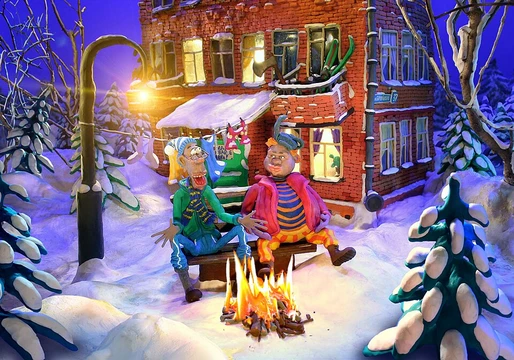
What It's Like Being Alone is a Canadian black comedy for adults that aired on CBC in 2006. Created by Brad Peyton, it used clay animation and featured voices from Stacey DePass, Adam Reid, Dwayne Hill, Julie Lemieux, Peter Cugno, and Andrew Sabiston. The series ran from June 26 to September 18 of that year, following mutant children in an orphanage trying to get adopted, led by a grey, warty princess named Lucy. Critics found it odd, and its ratings were very low.
Quick Facts
- Runtime
- 22 minutes
- Creator
- Brad Peyton
- Executive producers
- Fred Fuchs; Brad Peyton
- Producer
- Susan Ma; Marc Lougee
- Starring
- Pete Cugno
- Stacey DePass
- Adam Reid
- Dwayne Hill
- Julie Lemieux
- Andrew Sabiston
- Country
- Canada
- Network
- CBC
- Company
- Breakthrough Entertainment
Facts from the source article.
Characters
The storylines of What It's Like Being Alone revolve around the residents of the fictional Gurney Orphanage, a dark, run-down building that has been described by a columnist as Victorian and may be set in a bog on the Canadian island of Newfoundland. Aldous is the eldest orphan, tall, depressed, very gothic, and obsessed with her own death, carrying a black umbrella and spending most of her time moping and writing depressing poetry; it is insinuated that she actually cares for the other orphans without letting this on too much.
Aldous is voiced by Stacey DePass. Armie is a boy with no limbs except for his left arm, who glides around on a skateboard and often falls over when he uses his arm; he is happy and hopeful despite his handicap, and is voiced by Adam Reid. Brian Brain is an incredibly intelligent 9-year-old boy with two brains and three eyes, often seen inventing things or gloating about his superiority, voiced by Andrew Sabiston. Byron and Beasly is a blue baby with two heads, where Byron is constantly teased by the more demonic head Beasly; they vomit acid and are nearly impossible to bathe, and no one is credited with voicing this character.
Charlie is a somewhat homosexual boy who is always on fire, and though he tries not to harm others, someone or something always ends up burning; he was inspired by one of Peyton's jokes and is voiced by Peter Cugno. Princess Lucy is a short, fat, warty, grey girl who believes she is a princess, is ego-centric and crude, has a long lizard-like tongue, and often carries a lollipop; she firmly believes she is the most deserving of parents, and is voiced by Dwayne Hill, who was also part of the Story Department.
Sammy Fishboy resembles a swamp monster and must always keep a running hose over his head outside his tank; he is often rude, especially when drunk, and is in love with Isabella, a stone mermaid aquarium decoration, becoming depressed when it is not around. Sammy is voiced by Julie Lemieux.
Plot
The pilot aired with some anticipation; beforehand, columnist Randall Denley wrote that he suspected it would be the highlight of the evening, noting the series had been described as wondrous and fiendishly humorous. The first episode, titled 'The Gurney Orphanage For Beginners,' features Princess Lucy and her suitcase falling from the sky in front of the orphanage and killing three rabbits. Upon seeing the orphanage, she believes she has found her castle and royal family, but is surprised to find the building full of mutant orphans and devastated to learn she is an orphan herself.
She tries to escape but finds any way out blocked by a lake monster and a dangerous forest, among other things. Eventually, a woman agrees to adopt Lucy, but the other orphans see that the woman will probably not provide the best home for her and intervene; Lucy ultimately decides that she belongs in the orphanage more than her ideal castle. The series continued with twelve more episodes exploring social issues, pop culture references, and humour.
Due to the show's visual appearance of a children's television series, each episode was preceded by a content warning stating the show was intended for an adult audience and that parental discretion was advised. The second episode, 'Do Orphans Dream of Electric Parents?', is about Brian Brain inventing robots and making them his parents, only to find the robots want to divorce each other. In the third episode, 'An Orphans Life Indeed', Lucy seeks a best friend, but her vanity causes her to decide only she can be her own best friend; she clones herself, but the clones prove troublesome, and Seymore, who is in love with Lucy, solves the problem by slaughtering the clones with a chainsaw, a scene one critic remarked was particularly disturbing.
The fourth episode, 'The Perfect Lesson', sees the orphans trying to perform a play to impress visiting prospective parents, and it is from this episode that the show's title is derived, as the play repeatedly refers to 'what it's like being alone'. The episode aired on 24 July, 'The Poster Child', is about a corporation that attempts to adopt Aldous to use her in advertisements; Aldous, under a witch's curse, must accept this shallow adoption or die.
Production
Brad Peyton, a native of Newfoundland and Labrador, created the series. He has said that growing up, he saw himself as a freak, which drove him to focus on celebrating flawed characters in his work. The show also used stereotypical depictions of orphanages. Before this project, Peyton made a black comedy short film called Evelyn: The Cutest Evil Dead Girl.
After that, he turned down the chance to direct a major film, choosing instead to work on What It's Like Being Alone. He has described the show's origin by stating that his writing always comes from an emotional place. One of the writers, Karen Walton, had previously written the Canadian werewolf film Ginger Snaps. The animation style was chosen because of Peyton's personal interest in it, though he later noted that a single day of work could produce only a few seconds of footage.
Production required a factory staffed by 8 to 10 teams, and some of the animators had worked on Tim Burton's Corpse Bride. The characters were constructed from plastic and foam, with some computer animation used as well. Each character had a set of interchangeable lips to depict different sounds, and their eyes and eyebrows were frequently adjusted during filming. To show movement, the figures could be pinned to a surface, moved, and pinned again.
Peyton remarked that the most difficult aspect was timing and pacing, but he also stressed that the series was not expensive to produce. The show's broadcast was delayed for a year, possibly due to internal issues at the CBC. To convince the network to pick up the series, Peyton showed them a commercial featuring the CBC logo covered in blood, saying it had been far too long since they had waited to see their logo in blood. He also stated that the series was intended to attract university and high school students, a demographic he believed did not typically watch the CBC.
The CBC, meanwhile, was seeking original content and was enthusiastic about the series because it stood out among other Canadian television productions. Peyton's co-producer was Fred Fuchs, who later received a promotion within the CBC; one critic suggested that Fuchs's advancement was a factor in the network's decision to adopt the series.
Reception
Critics were largely puzzled by the show. CBC’s Stephen Cole called its opening sequence—which jumps from a black-and-white Canadian flag to the orphan characters—arguably the most surreal in TV history. He wondered if this meant the CBC had embraced “Addams Family values” and declared it the network’s wildest comedy since Twitch City. Another critic simply labeled it “weird” and told viewers to judge for themselves, adding that if they found it relatable, a “Yikes!” was warranted.
Bill Brioux of the Toronto Sun thought the series mixed a Tim Burton feel with Sesame Street elements, making it unlikely to fully appeal to any audience despite its originality. He also found Princess Lucy tiresome and wished the show had been funnier. Ratings were poor. The Toronto Star called it one of CBC’s “prime-time dogs,” drawing only 78,000 viewers.
Executive Richard Stursberg took heat for canceling the more popular Da Vinci’s City Hall and This Is Wonderland to make room for this and other shows, with critics labeling him a “one-man wrecking ball” for the network (the 2006 flop The One: Making a Music Star also aired under his watch). The series finale on September 18 managed just 163,000 viewers, part of a year of “shocking” low ratings for CBC that also included the documentary Hockey: A People’s History and a mini-series about former Quebec premier René Lévesque.
Frequently Asked Questions
Who stars in What It's Like Being Alone?
What It's Like Being Alone stars Pete Cugno, Stacey DePass, Adam Reid, Dwayne Hill, Julie Lemieux and Andrew Sabiston.
How many episodes of What It's Like Being Alone are there?
What It's Like Being Alone has 13 episodes.
More in Claymation Television Series
Spotted an error? Know more?
Reader corrections go straight into our review queue. Suggest an edit · How this site is sourced