Liaocheng
Prefecture-level city in western Shandong, China.
Last updated
Where it is
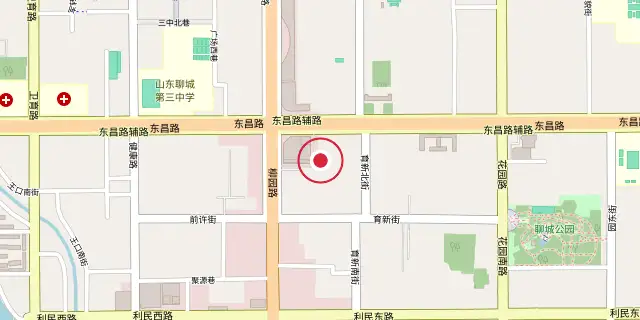
Coordinates: 36°27′22″N 115°59′06″E (36.4560, 115.9850) · Open in OpenStreetMap
Coordinates and connected clubs: the infobox of Wikipedia: Liaocheng (CC BY-SA 4.0). Map: drawn by Codexery from OpenStreetMap tiles.
Liaocheng, a prefecture-level city in western Shandong, China, sits near the provincial capital Jinan to its southeast, with Dezhou to the northeast and Tai'an to the south. To the west, it borders Hebei and Henan provinces.
Pre-Qin era
The Grand Canal runs through the city center. Its name comes from an ancient settlement, Liaocheng, which was part of the State of Qi during the Spring and Autumn period. At the 2010 census, the population was 5,789,863; the built-up area, mostly Dongchangfu District, held 1,229,768 people, though large rural sections remain.
Imperial era
The area’s history stretches back to the Warring States era, when the Strategies of the Warring States notes a Yan general captured Liaocheng, and the Zuo Zhuan describes Liao and She as Qi’s western frontier cities. Under the Qin dynasty, Liaocheng County was formed within Dong Commandery, a setup that continued through the Han. In 222, during the Three Kingdoms, it was moved to the Principality of Pingyuan, later Pingyuan Commandery, which the Jin dynasty kept. In 499, under Northern Wei, the county seat shifted to Wangcheng, northeast of today’s urban area, and became the administrative hub of Pingyuan Commandery.
In the Sui dynasty, Pingyuan Commandery was dissolved in 583, and Bo Prefecture was created in 596, only to be abolished during the Daye era; Liaocheng County then fell under Wuyang Commandery. In 618, the first year of Tang’s Wude era, the county was placed under Weizhou in Hebei Circuit, and Bo Prefecture was reestablished in 621. In 906, it was renamed Liaoyi County, but during the Five Dynasties it reverted to Liaocheng County.
In 992, under the Northern Song, the county seat moved to the site of the present-day city. During the Yuan dynasty, Bozhou Circuit was set up in 1267 with its seat at Liaocheng County, renamed Dongchang Circuit in 1276. In the early Hongwu reign of the Ming, it became Dongchang Prefecture, still seated at Liaocheng County, a structure the Qing kept; the area then belonged to the Jidong Taiwu Lin Circuit.
Modern era
In the Republic of China, the prefectural system was abolished in 1913, placing Liaocheng County under Jixi Circuit, then Donglin Circuit the next year. In 1925, it was reassigned to Dongchang Circuit. After the National Government ended the circuit system in 1928, the county came under Shandong’s Sixth Administrative Inspectorate District. In November 1938, the Imperial Japanese Army occupied Liaocheng.
After Japan withdrew, Nationalist troops retook the city. In December 1946, the People’s Liberation Army attacked, and Nationalist forces withdrew. In August 1949, Liaocheng was detached from Shandong and attached to Pingyuan. In November 1952, Pingyuan was dissolved, and Liaocheng returned to Shandong.
In 1967, Liaocheng Prefecture was reorganized as Liaocheng District. In August 1983, Liaocheng County became Liaocheng City (county-level). In March 1998, Liaocheng District was abolished, replaced by prefecture-level Liaocheng City; the former county-level city core became Dongchangfu District. In June 2019, the State Council approved Chiping County’s abolition and its replacement by Chiping District.
In 2007, the city was named one of China’s top ten livable cities in the Chinese Cities Brand Value Report, released at the 2007 Beijing Summit of China Cities Forum.
Administratively, Liaocheng governs eight county-level divisions: two districts (Dongchangfu and Chiping), one county-level city (Linqing), and five counties (Yanggu, Dong’e, Gaotang, Guan, and Shen). These are split into 134 township-level divisions. The climate is humid continental (Köppen: Dwa), with four distinct seasons; Liaocheng is among the world’s lowest-latitude cities with this climate. Educational institutions include Liaocheng University and Liaocheng NO.1 High School.
Transportation
Notable people from the area include Fu Sinian (1896–1950), Ji Xianlin (1911–2009), Kong Fansen (1944–1994), Wei Fenghe (born 1954), and Chen Xu (born 1962). Attractions include the Shanxi-Shaanxi Assembly Hall (also called Shanshan Hall), Guangyue Tower, the Iron Tower, the Lion Building (legendary site where Wu Song fought Ximen Qing), Linqing Mosque, and Liaocheng Sports Park Stadium. Transportation is served by Liaocheng railway station and Liaocheng West railway station on the high-speed network.
Liaocheng has sister-city relationships with Uiryeong County, South Korea (since June 7, 2001); Blacktown, Australia (October 14, 2003); Gwangmyeong, South Korea (May 3, 2005); and Naberezhnye Chelny, Russia (since 2009). It also has a partnership with Offenbach district in Germany.
Frequently Asked Questions
What is Liaocheng?
Liaocheng is a prefecture-level city situated in the western part of Shandong province, China. It was originally established as a county during the Qin dynasty and later grew into a major regional center.
How is Liaocheng administratively organized?
The prefecture-level city is divided into two municipal districts, one county-level city, and five counties. This structure gives it a mix of urban and rural governance areas under a single municipal government.
More in Cities Starting With L
Sources
Compiled from Wikipedia and the sources listed below. Text from Wikipedia is available under CC BY-SA 4.0; this entry is adapted from it.
- Wikipedia: Liaocheng (CC BY-SA 4.0).
Spotted an error? Know more?
Reader corrections go straight into our review queue. Suggest an edit · How this site is sourced