Alexandria Ariana
Last updated

via Wikipedia: Alexandria Ariana · see source
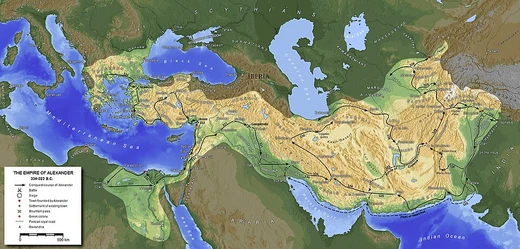
Alexander the Great founded Alexandria Ariana in 330 BC during his invasion of Persia and Central Asia. It was the first of many settlements he established in the eastern satrapies of the crumbling Achaemenid Empire. The remains of the ancient city lie in the general area of the modern settlement of Herat, Afghanistan, in the ancient regions of Aria and Ariana. No excavations of Herat have taken place, so the precise location of Alexandria Ariana is unknown.
History
Alexander the Great’s biographers—Arrian, Diodorus Siculus, and Quintus Curtius Rufus—never recorded the founding of Alexandria Ariana. They only described his march through Ariana from Hyrcania into Bactria and his later return to crush the revolt of the former satrap Satibarzanes. The city does appear, however, in the records of Alexander’s bematists, whose distances were later quoted by the geographers Eratosthenes and Pliny the Elder. Strabo mentions three cities in Aria, each named after its founder: Alexandria Ariana, Artacoana, and a settlement called Achaia.
Artacoana, the main citadel of the Achaemenid satrapy of Aria, may have been the site of a battle during Satibarzanes’ rebellion. Wilhelm Tomaschek proposed that Artacoana and Alexandria Ariana were actually the same place, with Artacoana as the fortress and Alexandria as the unwalled lower town.
But ancient writers like Strabo, Isidore of Charax, Pliny, and Ptolemy treat them as distinct, and most scholars agree they were separate cities. Artacoana probably survived for centuries after Alexandria Ariana was founded, though its exact location remains unknown. Pliny’s mention of Artacoana and Artacabene as two neighboring towns is almost certainly an error.
Did You Know?
- The city was not mentioned by Alexander's biographers Arrian, Diodorus Siculus, or Quintus Curtius Rufus.
- The name in Greek was 'Alexandria among the Ar[e]ians' or 'Alexandria of the Areians'.
- The current Herat citadel was initially constructed shortly after the Islamic conquest and has been rebuilt many times.
More in Cities Founded by Alexander the Great
Related in Cities Founded by Alexander the Great
Links follow this subject's own source article.
Sources
Compiled from Wikipedia and the sources listed below. Text from Wikipedia is available under CC BY-SA 4.0; this entry is adapted from it.
- Wikipedia: Alexandria Ariana (CC BY-SA 4.0).
Spotted an error? Know more?
Reader corrections go straight into our review queue. Suggest an edit · How this site is sourced