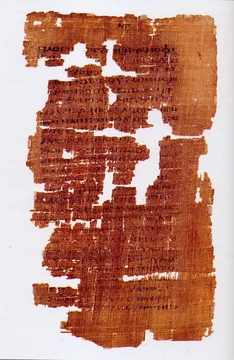
Gospel of Matthew
First Gospel, presenting Jesus as Jewish Messiah fulfilling scripture.

The Gospel of Matthew opens the New Testament and is counted among the four canonical Gospels, as well as the three synoptic Gospels. It recounts Jesus’s life, from his birth and the start of his ministry after John the Baptist baptized him, through his crucifixion, resurrection, and final commission to the world. The Gospel stresses that Jewish tradition should remain relevant as the church becomes more gentile, and it portrays Jesus as the Jewish Messiah who completes the prophecies found in Jewish scripture.
The text reflects tensions between Jewish Christians and other Jews, especially through its criticism of the scribes and Pharisees. It conveys the idea that the Kingdom of Heaven has been removed from them and given to the church. Jesus is presented as the Son of David, Son of Man, and Son of God, and his teachings, miracles, and parables are framed to honor both Jewish law and the emerging Christian church. The narrative builds toward the Passion, Resurrection, and Great Commission, structured around alternating sections of story and discourse.
Written anonymously in the last quarter of the first century, the author was a Jew familiar with Hebrew and the legal aspects of scripture. The earliest attribution to Matthew comes from Papias of Hierapolis, who knew the Elder and the daughters of Philip. The Gospel may incorporate a source from Matthew, and traditional authorship still has conservative defenders. It was very popular among early Christians, and many scholars now believe both Luke and John used it. Most scholars think Matthew relied on Mark and a hypothetical Q source, but a growing number question Q, favoring the Farrer hypothesis or Matthean Posteriority instead.
The synoptic Gospels follow Mark closely compared to how other ancient historians used sources, though their parallels and variations are typical of ancient historical biographies. Matthew is a product of the second generation of the Christian movement, though it draws on memories from the first generation of Jesus’s disciples.
- field
- Gospel, New Testament
- known_for
- First book of the New Testament; emphasizes Jesus as Jewish Messiah; used by early Christians
- language
- Greek (author familiar with Hebrew)
- authorship
- Anonymous; traditionally attributed to Matthew the apostle by Papias of Hierapolis
- date
- Last quarter of the first century (some scholars argue 40s–50s CE)
- sources
- Most scholars believe Matthew used Mark and the Q source; alternatives include Farrer hypothesis and Matthean Posteriority
Quick Facts
- Religion
- Christianity
- Author
- Traditionally Matthew the Apostle
- Period
- c. 80–90 AD
- Language
- Koinē Greek
- Chapters
- 28
- Verses
- 1071
- Orig Lang Code
- el
- Wikisource
- Gospel of Matthew
- Next
- Gospel of Mark
Facts from the source article.
Lore & Background
The Gospel of Matthew was written anonymously in the last quarter of the first century by a Jewish author familiar with legal aspects of scripture and the Hebrew language. Papias of Hierapolis, a companion of the Elder and the daughters of Philip, provides the first attribution to Matthew. The text may incorporate a source from Matthew, and traditional authorship still has conservative defenders. The gospel was highly popular among early Christians; scholars increasingly contend that it was used by both Luke and John. Most scholars believe that Matthew used Mark and the Q source, but a growing number of scholars are skeptical of Q and advocate for the Farrer hypothesis or Matthean Posteriority instead.
Reader's Guide
The Gospel of Matthew reflects conflicts between Jewish Christians and other Jews, particularly with its criticism of the scribes and Pharisees, presenting the view that the Kingdom of Heaven has been taken away from them and given to the church. It emphasizes Jesus’s role as the Son of David, Son of Man, and Son of God, and frames his teachings, miracles, and parables to reflect both Jewish law and the Christian church. It culminates in the Passion, Resurrection, and Great Commission, having been structured around alternating narratives and discourses. The gospel is the product of the second generation of the Christian movement, although it draws on the memory of the first generation of the disciples of Jesus. Its significance lies in its role as a foundational text for Christian theology, bridging Jewish tradition and the emerging gentile church, and in its influence on later Gospels and early Christian communities.
Did You Know?
- The gospel was written anonymously; Papias of Hierapolis first attributed it to Matthew.
- Most scholars view the author as a Jew familiar with Hebrew and Torah, standing on the margin between traditional and non-traditional Jewish values.
- The gospel alternates five blocks of narrative with five of discourse, each marked off with the phrase 'When Jesus had finished'.
Frequently Asked Questions
Who is the author of the Gospel of Matthew?
The text itself is anonymous, but early church tradition—traced back to Papias of Hierapolis—credits it to Matthew the apostle. Modern scholarship generally treats the author as unknown, with most placing composition in the last quarter of the first century.
What is the Gospel of Matthew primarily about?
It narrates the life of Jesus from his birth, through his baptism, public ministry, crucifixion, and resurrection. A central thread runs throughout: presenting Jesus as the long-awaited Jewish Messiah who fulfills the prophecies found in the Hebrew scriptures.
How does the Gospel of Matthew end?
The final chapter records post-resurrection appearances and culminates in the Great Commission, where Jesus instructs his disciples to go and make followers among all nations. He closes with the promise that he will remain with them until the end of the age.
Why is the Gospel of Matthew considered significant in the New Testament?
As the very first book of the New Testament, it profoundly shaped how early Christian communities understood Jesus's identity and mission. It also functioned as a bridge for Jewish believers, demonstrating that the new movement grew organically out of their scriptural heritage rather than replacing it.
What sources did the author of the Gospel of Matthew draw from?
Most scholars conclude the author relied heavily on the Gospel of Mark along with a shared collection of Jesus's sayings known as the Q source. Alternative models, such as the Farrer hypothesis, propose different literary relationships among the synoptic Gospels.
More in Christian Scriptures And Epistles 1-18
Spotted an error? Know more?
This is a living reference — every entry is fact-audited, and reader corrections feed straight into our audit queue. Suggest an edit · See this site's audit record