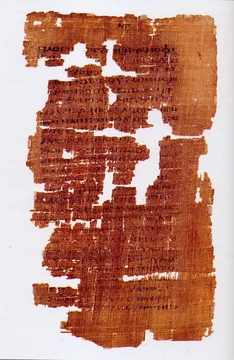
Epistle to the Romans
Pauline epistle outlining salvation through faith in Jesus Christ.

The Epistle to the Romans is the sixth book of the New Testament and, among the thirteen letters attributed to Paul, the longest. Scholars generally agree that Paul the Apostle wrote it to present salvation as something offered through the gospel of Jesus Christ.
The letter was likely composed while Paul was lodging in Corinth at the home of Gaius, with Tertius acting as his scribe. It is dated to late 55 through early 57. Although the final version contains sixteen chapters, earlier copies circulated with only fourteen or fifteen chapters. Some of these shorter versions removed all mention of the original recipients—Christians in Rome—making the letter more general. Other textual variations include notes naming Corinth as the place of writing and identifying Phoebe, a deacon from the church in Cenchreae, as the messenger who carried the epistle to Rome.
Before writing Romans, Paul had preached around the Aegean Sea and wanted to take the gospel further west to Spain, planning to visit Rome along the way. The letter can therefore be seen as an explanation for that trip and a way to prepare the Roman church for his arrival. The Christians in Rome included both Jews and Gentiles, and the congregation may have faced tension between these groups. Paul, a Hellenistic Jew and former Pharisee, tailored his argument to address both audiences and the church as a whole. Because the work contains material aimed at specific recipients as well as the broader Christian public in Rome, scholars have struggled to classify it strictly as a private letter or a public epistle.
Though sometimes treated as a systematic theology, Romans does not cover many topics Paul addresses elsewhere. Still, it is widely regarded as a major work, especially on justification and salvation. Supporters of both *sola fide* and the Roman Catholic view that faith and works are both necessary find backing in its text.
Jesuit scholar Joseph Fitzmyer described the book as overwhelming the reader with the density and sublimity of its subject: the gospel of justification and salvation for both Jew and Greek through faith in Jesus Christ, revealing God’s uprightness and love. Anglican bishop N. T. Wright called Romans Paul’s masterpiece—neither a systematic theology nor a summary of his life’s work, but an Alpine peak towering over hills and villages. He noted that observers have viewed it from different angles, producing varied snapshots and paintings, and climbers have taken different routes up its sides, with frequent disagreement on the best approach. What is undisputed, he said, is that it is a work of massive substance, offering a formidable intellectual challenge and a breathtaking theological and spiritual vision.
The consensus among scholars is that Paul wrote Romans. C. E. B. Cranfield, in his commentary, stated that denial of Pauline authorship is now a curiosity of New Testament scholarship, with no responsible criticism disputing it. The letter appears in the Apostolic Fathers, was listed and cited as Paul’s by the end of the second century, and is included in every early list of New Testament books. External evidence for authenticity is extremely strong, supported by internal evidence from language, style, history, and theology.
The letter was most likely written in Corinth, where Paul was staying at Gaius’s house and using Tertius as his scribe. Several factors point to Corinth: Paul was about to travel to Jerusalem, which matches Acts’ report of a three-month stay in Greece, likely in Corinth, his most successful missionary site in that region. Phoebe, a deacon in Cenchreae (east of Corinth), could have brought the letter to Rome after passing through Corinth and boarding a ship from its western port. Erastus, mentioned in Romans 16:23, lived in Corinth as the city’s commissioner for public works and treasurer, further supporting Corinth as the place of writing.
The exact date is not given in the epistle, but it was written after the collection for Jerusalem had been gathered and Paul was about to go there—at the end of his second visit to Greece, during the winter before his last trip to Jerusalem. Most scholars date it to late 55/early 56 or late 56/early 57. Early 55 and early 58 have some support, while Gerd Lüdemann argues for 51/52 or 54/55, following Knox’s proposal of 53/54. Lüdemann is the only serious challenge to the mid-to-late 50s consensus.
Strong indirect evidence suggests that a version of Romans without chapters 15 and 16 was widely used in the western Roman Empire until the mid-4th century. This conclusion is partly based on Church Fathers like Origen and Tertullian, who refer to a fourteen-chapter edition. The placement of Paul’s doxology in some manuscripts also supports this.
- field
- New Testament epistle
- author
- Paul the Apostle
- amanuensis
- Tertius
- messenger
- Phoebe, a deacon of the church in Cenchreae
- place of composition
- Corinth (house of Gaius)
- date
- AD late 55 to early 57 (scholarly consensus)
- chapters
- 16 (with early recensions of 14 or 15 chapters)
Lore & Background
The Epistle to the Romans was likely written while Paul was staying in the house of Gaius in Corinth and transcribed by his amanuensis Tertius. It is dated AD late 55 to early 57. Prior to composing the epistle, Paul had evangelized areas surrounding the Aegean Sea and was eager to take the gospel farther to Spain, a journey that would allow him to visit Rome on the way. The epistle can be understood as a document outlining his reasons for the trip and preparing the church in Rome for his visit. Christians in Rome would have been of both Jewish and Gentile background, and it is possible the church suffered from internal strife between these two groups. Paul—a Hellenistic Jew and former Pharisee—shifts his argument to cater to both audiences and the church as a whole.
Reader's Guide
Although sometimes considered a treatise of systematic theology, Romans remains silent on many issues that Paul addresses elsewhere, but is nonetheless generally considered substantial, especially on justification and salvation. Proponents of both sola fide and the Roman Catholic position of the necessity of both faith and works find support in Romans. The book has been described by Jesuit biblical scholar Joseph Fitzmyer as overwhelming the reader by the density and sublimity of the topic with which it deals—the gospel of the justification and salvation of Jew and Greek alike by the grace of God through faith in Jesus Christ. Anglican bishop N. T. Wright notes that Romans is neither a systematic theology nor a summary of Paul's lifework, but is by common consent his masterpiece, presenting a formidable intellectual challenge while offering a breathtaking theological and spiritual vision.
Did You Know?
- Some early recensions of Romans had only 14 or 15 chapters, lacking all reference to the original audience of Christians in Rome.
- Textual variants include subscripts explicitly mentioning Corinth as the place of composition and naming Phoebe as the messenger who took the epistle to Rome.
- The Codex Boernerianus lacks the explicit references to the Roman church in Romans 1:7 and 1:15.
- Papyrus 46 places Paul's doxology at the end of chapter 15, which may indicate a fifteen-chapter recension.
The Anonymous Author and the Question of Paul
The Epistle to the Hebrews stands as one of the New Testament's most persistent puzzles: its text never names its writer. For centuries the letter was handed down as the fourteenth epistle of Paul the Apostle, a placement reflected in the majority of Ancient Greek manuscripts, the Old Syriac Peshitta, and portions of the Old Latin tradition. Yet even in antiquity voices of doubt emerged. Eusebius recorded skepticism within the Roman Church, and the third-century theologian Origen observed that the letter's diction lacked the roughness Paul himself acknowledged, its syntax hugging Greek conventions more tightly than Paul's spontaneous, volatile style. Origen suggested the content was Pauline while the phrasing belonged to a student who remembered and reinterpreted his master's teaching, naming Clement of Rome or Luke as possibilities. By the fourth century, Jerome and Augustine championed Pauline authorship, and the Church held that view firmly until the Reformation. Modern scholarship, however, has largely set Paul aside, with many researchers proposing the author was a leader of a predominantly Jewish congregation, perhaps one of Paul's associates. A smaller group sees the letter as a deliberate stylistic imitation of Paul, with candidates like Apollos or the couple Priscilla and Aquila occasionally raised.
A Masterpiece of Greek Prose and Theological Architecture
Greek scholars consistently rank Hebrews as the most polished and eloquent composition in the entire New Testament. Where Paul's letters are often described as spontaneous and volatile, shaped by immediate context, Hebrews presents a carefully composed and studied prose that reads as though every clause was weighed and re-weighed. The letter is frequently called intricate, and its theological architecture reflects that care. It opens with a sweeping exaltation of Jesus as the radiance of God's glory, the express image of his being, the one who upholds all things by his powerful word. Throughout, the author assigns Jesus a constellation of titles—pioneer or forerunner, Son, Son of God, priest, and high priest—yet the epistle's most distinctive move is its dual Christology: casting Jesus simultaneously as the exalted Son and as the High Priest who mediates between God and humanity. This priestly emphasis is not incidental; it forms the structural spine of the argument, weaving together Old Testament sacrificial imagery with a vision of an eternal intercession in a heavenly sanctuary. The result is a text that treats the person and role of Christ not as a single note but as a sustained, layered symphony.
A Community Under Pressure
The circumstances that produced Hebrews were urgent. The letter was directed at Jewish Christians—possibly a congregation in Jerusalem—who were enduring persecution for their belief in Jesus as the Messiah. Under that pressure, some believers were seriously considering a return to Judaism and its system of law as a way to escape the hostility they faced. The epistle's essential purpose was to exhort these wavering faiths to persevere. Traditional scholarship frames the argument as one of supersession: the Jewish Law had served a legitimate historical role, but a New Covenant had rendered it fulfilled. Yet a growing body of scholars points out that the very words Gentile, Christian, and Christianity never appear in the text. This has led to a reframing: Hebrews is best understood as an intra-Jewish debate, a confrontation between Jewish followers of Jesus and proto-rabbinical Judaism. In tone and detail the letter goes beyond Paul, offering a more complex, nuanced, and openly adversarial definition of the relationship. Its Old Testament quotations are interpreted through the lens of first-century rabbinical Judaism, and scholar Eric Mason has drawn parallels between its priestly Christology and the messianic priest and Melchizedek figures found in the Qumran scrolls.
A Hard-Won Place in the Canon
Because no name was attached to the letter, Hebrews had a long and uncertain road to full canonical acceptance. By the close of the first century no consensus existed on who had written it, and over the following centuries a remarkable roster of candidates was proposed: Clement of Rome, Barnabas, Paul, Luke the Evangelist, Silas, Apollos, and even the married pair Priscilla and Aquila. The letter was classed among the Antilegomena—books whose authority was disputed—and its inclusion in the Christian canon was far from a foregone conclusion. What ultimately carried the day was the letter's intrinsic quality: its sound theology, its eloquent and carefully crafted presentation, and the sheer weight of its argument. In antiquity certain circles began ascribing it to Paul, and the Church gradually settled on treating it as his fourteenth epistle, a position that held until the Reformation challenged it. Origen, writing in the third century, captured the irreducible mystery at the heart of the question with a line that still resonates: the matter of the epistle is wonderful and equal to the Apostle's acknowledged writings, but who actually penned it is known to God alone.
Frequently Asked Questions
Who wrote the Epistle to the Romans?
Paul the Apostle is universally recognized as the author of this letter. He had Tertius serve as his scribe, and the document was composed in Corinth at the home of Gaius.
What is the central message of the Epistle to the Romans?
The letter lays out Paul's argument that God's righteousness is made available to all people through faith in Jesus Christ, rather than through strict adherence to the Mosaic law. It stands as the most systematic theological treatise among the Pauline letters.
When and where was the Epistle to the Romans written?
Scholarly consensus places its composition in the late 50s or very early 60s of the first century CE. Paul sent it from Corinth to the Christian community in Rome, a congregation he had not yet visited in person.
Who delivered the Epistle to the Romans to the church?
Phoebe, identified in the closing verses as a deacon of the congregation in Cenchreae, is named as the one who carried the letter to its recipients in Rome.
Why is the Epistle to the Romans considered so significant in Christian theology?
As the longest of Paul's thirteen epistles and the sixth book of the New Testament, it has served as a cornerstone for doctrines of grace, justification by faith, and the unity of Jews and Gentiles in the body of Christ. Its profound influence on thinkers from Augustine to Martin Luther underscores its lasting theological weight.
More in Christian Scriptures And Epistles 1-18
Spotted an error? Know more?
This is a living reference — every entry is fact-audited, and reader corrections feed straight into our audit queue. Suggest an edit · See this site's audit record