First Epistle to Timothy
A New Testament letter of counsel to Timothy in Ephesus.

The First Epistle to Timothy is one of three New Testament letters known as the pastoral epistles, alongside Second Timothy and Titus. It has traditionally been credited to the Apostle Paul and offers advice to his younger associate Timothy, who is serving in Ephesus. The letter covers how the Church should be organized, the duties of its leaders, and calls for Timothy to stay faithful to the truth in the face of false teachings. Most scholars today believe the pastoral epistles were composed after Paul’s death, though a small and shrinking number still defend Pauline authorship.
Regarding authorship, the letter itself names Paul as its writer. In early Christianity, this claim was sometimes disputed. By the nineteenth and twentieth centuries, many scholars began questioning its authenticity, arguing that First Timothy, along with Second Timothy and Titus, was written by an unknown Christian in the late first or mid-second century. Most scholars now accept this view. They point out that the pastoral epistles contain over three hundred words Paul never uses in his undisputed letters, have a different writing style, reflect a church structure that did not exist in Paul’s time, and are absent from early lists of his accepted works. Scholars who still support Pauline authorship note that Polycarp likely knew First and Second Timothy, and some—like Robert Grant, Ian Howard Marshall, and Hans von Campenhausen—even suggest Polycarp himself wrote First Timothy around 140. Marcion, an excommunicated bishop, created an early scriptural canon around 140 that included ten Pauline letters but excluded the pastorals. Whether he rejected them as inauthentic or because they contradicted his teachings—such as their view that creation is good—remains debated. The word “antithesis” in 1 Timothy 6:20 has been seen as a possible reference to Marcion’s work, but it is a common Greek term, and the attack on heresy is not central to these letters. By the late second century, Irenaeus quoted all three pastorals and attributed them to Paul. The Muratorian Canon (around 170–180) also lists them as Pauline, and Eusebius (around 330) considered them undisputed. Exceptions include Tatian and the gnostic Basilides. Earlier possible allusions appear in writings by Clement of Rome, Ignatius, and Polycarp, but the nature of these connections is unclear.
Scholars generally date First Timothy to the late first or early second century, with a wide margin of uncertainty. If Polycarp’s epistle depends on First Timothy, that sets a cutoff date before Polycarp wrote. Verbal similarities between Ignatius and a section of First Timothy could push the date earlier if Ignatius borrowed from it. Irenaeus, writing around 180, is the first author to clearly attribute the letter to Paul.
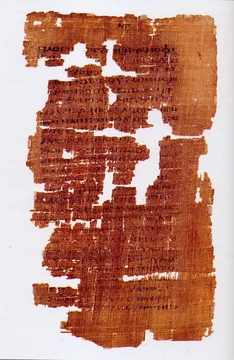
The original Greek manuscript is lost, and surviving copies vary. The earliest known fragment, Oxyrhynchus Papyrus 5259 (designated P133), dates to the fourth century (330–360). Other early manuscripts include Codex Alexandrinus (400–440), Codex Ephraemi Rescriptus (around 450), Codex Freerianus (around 450), Uncial 061 (around 450), Codex Claromontanus (around 550), Codex Coislinianus (around 550), and Uncial 0262 (seventh century).
The epistle opens by claiming Paul as its author and addressing Timothy. Paul reminds Timothy that he was asked to stay in Ephesus to stop others from teaching false interpretations of the law. Paul explains that the law is meant for certain people.
- Traditional author
- Apostle Paul
- Recipient
- Timothy
- Location addressed
- Ephesus
- Genre
- Pastoral epistle
- Canonical status
- New Testament
Lore & Background
The authorship of First Timothy was traditionally attributed to the Apostle Paul, although in pre-Nicene Christianity this attribution was open to dispute. He is named as the author of the letter in the text. Nineteenth- and twentieth-century scholarship questioned the authenticity of the letter, with many scholars suggesting that First Timothy, along with Second Timothy and Titus, are not the work of Paul, but of an unidentified Christian writing some time in the late-first to mid-second centuries. Most scholars now affirm this view. Modern scholars who support Pauline authorship stress the importance of Polycarp, where there is a high probability that 1 and 2 Timothy were known to him. Scholars Robert Grant, Ian Howard Marshall, and Hans von Campenhausen believe that Polycarp was the actual author of First Timothy, which would date its composition to around 140.
Reader's Guide
The First Epistle to Timothy holds significance as a key text for understanding early Christian church organization and leadership roles. Its counsels include instructions on the organization of the Church and the responsibilities resting on certain groups of leaders, as well as exhortations to faithfulness in maintaining the truth amid surrounding errors. The letter details roles of men and women, particularly in 1 Timothy 2:12, which has been a source of considerable controversy concerning gender equality. Certain Christian churches such as the Eastern Orthodox Church and Roman Catholic Church use it as a justification to reject the ordination of women. The epistle also discusses a list of widows to be supported by the church, setting restrictions on the types of women to help. Its legacy is marked by ongoing scholarly debate over authorship, with most modern scholars considering it written after Paul's death. The letter's influence extends to music, with composers using lines from the epistle in Christmas cantatas, and to figures such as Jonathan Edwards, who identified reading 1 Timothy 1:17 as an important moment in his religious experience.
Did You Know?
- The epistle contains the Greek word ἀρσενοκοίτης, sometimes translated as 'homosexual men,' though its meaning is debated.
- Marcion, an orthodox bishop later excommunicated for heresy, formed an early canon of scripture around 140 that excluded 1–2 Timothy and Titus.
- Jonathan Edwards identified reading 1 Timothy 1:17 as an important moment in his religious experience.
Frequently Asked Questions
Who wrote First Epistle to Timothy and to whom was it addressed?
The letter is traditionally attributed to the Apostle Paul, who writes to his younger colleague Timothy. It belongs to the group of three pastoral epistles in the New Testament, alongside Second Timothy and Titus.
What is First Epistle to Timothy actually about?
The epistle is essentially a practical handbook for Timothy's oversight of the church in Ephesus, covering leadership qualifications, worship conduct, and warnings against false teaching. Paul urges his delegate to stay firm in the truth while errors circulate around him.
Where was Timothy when he received First Epistle to Timothy?
Timothy was based in Ephesus, a major port city in the Roman province of Asia, where he was responsible for guiding the local congregation. Paul composed the letter from elsewhere, offering counsel at a distance.
What makes First Epistle to Timothy a 'pastoral' epistle rather than a doctrinal treatise?
Its content centers on the day-to-day administration of a local church—qualifying elders, ordering deacons, and handling internal disputes—rather than on systematic theological argument. That practical, shepherding tone is what sets it apart from Paul's more argumentative letters like Romans or Corinthians.
Why does First Epistle to Timothy still matter to readers today?
It offers one of the earliest surviving blueprints for how a Christian community should be organized, led, and kept doctrinally sound. Its guidance on character-based leadership and guarding against heresy has continued to influence church governance well into the modern era.
More in Christian Scriptures And Epistles 1-18
Spotted an error? Know more?
This is a living reference — every entry is fact-audited, and reader corrections feed straight into our audit queue. Suggest an edit · See this site's audit record