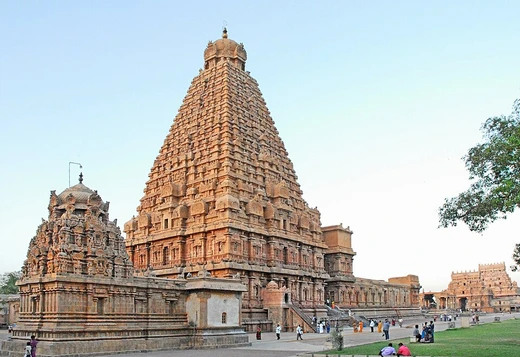
Thyagaraja Temple, Tiruvarur
A major Chola-era Shiva temple with the largest chariot in Asia.
Last updated

via Wikipedia: Thyagaraja Temple, Tiruvarur · see source
In the town of Thiruvarur, Tamil Nadu, stands the Thyagaraja Temple, a Shiva temple where the god is worshipped as a lingam under the names Thyagarajaswami and Putridankondar. His consort Parvati is honored as Neelotpalambika and also as Kamalambika, whose separate shrine is a major Shakti Peetha and a key site for Shaktism and Tantra. The main deity is praised in the 7th-century Tamil Tevaram by the Nayanar saints, making this a Paadal Petra Sthalam.
The temple complex spans 20 acres, ranking among India’s largest. It has nine entrance towers, or gopurams, with the four-story eastern tower reaching 30 meters. The most important shrines are those of Thyagarajaswami, Neelotpalambika, and Kamalambika.
History
According to legend, the Chola king Muchukunda obtained a boon from Indra and wished for a lingam of Shiva dancing on Vishnu's chest. Indra had seven images made, but the king chose the correct one and consecrated it at Tiruvarur. The Muchukunda Sahasranamam refers to the deity as Anapaayamahipaala and Rajaveshadari. The temple is believed to have been initiated as a large complex by the Pallavas in the 7th century.
Contemporary history dates to the Medieval Cholas. An inscription from the 20th regnal year of Rajendra I (1012–1044) on the north and west walls of the Thyagaraja shrine records gifts of jewels and lamps, and states that the stone temple was built by Anukkiyar Paravai Nangaiyar. She also endowed gold for plating the vimana, entrance, and shrine sides, and copper for doors and pillar corbels. The temple complex may have served as a cultural model for the Brihadeeswara Temple in Thanjavur.
The last Chola monarch with a significant role was Kulothunga Chola III in the early 13th century. The Golaki Monastery was established in the 13th and 14th centuries, and the temple attracted Jains, who were attacked by Hindus as recorded in the Periya Puranam.
Architecture
The Thyagaraja Temple in Tiruvarur sprawls across roughly 17 acres, matched in size by the Kamalalayam tank on its western side. The complex includes nine gopurams, 80 vimanas, twelve walls, 13 halls, fifteen large water bodies, three gardens, and three precincts. Its main gopuram rises seven stories to 118 feet. Two principal shrines honor Vanmikinathar, an ancient form of Shiva, and Thyagarajar.
In the older shrine, an anthill takes the place of the usual linga; the 7th-century poet-saint Appar called this deity Putritrukondan, meaning one who dwells in an anthill. The temple’s sacred tree is the red patiri, or trumpet flower. All nine Navagraha planetary deities are arranged in a straight line to the south, with another placement in the northwest corner of the first prakaram. This temple is said to have more shrines than any other in India.
Thyagaraja’s feet are revealed only twice annually; during the Panguni Uthiram and Thiruvathirai festivals, the right leg of Thyagarajaswami and the left leg of Nilotpalambika are shown. A notable feature is the standing Nandi statue that faces the main deity.
Worship and religious practises
The temple’s daily rituals are conducted six times, starting at 5:30 a.m. with Ushathkalam and ending with Ardha Jamam at 8:00 p.m. Priests, who belong to the Shaiva Brahmin sub-caste, handle these rites and festival ceremonies. A notable belief holds that during the evening Sayarakshai, all 33 crore celestial beings gather to worship Lord Thiyagarajar. Attending this service in Tiruvarur followed by the Ardha Jamam in Chidambaram is thought especially lucky.
Weekly observances include Monday and Friday, while fortnightly ones feature pradosham. Monthly events mark new moons, kiruthigai, full moons, and sathurthi. The main idol is draped in cloth and flowers, revealing only the faces of Thiyagarajar and his consort. Their feet are uncovered only during Aarudhra Dharshan in Margazhi and Panguni Uthiram in Panguni.
Music, dance and literature
Thiruvarur has historically been a centre for religion, arts, and science. Sundarar, an 8th-century Saivite saint, wrote in Tevaram, 'I am the slave of all those born in Thiruvarur. Two of the 63 nayanmars, Kalarsinga Nayanar and Tandiyadigal Nayanar, were born here.
The Periyapuranam dedicates a chapter to those born in Thiruvarur. The town was a traditional centre of music and dance; inscriptions from Rajaraja Chola associate a large body of dancers with the temple. Thiruvarur is home to the Trinity of Carnatic music: Thyagaraja, Muthuswami Dikshitar, and Shyama Shastri.
Muthuswami Dikshitar sang eulogies of the temple deities. Thyagaraja was named after the deity. A unique musical instrument called panchamuga vadyam is used in the temple, and a type of nadaswaram called Barinayanam is found only in Thiruvarur.
Did You Know?
- The temple has the largest processional chariot in Asia, weighing 300 tonne with a height of 96 ft.
- The temple holds the record of having a maximum number of shrines in India.
- The memorial for Thiruvalluvar, Valluvar Kottam, is inspired from the design of the Thiruvarur chariot.
More in Chola Architecture
Sources
Compiled from Wikipedia and the sources listed below. Text from Wikipedia is available under CC BY-SA 4.0; this entry is adapted from it.
- Wikipedia: Thyagaraja Temple, Tiruvarur (CC BY-SA 4.0).
Spotted an error? Know more?
Reader corrections go straight into our review queue. Suggest an edit · How this site is sourced