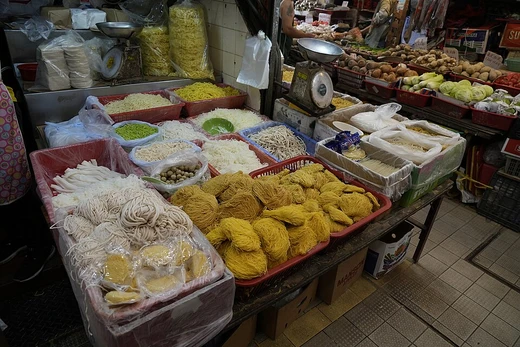
Lamian
Hand-pulled Chinese noodle made by stretching and folding dough.
Last updated
Lamian is a type of handmade Chinese noodle made from soft wheat flour, particularly common in northern China. It is produced by twisting, stretching, and folding the dough into strands, using the dough's own weight. The length and thickness of the strands depend on how many times the dough is folded.
History
The method of making lamian noodles with the pulling technique originated in China. The earliest known description appears in the Songshi Yangsheng Bu (宋氏養生部), a dietary manual from 1504 written by Ming dynasty agriculturalist and gastronomer Song Xu (宋詡). The Japanese dish ramen does not derive from lamian, though its name is a borrowing; how ramen acquired that name remains unclear. The Korean instant noodle variety ramyeon also traces its name back through Japanese.
Description
The hand-making process begins with a lump of dough that is repeatedly stretched to produce many thin, long strands. A piece of soft wheat dough is repeatedly stretched and folded onto itself to align the glutens and warm the dough. It is then rolled out and cut into workable portions; the end pieces are discarded because their glutens are less aligned. The dough is pulled to about an arm span's length, then looped by joining the two ends into one clump, with fingers inserted into the loop to prevent sticking.
This doubles the length while reducing thickness, and the process repeats until the desired thickness and quantity are reached. Some pullers dip the strands in flour between stretches to keep them separated, then slap the noodles against the prep board to remove excess flour. In the Lanzhou style, the dough is pulled with straight, quick tugs without twisting or waving, and the noodle is regularly slammed against the board for even stretching. Flour is sometimes used to dust strands.
In the Beijing style, the dough is twisted and stretched delicately by waving the arms and body, then untwisted and looped to double the strands; flour dusting is more liberally employed. Another style, often done for show, involves stretching one thick, flat strand between two hands while twirling and spinning.
Region
Lamian, a hand-pulled noodle dish, is a staple in small, affordable restaurants across Western China and also appears in Eastern Chinese cities. These eateries offer low-cost options like lamian, knife-cut noodles, and Xi'an-style paomo, often with beef or mutton in soup or stir-fried. A cold version with cucumber and tomato is a summer dish. Most lamian restaurants in China are halal, run by Hui families from the northwest.
Another type is Shandong lamian from Yantai. In New York, lamian spots are common in Manhattan's and Sunset Park's Chinatowns, mostly run by Fuzhounese. In Filipino Chinatowns, lamian resembles pancit canton. In Germany, Munich and Frankfurt have lamian restaurants near their main train stations.
Did You Know?
- Dishes using lamian are usually served in a beef-flavored soup called tangmian, or stir-fried as chaomian.
- The word chaomian is etymologically related to chow mein, though the dishes differ.
More in Chinese Noodles
Sources
Compiled from Wikipedia and the sources listed below. Text from Wikipedia is available under CC BY-SA 4.0; this entry is adapted from it.
- Wikipedia: Lamian (CC BY-SA 4.0).
Spotted an error? Know more?
Reader corrections go straight into our review queue. Suggest an edit · How this site is sourced