
Aldehyde
Organic compounds with a formyl group, common in technology and biology.

NEUROtiker · Public domain
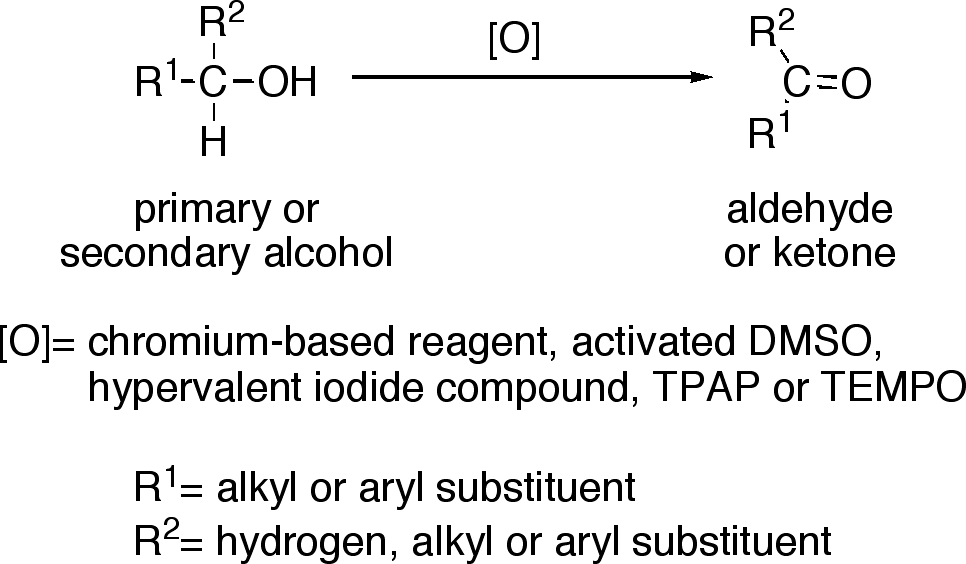
An aldehyde is an organic compound characterized by a functional group with the structure R−CH=O, where the central carbon is double-bonded to oxygen, single-bonded to hydrogen, and single-bonded to a carbon or hydrogen substituent. This central carbon is typically sp²-hybridized, and the carbon-oxygen bond length measures approximately 120 to 122 picometers. The aldehyde group is somewhat polar. The functional group itself, without the side chain, is also called a formyl group. Aldehydes are widespread in both technology and biology. Their physical properties vary greatly depending on the rest of the molecule; smaller aldehydes like formaldehyde and acetaldehyde are water-soluble, and volatile ones often have strong, pungent odors. Spectroscopically, aldehydes show a strong infrared absorption near 1700 cm⁻¹. In proton NMR, the formyl hydrogen appears as a distinctive signal around δH 9.5 to 10, with small coupling to any alpha protons, while carbon NMR gives a weak but characteristic signal for the carbonyl carbon between δC 190 and 205. Many aldehydes occur naturally in essential oils, contributing pleasant scents such as cinnamaldehyde and vanillin. They are not common in basic biological building blocks like amino acids, but most sugars are aldehyde derivatives, existing largely as hemiacetals in solution. Industrially, aldehydes are produced on a large scale via hydroformylation of alkenes, oxidation of alcohols, or autoxidation of hydrocarbons. They undergo many reactions, including condensations, reductions to alcohols, and nucleophilic additions forming imines or hemiacetals. The alpha hydrogen in an aldehyde is weakly acidic, with a pKa near 17, due to resonance stabilization of the enolate conjugate base. Aldehydes can also exist in equilibrium with their enol tautomers, though the keto form usually dominates in neutral solution.
- field
- Organic chemistry
- known_for
- Functional group with structure R−CH=O; key in technology and biology
- typical_1H_NMR_shift
- δH 9.5 to 10
Lore & Background
Aldehyde molecules have a central carbon atom connected by a double bond to oxygen, a single bond to hydrogen, and another single bond to a third substituent, which is carbon or, in the case of formaldehyde, hydrogen. The central carbon is often described as being sp2-hybridized. The aldehyde group is somewhat polar. Smaller aldehydes such as formaldehyde and acetaldehyde are soluble in water, and volatile aldehydes have pungent odors. Aldehydes can be identified by spectroscopic methods. In their ¹H NMR spectra, the formyl hydrogen center absorbs near δH 9.5 to 10, a distinctive part of the spectrum. Traces of many aldehydes are found in essential oils and often contribute to their pleasant odours, including cinnamaldehyde, cilantro, and vanillin. Most sugars are derivatives of aldehydes. These aldoses exist as hemiacetals, a masked form of the parent aldehyde.
Reader's Guide
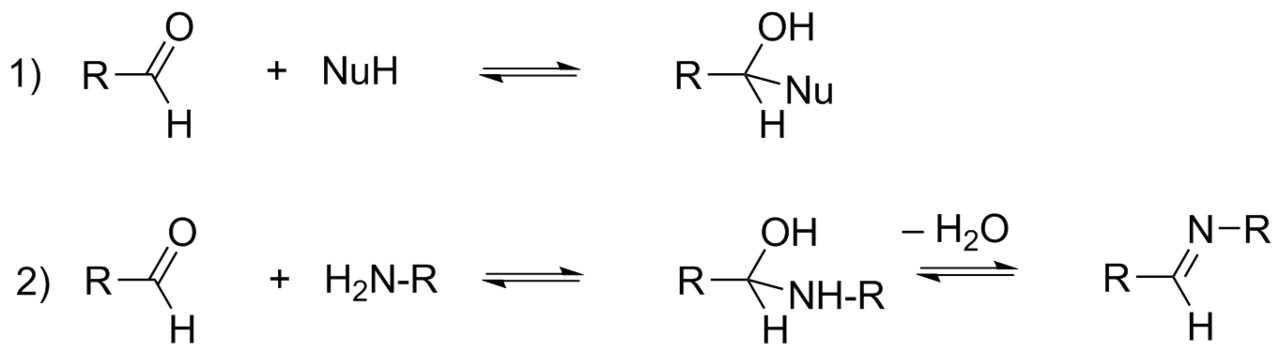
Aldehydes are significant because they serve as a common motif in many chemicals important in technology and biology. Their formyl group is highly reactive, participating in many reactions such as condensations, reductions to alcohols, and nucleophilic additions. Industrially, hydroformylation is a dominant technology for preparing aldehydes on a large scale, as illustrated by the generation of butyraldehyde from propylene. Oxidative routes, including the conversion of methanol to formaldehyde and ethanol to acetaldehyde, are conducted on multimillion ton scales annually. In biological contexts, key reactions involve addition of nucleophiles to the formyl carbon in the formation of imines and hemiacetals, the latter being structures of aldose sugars. The formyl group readily oxidizes to a carboxyl group, and the silver-mirror test and Fehling's test are used to detect aldehydes. Their ability to form enolates and undergo tautomerism also contributes to their versatility in organic synthesis.
Did You Know?
- In ¹H NMR spectra, the formyl hydrogen absorbs near δH 9.5 to 10.
- Hydroformylation of propylene can produce both butyraldehyde and isobutyraldehyde.
- Most sugars are derivatives of aldehydes, existing as hemiacetals in aqueous solution.
Gallery



Frequently Asked Questions
Who is Aldehyde?
Aldehyde is an organic compound defined by a functional group with the structure R−CH=O, where the carbonyl carbon carries at least one hydrogen. The group itself is also called a formyl group, and Aldehyde sits firmly in the organic-chemistry corner of the canon.
What is Aldehyde's signature identifier in the lab?
The aldehydic proton shows up at a ¹H NMR chemical shift of roughly δH 9.5–10, one of the most downfield resonances you will see. That distinctive, isolated peak makes Aldehyde easy to pick out in a spectrum.
What role does Aldehyde play in the wider story?
Aldehydes are a recurring structural motif in a broad range of compounds that are central to both technology and biology. Rather than starring in just one molecule, the group threads through many important chemical systems.
How do you tell Aldehyde apart from its close relatives?
The defining feature is that the carbonyl carbon is bonded to at least one hydrogen (R−CH=O), which sets it apart from ketones where both sides are carbon groups. That single hydrogen is what gives Aldehyde its characteristic NMR signal and reactivity profile.
Why is Aldehyde considered important in the canon?
Because the formyl group appears as a common building block across so many technologically and biologically significant molecules, it functions as a foundational motif in organic chemistry. Fans and researchers alike keep returning to it as a go-to structural element.
More in Chemistry Fundamentals 1-24
Spotted an error? Know more?
This is a living reference — every entry is fact-audited, and reader corrections feed straight into our audit queue. Suggest an edit · See this site's audit record