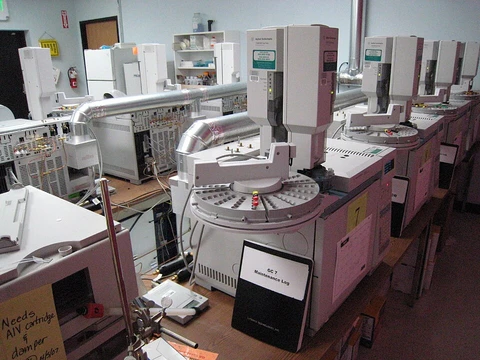
Gravimetric analysis
Quantitative analysis by mass with high precision and accuracy.

Gravimetric analysis refers to a group of techniques in analytical chemistry used to measure the amount of an analyte—the ion under study—by weighing it. The core idea is that once the mass of an ion is measured as part of a specific compound, that known value can be applied to determine the same ion's mass in a mixture, as long as the amounts of the other components are known. The four main categories of this approach are precipitation, volatilization, electro-analytical, and miscellaneous physical methods. These techniques work by changing the phase of the analyte to isolate it in its pure form from the original mixture, providing quantitative results.
This method is known for its high precision. In fact, gravimetric analysis was used to determine the atomic masses of many elements on the periodic table to six-figure accuracy. It leaves little room for instrument error and does not require a set of standards to calculate an unknown. Additionally, gravimetric methods often do not need costly equipment. Because of its accuracy, it can also be used to calibrate other instruments instead of relying on reference standards.
To some extent, gravimetric analysis has been replaced by spectroscopic methods, which are faster, more specific, and require less hands-on work. For instance, quantifying silver ions by precipitating silver chloride is now considered an outdated approach.
**Precipitation method**
*Principles* General qualities for precipitation reagents include: the precipitate should be nonhygroscopic so its weight does not change with humidity; the product should have a high molecular weight to make measuring small amounts of the analyte easier; and the precipitation should be selective for the ion of interest. On the downside, gravimetric analysis usually only handles one or a few elements at a time. The methods can be complex. Challenges with precipitation come from impurities in the solid, which can result from occlusions or surface adsorption of other ions. Some of these issues can be avoided by using homogeneous precipitation, where the precipitate forms from a single homogeneous solution, as with barium sulfate. The solubility of precipitates can also be affected by other ions in the solution. For example, the solubility of silver chloride (AgCl; Ksp = 1.0 × 10⁻¹⁰ in 0.1 M NaNO₃) can increase by many orders of magnitude when other anions are present.
*Case studies*
*Potassium* Potassium (K) can be measured using hexachloroplatinic acid as the precipitating agent. Treating a solution containing K⁺ ions with an excess of this chloroplatinic acid quantitatively produces potassium hexachloroplatinate, which is easy to weigh and nonhygroscopic: 2 K⁺ + H₂[PtCl₆] → K₂[PtCl₆] + 2 H⁺. A similar procedure yields a precipitate of potassium tetraphenylborate from sodium tetraphenylborate.
*Phosphate* Adding an aqueous solution of ammonium molybdate to a solution containing hydrogen phosphate gives a precipitate of ammonium phosphomolybdate.
*Complexation: nickel, aluminium* Several gravimetric methods use organic ligands that form precipitates with specific metal ions. A solution of nickel ions is treated with more than two equivalents of dimethylglyoxime, producing a bright red precipitate of nickel bis(dimethylglyoximate). Similarly, a solution of aluminium ions is treated with 8-hydroxyquinoline to yield aluminium tris(8-hydroxyquinolinate).
*Barium* Barium sulfate is very insoluble in water. Using homogeneous precipitation, a sample solution containing barium ions is treated with an excess of sulfamic acid. This solution is heated to cause the sulfamic acid to hydrolyze into bisulfate: 2 H₂NSO₃H + 2 H₂O → 2 NH₄⁺ + 2 HSO₄⁻. The bisulfate then reacts with barium ions to form the sulfate: 2 HSO₄⁻ + Ba²⁺ → BaSO₄ + 2 H⁺.
**Volatilization methods**
*Calcium* To determine the amount of calcium in water, an excess of oxalic acid precipitates calcium oxalate: Ca²⁺(aq) + C₂O₄²⁻ → CaC₂O₄. When this precipitate is ignited at high red heat in air, it converts to calcium oxide: CaC₂O₄ → CaO(s) + CO(g) + CO₂(g). The precipitate is weighed, and the difference in weight before and after reveals the mass of analyte lost—in this case, calcium oxide. That number can then be used to calculate the amount or percent concentration of calcium oxide in the original mixture.
*Types of volatilization methods* In volatilization methods, the analyte is removed by heating or chemically decomposing a volatile sample at a suitable temperature. In other words, thermal or chemical energy is used to drive off a volatile species. For example, the water content of a compound can be determined by vaporizing the water with heat. Heat can also be used, in the presence of oxygen, for combustion to isolate the target species and get the desired results. The two most common gravimetric methods using volatilization are for water and carbon dioxide. An example is isolating sodium bicarbonate (the main ingredient in most antacid tablets) from a mixture of carbonate and bicarbonate. The total amount of this analyte, in whatever form, is obtained by adding an excess of dilute sulfuric acid to the analyte in solution. In this reaction, nitrogen gas is introduced through a tube into the flask containing the solution, gently bubbling as it passes through. The gas then exits, first passing through a drying agent (here CaSO₄, the common desiccant Drierite). It then passes through a mixture of the drying agent and sodium hydroxide on asbestos or Ascarite II, a non-fibrous silicate containing sodium hydroxide. The mass of the carbon dioxide is obtained by measuring the increase in mass of this absorbent.
- field
- Analytical chemistry
- known_for
- Quantitative determination of analytes by mass, used to determine atomic masses of many elements to six-figure accuracy
- methods
- Precipitation, volatilization, electro-analytical, miscellaneous physical
- key_principle
- Changing the phase of the analyte to separate it in pure form from a mixture
Quick Facts
- Classification
- Gravimetric
- Analytes
- Solids / Liquids
- Related
- Precipitation / Titration
Facts from the source article.
Lore & Background
Gravimetric analysis provides exceedingly precise analysis and was used to determine the atomic masses of many elements in the periodic table to six figure accuracy. It offers very little room for instrument error and does not require a series of standards for calculation of an unknown. Gravimetric methods often do not require expensive equipment and can be used to calibrate other instruments instead of using reference standards.
Reader's Guide
Gravimetric analysis has been largely displaced by spectroscopic methods, which are faster, highly specific, and entail less intervention. For example, silver ions can be quantified by precipitation of silver chloride, but this approach is now considered archaic. The method usually provides for the analysis of only one or a few elements, and procedures can be convoluted. Challenges include impurities in the solid caused by occlusions or surface adsorption of other ions. Some problems can be averted using homogeneous precipitation, as in the case of barium sulfate. The insolubility of precipitates can be affected by other ions in solution; for instance, the solubility of silver chloride can increase by many orders of magnitude in the presence of other anions. Despite its displacement, gravimetric analysis remains significant for its high accuracy and role in establishing atomic masses.
Did You Know?
- Gravimetric analysis was used to determine the atomic masses of many elements in the periodic table to six figure accuracy.
- The four main types of gravimetric analysis are precipitation, volatilization, electro-analytical, and miscellaneous physical methods.
- Gravimetric methods often do not require expensive equipment and can be used to calibrate other instruments instead of using reference standards.
- The solubility of silver chloride can increase by many orders of magnitude in the presence of other anions.
More in Chemical Analysis And Spectroscopy 1-18
Spotted an error? Know more?
This is a living reference — every entry is fact-audited, and reader corrections feed straight into our audit queue. Suggest an edit · See this site's audit record