Column chromatography
A low-cost method for separating mixture components by differential adsorption.

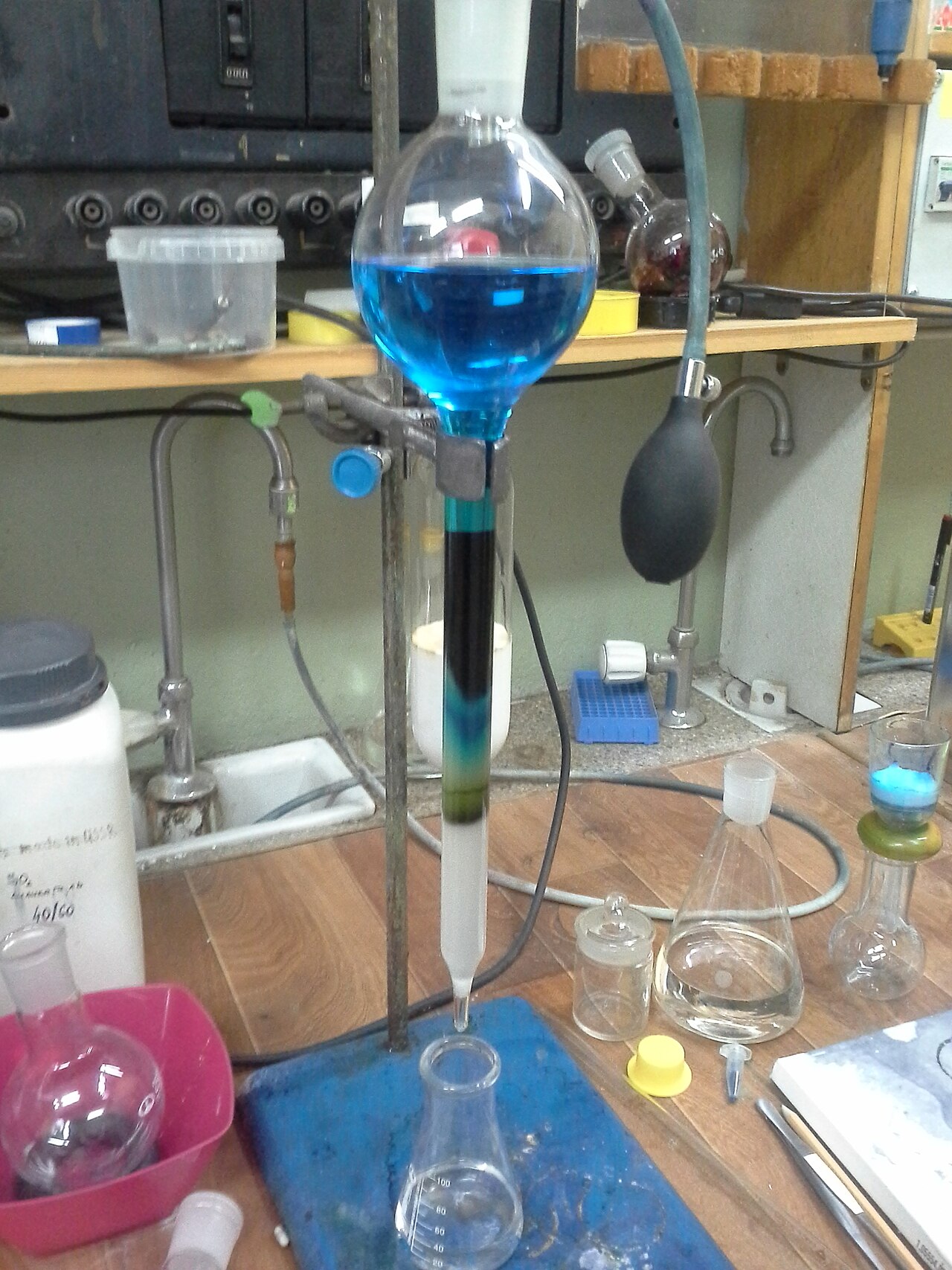
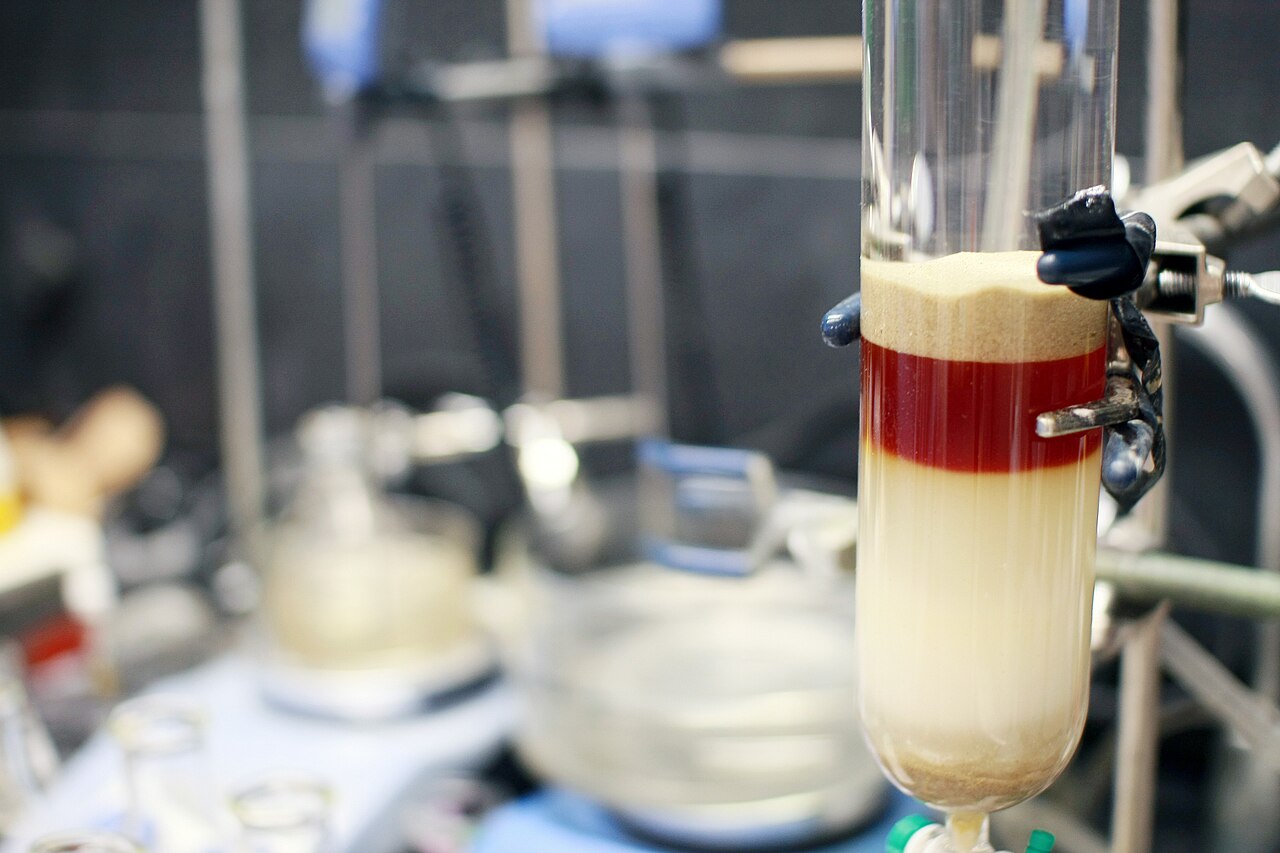
Максим Фомич · CC BY 2.0
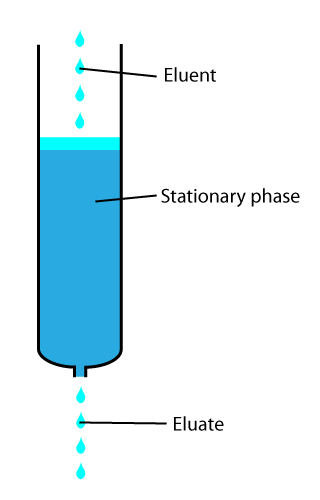
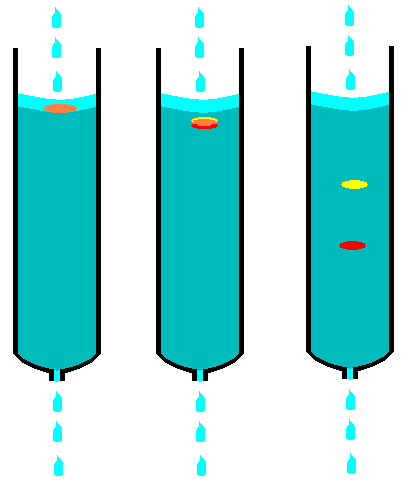
Column chromatography is a technique in analytical chemistry for separating the components of a mixture. The mixture, dissolved in a solvent called the eluent, forms the mobile phase. This mobile phase travels through a column filled with solid particles, known as the stationary phase. Because each component adsorbs to the stationary phase at a different rate, they exit the column at different times, achieving separation. The method is versatile, working with various adsorbents (like normal or reversed phase) and solvents, and can handle sample amounts from micrograms to kilograms. Its main advantages are low cost and the ability to replace the stationary phase after use, which prevents cross-contamination and degradation from recycling. The mobile phase can be driven by gravity, compressed gas, or pressurized pumps, as in high-performance liquid chromatography. Before starting, thin-layer chromatography is typically run on a small sample to predict how the mixture will behave and to optimize the mobile and stationary phases.
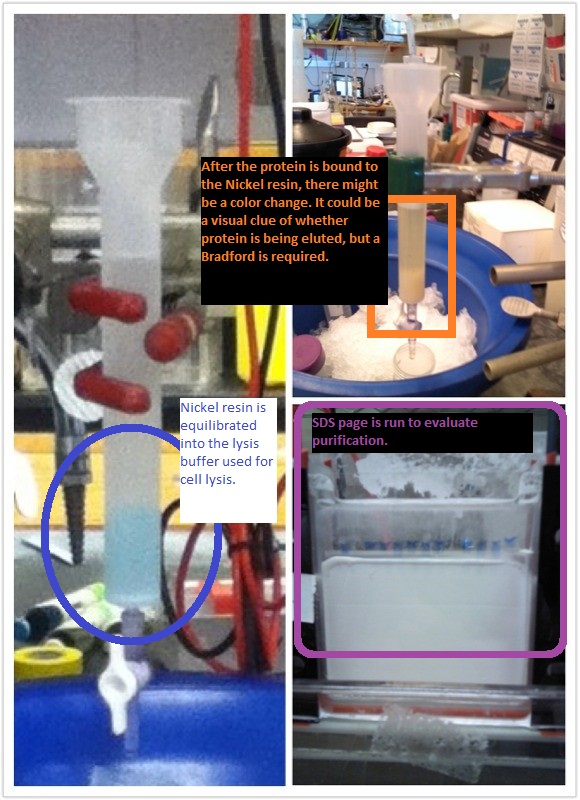
**Column preparation** A column is made by packing a solid adsorbent into a cylindrical glass or plastic tube, sized according to the amount of compound to isolate. The tube’s base has a filter—either a cotton or glass wool plug, or a glass frit—to hold the solid phase. A solvent reservoir can be attached at the top. Two packing methods exist: the dry method, where dry stationary phase powder is added first, then mobile phase is flushed through until fully wet, never allowing it to dry afterward; and the wet method, where a slurry of eluent and stationary phase powder is carefully poured into the column. The silica top must be flat and can be protected by a sand layer. Eluent is slowly passed through to advance the material. Components separate as they move at different speeds, eluting one at a time. The eluent is collected in a series of fractions, often automatically using fraction collectors. Productivity can be increased by running multiple columns simultaneously with multi-stream collectors. The eluent flow is monitored, and each fraction is analyzed for dissolved compounds via analytical chromatography, UV absorption, or fluorescence. Colored or fluorescent compounds (visible under UV light) can be seen as moving bands through the glass wall.
**Stationary phase** The column contains packed solid particles, finely ground powders, or gels—the stationary phase or adsorbent. This is most commonly silica gel or alumina; cellulose powder was often used historically. A wide range of stationary phases enables different column chromatography types: ion exchange, reversed-phase, affinity, or expanded bed adsorption (EBA). The solid phase may be microporous for increased surface area, though EBA uses a fluidized bed. Generally, much more stationary phase than analyte mixture is used. For silica columns, 20 to 100 grams of stationary phase are needed per gram of dry analyte mass. More silica improves resolving power but slows the process.
**Mobile phase (eluent)** The mobile phase, or eluent, is a solvent or solvent mixture that moves compounds through the column. Choosing an eluent depends on the retention factor: the target compound’s retention factor should be around 0.2–0.3 to minimize time and eluent volume, while other compounds should have significantly different retention factors. To find a suitable eluent, small-scale pretests are run, often using thin-layer chromatography with the same stationary phase and solvents of varying polarity until a good system is found. Common solvents, in order of increasing polarity, include hexane, dichloromethane, ethyl acetate, acetone, and methanol. A typical system is a hexane:ethyl acetate mixture, with proportions adjusted so the target compound’s retention factor is 0.2–0.3. Contrary to common belief, methanol alone can be used for highly polar compounds and does not dissolve silica gel. The eluent flow rate can be optimized: a higher rate reduces run time and diffusion, improving resolution, but if too high, the analyte fails to equilibrate between phases (as per Van Deemter’s equation). For gravity-flow columns, flow rate can be increased by raising the fresh eluent height above the stationary phase or adjusting the tap. It can also be increased with a pump or compressed gas (air, nitrogen, or argon) for flash column chromatography.
- field
- Analytical chemistry
- known_for
- Separation of mixture components using a column packed with stationary phase and a mobile phase
- key_components
- Stationary phase (e.g., silica gel, alumina), mobile phase (eluent), column, filter, fraction collector
- common_eluent_system
- Hexane:ethyl acetate mixture
- typical_stationary_phase_ratio
- 20 to 100 grams of stationary phase per gram of analyte mixture
Lore & Background
Column chromatography is performed by packing a solid adsorbent into a cylindrical glass or plastic tube, with a filter at the base to hold the solid phase in place. The column can be prepared using either the dry method (filling with dry stationary phase powder then adding mobile phase) or the wet method (pouring a slurry of eluent and stationary phase powder into the column). The top of the stationary phase should be flat, and a layer of sand may protect it. Eluent is passed through the column, and the individual components separate as they run at different speeds, eluting one at a time. The eluent is collected in fractions, which can be collected automatically by fraction collectors. Productivity can be increased by running several columns simultaneously using multi-stream collectors. The composition of the eluent flow can be monitored, and fractions analyzed by methods such as analytical chromatography, UV absorption spectra, or fluorescence. Colored or fluorescent compounds can be seen as moving bands through the glass wall.
Reader's Guide
Column chromatography is significant for its low cost and versatility, allowing separation of mixtures on scales from micrograms to kilograms. Its main advantage is that the stationary phase can be replaced after use, preventing cross-contamination and degradation. The technique is widely applicable because many different adsorbents (normal phase, reversed phase, or otherwise) can be used with a wide range of solvents. Before performing column chromatography, thin-layer chromatography is usually done on a small sample to optimize the combination of mobile and stationary phases. The retention factor of the target compound should be around 0.2–0.3 to minimize time and eluent usage. The eluent flow rate can be optimized: higher flow rates decrease diffusion and improve resolving power, but too high a rate prevents equilibration. Flow rate can be increased by raising the eluent column height, using a pump, or compressed gas (flash column chromatography). Automated low pressure liquid chromatography systems reduce human involvement and can separate samples from milligrams to industrial kilogram scales, though resolution is lower than high pressure systems due to larger packing material (around 50 micrometers).
Did You Know?
- For silica column chromatography, 20 to 100 grams of stationary phase are used per gram of dry mass of the analyte mixture.
- The mobile phase can be moved by gravity, compressed gas, or pressurized pumps, as in high-performance liquid chromatography.
- Common mobile phase solvents, in order of increasing polarity, include hexane, dichloromethane, ethyl acetate, acetone, and methanol.
Origins in Agriculture and Wartime Necessity
The story of ion chromatography begins not in a laboratory but in the fields of English agriculture. T. Way investigated how water-soluble fertilizer salts—specifically ammonium sulfate and potassium chloride—interacted with clay soils. Their experiments revealed that treating clays with these salts could extract ammonia and release calcium, a discovery that laid the groundwork for what would become a cornerstone analytical technique. The method's trajectory accelerated dramatically during World War II, when the Manhattan Project drove significant expansion of ion-exchange applications. By the late 1940s, Spedding and Powell were applying displacement ion-exchange chromatography to separate rare-earth elements and even distinguish between nitrogen-14 and nitrogen-15 isotopes in ammonia. In the early 1950s, Kraus and Nelson extended the approach to metal ions by separating their chloride, fluoride, nitrate, and sulfate complexes through anion chromatography. What began as an agricultural curiosity had, within a single generation, become an indispensable tool across chemistry, with its principles finding application in distillation, adsorption, and filtration.
The Logic of Charge: Anion and Cation Exchange
At its core, ion chromatography exploits a single electrostatic principle: oppositely charged species attract. The technique splits into two complementary modes. In cation-exchange chromatography, the stationary phase carries a negative charge, and the analyte molecules of interest are positively charged. This positive charge is achieved by running the separation at a pH below the molecule's isoelectric point. Conversely, anion-exchange chromatography employs a positively charged stationary phase to capture negatively charged analytes, which requires operating at a pH above the isoelectric point. For proteins specifically, the separation must occur at least one pH unit away from the isoelectric point to ensure adequate charge. The stationary phase contains an ionizable functional group that forms ionic bonds with the target molecules as they pass through the column. Once bound, the analytes are released—eluted—either by flushing the column with a higher concentration of competing ions or by shifting the pH. This straightforward charge-based mechanism allows the method to handle an extraordinarily wide range of molecules, from small inorganic anions and nucleotides to large proteins and amino acids.
The Detection Revolution and a Market in Competition
For decades, ion chromatography lacked a sensitive, automated way to detect eluted species. That changed in the late 1960s and early 1970s when Small, Stevens, and Bauman at Dow Chemical Company introduced a system of suppressed conductivity detection, enabling efficient separation of both anions and cations. The breakthrough sparked rapid adoption. The result was a fierce rivalry within the ion chromatography market between proponents of suppressed and non-suppressed detection. Rather than stifling progress, this competition accelerated the development of new column formats, elution strategies, and detector designs.
Strengths, Constraints, and the Road Ahead
One of ion chromatography's most celebrated strengths is the simplicity of its interaction: only a single ionic force governs the separation, unlike many other techniques that rely on multiple simultaneous mechanisms. This singular focus translates into higher matrix tolerance, meaning the method can handle complex sample backgrounds more gracefully. Elution patterns are also remarkably predictable because they depend on the presence and nature of the ionizable group, and a local charge balance is always maintained throughout the process. The technique finds routine use in protein purification, water analysis, quality control, semiconductor manufacturing, and environmental monitoring of aqueous systems. Yet limitations persist. The method is inherently restricted to molecules that possess an ionizable group, which excludes a significant portion of chemical space. Column-to-column inconsistency remains a practical headache, partly because the technique is still evolving. Looking forward, researchers identify the preparation of highly efficient monolithic ion-exchange columns as a critical challenge whose resolution would mark a major leap in the field's capabilities.
Gallery
Frequently Asked Questions
Who is Column chromatography?
Column chromatography is a separation technique in analytical chemistry that splits a mixture into its individual parts. It works by pushing a liquid solvent through a tube filled with tiny solid particles, letting each component travel at its own pace.
What are Column chromatography's powers/role?
Its core ability is differential adsorption—each compound in the mixture sticks to the solid packing material to a different degree, so they emerge from the column one by one. This makes it one of the most versatile tools for isolating compounds in a lab.
How does Column chromatography's story end?
The run wraps up when the last component elutes from the bottom of the column and is caught in a fraction collector. At that point every separated band has passed through, and the separation is complete.
Why is Column chromatography important?
It is a low-cost, go-to method that can handle samples anywhere from microgram to kilogram scale, making it accessible across research and industry. Its flexibility with different adsorbents and solvent systems means it can tackle a huge range of mixtures.
What does Column chromatography need to pull off its act?
You need a column packed with a stationary phase such as silica gel or alumina, a mobile phase (often a hexane and ethyl acetate blend), a filter, and a fraction collector to catch the separated bands. The packing-to-sample ratio typically falls between 20 and 100 grams of solid per gram of mixture.
More in Chemical Analysis And Spectroscopy 1-18
Spotted an error? Know more?
This is a living reference — every entry is fact-audited, and reader corrections feed straight into our audit queue. Suggest an edit · See this site's audit record