Gel permeation chromatography
A technique separating polymers by size using porous gel columns.

Gel permeation chromatography (GPC) is a form of size-exclusion chromatography (SEC) that sorts high molecular weight or colloidal substances by their size or diameter, usually in organic solvents. It is commonly applied to analyze polymers. The SEC method was first developed in 1955 by Lathe and Ruthven. The term "gel permeation chromatography" originates from J.C. Moore at Dow Chemical Company, who studied the technique in 1964. Dow licensed the proprietary column technology to Waters Corporation, which commercialized it that same year. Today, GPC systems and consumables are available from multiple manufacturers. Separating polymers is often necessary for both analysis and purification of the desired product.
When characterizing polymers, key properties include their size distribution, dispersity (Đ), and molecular weight. Polymers can be described by several molecular weight definitions: number average (Mn), weight average (Mw), size average (Mz), and viscosity molecular weight (Mv). GPC can determine Đ and Mv directly, and with additional data, Mn, Mw, and Mz can also be found.
**How it works** GPC separates analytes based on their size or hydrodynamic volume (radius of gyration), unlike other chromatographic methods that rely on chemical or physical interactions between mobile and stationary phases. Separation occurs using porous gel beads packed inside a column. The principle is differential exclusion or inclusion of macromolecules by the porous gel. Larger molecules cannot enter the pores and elute earlier; smaller molecules enter the pores, stay longer, and elute later. No interaction occurs between analytes and the stationary phase surface. Smaller analytes relative to pore sizes permeate the pores, increasing retention time, while larger ones spend little time inside the gel and elute sooner. Each column has a molecular weight range it can separate, determined by its pore sizes. An analyte too large for the pores is totally excluded and elutes with the free volume outside the particles (Vo), marking the total exclusion limit. An analyte small enough to fully permeate elutes with the solvent, indicating the total permeation volume, which includes solvent held inside the pores (Vi). The total volume (Vt) is given by Vt = Vg + Vi + Vo, where Vg is the volume of the polymer gel. Because each column can only separate a limited molecular weight range, the pore size of the packing should match the analyte’s molecular weight range. For polymers, pore sizes should be similar to the polymers being analyzed. For samples with a broad molecular weight range, several GPC columns with different pore volumes may be used in series for full resolution.
**Application** GPC is often used to determine the relative molecular weight of polymer samples and the distribution of those weights. What GPC actually measures is molecular volume and shape function, defined by intrinsic viscosity. When comparable standards are used, this relative data can yield molecular weights within ±5% accuracy. Polystyrene standards with dispersities below 1.2 are typically used for calibration. However, polystyrene is a very linear polymer, so as a standard it is only useful for comparing to other polymers known to be linear and of similar size.
**Materials and methods**
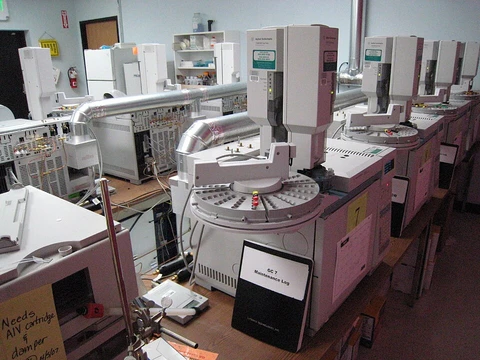
**Instrumentation** GPC is almost always performed on chromatography systems. The experimental setup is similar to other high-performance liquid chromatography techniques. Samples are dissolved in an appropriate solvent (often organic for GPC), filtered, and injected onto a column. Separation of a multi-component mixture occurs in the column. A pump supplies fresh eluent continuously. Since most analytes are not visible, a detector is needed; multiple detectors are often used to gather more information about the polymer sample. The detector makes fractionation convenient and accurate.
**Gel** Gels serve as the stationary phase in GPC. The pore size of a gel must be carefully controlled for a given separation. Other desirable properties include the absence of ionizing groups and, in a given solvent, low affinity for the substances being separated. Commercial gels include PLgel and Styragel (cross-linked polystyrene-divinylbenzene), LH-20 (hydroxypropylated Sephadex), and Bio-Gel (cross-linked polyacrylamide).
- field
- Analytical chemistry, polymer science
- known_for
- Separation and characterization of polymers by size
Lore & Background
Gel permeation chromatography separates analytes based on their size or hydrodynamic volume, unlike other chromatographic techniques that depend on chemical or physical interactions. Separation occurs via porous gel beads packed inside a column; larger molecules are excluded from pores and elute earlier, while smaller molecules enter pores and elute later. The process takes place without any interaction of the analytes with the surface of the stationary phase. Each column has a range of molecular weights that can be separated according to pore sizes, and for broad molecular weight ranges, several columns with varying pore volumes may be used in tandem.
Reader's Guide
Gel permeation chromatography is significant as the most widely used technique for analyzing polymer samples to determine molecular weights and weight distributions. It allows determination of dispersity (Đ) and viscosity molecular weight (Mv), and based on other data, number average (Mn), weight average (Mw), and size average (Mz) molecular weights can be determined. The technique is conducted in chromatography systems similar to high performance liquid chromatography, using organic solvents as eluents. Common detectors include differential refractometers and UV photometers. GPC systems and consumables are available from multiple manufacturers, and the technique is essential both for analyzing polymers and purifying desired products.
Did You Know?
- GPC separates analytes based on size or hydrodynamic volume, not chemical interactions.
- Polystyrene standards with dispersities less than 1.2 are typically used to calibrate GPC.
- The total column volume is given by Vt = Vg + Vi + Vo, where Vg is gel volume, Vi is pore volume, and Vo is void volume.
More in Chemical Analysis And Spectroscopy 1-18
Spotted an error? Know more?
This is a living reference — every entry is fact-audited, and reader corrections feed straight into our audit queue. Suggest an edit · See this site's audit record