Gas chromatography
A technique for separating vaporizable compounds in a mixture.

Gas chromatography (GC) is a widely used analytical technique for separating and analyzing chemical compounds that can be turned into vapor without breaking down. It is often employed to check the purity of a substance or to isolate the individual components within a mixture. In preparative work, GC can also be used to produce pure compounds from a mixture. The method is sometimes referred to as vapor-phase chromatography (VPC) or gas–liquid partition chromatography (GLPC), abbreviations that appear frequently in scientific literature.
The process works by injecting a gaseous or liquid sample into a mobile phase—typically an inert or unreactive carrier gas like helium, argon, nitrogen, or hydrogen. This gas carries the sample through a stationary phase, which is usually a polymeric liquid inside a separation column. Most modern GC columns are made of fused silica capillaries, measuring 100–320 micrometers in inner diameter and 5–60 meters in length. The column sits inside a temperature-controlled oven, and the effluent leaving the column is monitored by a detector.
In operation, a gas chromatograph consists of a narrow tube (the column) through which the vaporized sample is swept by a continuous flow of inert gas. The sample’s components travel through the column at different speeds, depending on their chemical and physical properties and how they interact with the stationary phase. As each chemical exits the column, it is detected and identified electronically.
The history of chromatography begins in 1903 with Russian scientist Mikhail Semenovich Tswett, who separated plant pigments using liquid column chromatography. Gas chromatography itself was invented in 1951 by Anthony T. James and Archer J.P. Martin at the National Institute for Medical Research in Mill Hill, London. Their instrument used partition chromatography rather than adsorption. The technique gained popularity quickly after the flame ionization detector was developed. Martin and his colleague Richard Synge, with whom he shared the 1952 Nobel Prize in Chemistry, had earlier suggested that chromatography could separate gases. Synge moved on to other work, while Martin continued with James. Griffin and George Ltd. in London began manufacturing and selling gas chromatographs in 1954, followed by Pye Unicam in Cambridge and US companies in 1955 and 1956.
Earlier work on gas adsorption chromatography included that of German physical chemist Erika Cremer and Austrian graduate student Fritz Prior in 1947, who built what is considered the first gas chromatograph—featuring a carrier gas, a column packed with silica gel, and a thermal conductivity detector. They presented it at ACHEMA in Frankfurt, but it drew no interest. In 1943, N.C. Turner of the Burrell Corporation introduced a large instrument using a charcoal column and mercury vapors. Stig Claesson at Uppsala University published work in 1946 on a charcoal column also using mercury. Gerhard Hesse at the University of Marburg/Lahn tested the prevailing belief that molecules could not be separated in a moving gas stream; he built a simple glass column filled with starch and successfully separated bromine and iodine using nitrogen as the carrier gas. He later constructed a system with an inert gas flowing through a glass condenser packed with silica gel, collecting the eluted fractions. Courtenay S.G. Phillips at Oxford University investigated separation in a charcoal column with a thermal conductivity detector. He consulted Claesson and initially used displacement as his separating principle, but after learning of James and Martin’s results, he switched to partition chromatography.
Early gas chromatography used packed columns, 1–5 meters long and 1–5 millimeters in diameter, filled with particles. The invention of capillary columns, where the stationary phase is coated on the inner wall, improved resolution.
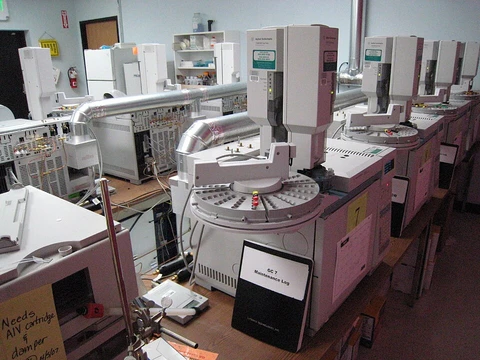
Physical components include autosamplers, which automatically introduce samples into the inlets. Manual injection is possible but rare, as automatic insertion offers better reproducibility and time efficiency. Autosamplers vary by sample capacity (auto-injectors handle few samples; autosamplers handle more), robotic technology (XYZ robot vs. rotating robot), or analysis type: liquid, static head-space by syringe, dynamic head-space by transfer-line, or solid phase microextraction (SPME).
The column inlet, or injector, introduces the sample into the continuous carrier gas flow. It is a piece of hardware attached to the column head. Common inlet types include the split/splitless (S/SL) injector, where a sample is injected via syringe through a septum into a heated chamber, causing volatilization. The carrier gas then either sweeps the entire sample (splitless mode) or a portion of it.
- field
- Analytical chemistry
- known_for
- Separating and analyzing vaporizable compounds
- inventors
- Anthony T. James and Archer J.P. Martin
- invention_location
- National Institute for Medical Research, Mill Hill, London
Lore & Background
The invention of gas chromatography is attributed to Anthony T. James and Archer J.P. Their gas chromatograph used partition chromatography as the separating principle. Martin and Richard Synge had noted in an earlier paper that chromatography might also be used to separate gases; Synge pursued other work while Martin continued with James. The popularity of gas chromatography quickly rose after the development of the flame ionization detector. They exhibited it at ACHEMA in Frankfurt, but nobody was interested. Other precursors include N.C. Early gas chromatography used packed columns. Resolution was improved by the invention of capillary columns, where the stationary phase is coated on the inner wall.
Reader's Guide
Gas chromatography is significant as a foundational analytical technique for separating and analyzing compounds that can be vaporized without decomposition. The technique's legacy includes its widespread use in testing purity, separating mixture components, and preparing pure compounds via preparative chromatography. The development of capillary columns improved resolution over earlier packed columns. The technique's alternative names—vapor-phase chromatography and gas–liquid partition chromatography—reflect its varied applications. The choice of carrier gas, such as helium, hydrogen, argon, or nitrogen, and the use of temperature-controlled ovens and detectors, remain central to its operation. The work of earlier researchers like Cremer, Prior, Turner, Claesson, Hesse, and Phillips provided foundational steps, though James and Martin's partition chromatography approach became the standard. Commercialization began in 1954 with Griffin and George Ltd.
Did You Know?
- Gas chromatography is also known as vapor-phase chromatography (VPC) or gas–liquid partition chromatography (GLPC).
More in Chemical Analysis And Spectroscopy 1-18
Spotted an error? Know more?
This is a living reference — every entry is fact-audited, and reader corrections feed straight into our audit queue. Suggest an edit · See this site's audit record