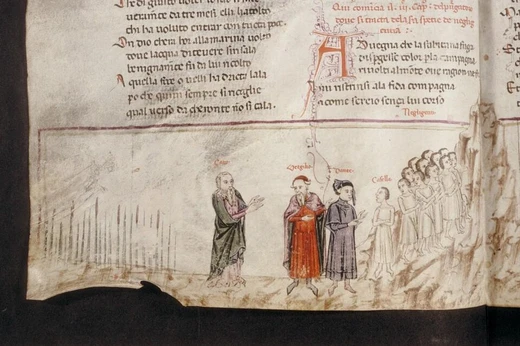
Pope Boniface VIII
Pope who claimed supreme temporal power and was condemned by Dante.

via Wikipedia: Pope Boniface VIII · see source
Pope Boniface VIII, born Benedetto Caetani, was head of the Catholic Church and leader of the Papal States from 24 December 1294 until his death in 1303. He succeeded Pope Celestine V, who had abdicated. Boniface put forward some of the strongest claims of any pope to temporal as well as spiritual power, and involved himself often in foreign affairs, including in France, Sicily, Italy, and the First War of Scottish Independence. These views and his chronic intervention in temporal affairs led to bitter quarrels with Albert I of Germany, Philip IV of France, and later Dante Alighieri, who expected the pope to soon arrive at the eighth circle of Hell in his Divine Comedy, among the simoniacs.
Quick Facts
- Honorific prefix
- Pope
- Birth name
- Benedetto Caetani
- Church
- Catholic Church
- Took office
- 24 December 1294
- Left office
- 11 October 1303
- Predecessor
- Celestine V
- Successor
- Benedict XI
- Consecration
- 23 January 1295
Facts from the source article.
Did You Know?
- Boniface VIII systematized canon law by collecting it in a new volume, the Liber Sextus (1298), which continues to be important source material for canon lawyers.
- He established the first Catholic jubilee year to take place in Rome.
- Boniface excommunicated King Philip IV and all others who prevented French clergy from traveling to the Holy See, after which the king sent troops to attack the pope's residence in Anagni on 7 September 1303 and capture him; Boniface was held for three days and died a month afterwards.
- While in England as part of Cardinal Ottobono Fieschi's legation, Benedetto Caetani became rector of St. Lawrence's church in Towcester, Northamptonshire.
Life and career
Benedetto Caetani was born in Anagni, some 31 mi southeast of Rome. He was a younger son of Roffredo Caetani (Podestà of Todi in 1274–1275), a member of a baronial family of the Papal States. Through his mother, Emilia Patrasso di Guarcino, a niece of Pope Alexander IV, he was not far distant from the seat of ecclesiastical power and patronage. Benedetto took his first steps into religious life when he was sent to the monastery of the Friars Minor in Velletri, under the care of his maternal uncle Fra Leonardo Patrasso.
He was granted a canonry at the cathedral in Anagni with the permission of Pope Alexander IV. The earliest record of him is as a witness to an act of Bishop Pandulf of Anagni on 16 October 1250. In 1252, when his paternal uncle Pietro Caetani became Bishop of Todi, Benedetto followed him to Todi and began his legal studies there. His uncle granted him a canonry in the Cathedral of Todi in 1260.
He also came into possession of the small nearby castello of Sismano, a place with twenty-one fires (hearths, families). In later years Father Vitalis testified that Benedetto was in a school run by Rouchetus, a Doctor of Laws, from that city. Benedetto later described Todi as 'the dwelling place of his early youth', the city which 'nourished him while still of tender years', and as a place where he 'held lasting memories.' In 1264, Benedetto entered the Roman Curia, perhaps with the office of Advocatus.
He served as secretary to Cardinal Simon de Brion, the future Pope Martin IV, on a mission to France. On 1 May 1264 Cardinal Simon was given permission to appoint two or three tabelliones (secretaries) for his mission, one of whom was Benedetto. On 4 May 1265, Cardinal Ottobono Fieschi was appointed Apostolic Legate to England, Scotland, Wales, and Ireland; he was accompanied by Benedetto Caetani. While in England, Benedetto Caetani became rector of St. Lawrence's church in Towcester, Northamptonshire.
Upon his return from England, there is an eight-year period in which nothing is known about his life. In 1276, Benedetto was sent to France to supervise the collection of a tithe, which is perhaps when he held the office of Advocatus in the Roman Curia, and then was appointed a papal notary in the late 1270s. During this time, Benedetto accumulated seventeen benefices. At Orvieto, on 12 April 1281, Pope Martin IV created Benedetto Caetani cardinal deacon of Saint Nicholas in Carcere.
In 1288 he was sent as Legate to Umbria to attempt to calm the strife between Guelphs and Ghibellines. In the winter of 1289, he was one of Pope Nicholas IV's advisors as he decided on a settlement of disputes over the election or appointment of Portuguese bishops. Three years later, on 22 September 1291, Pope Nicholas IV promoted him to the Order of Cardinal Priests, with the title of SS. Silvester and Martin. As cardinal, he served as papal legate in diplomatic negotiations to France, Naples, Sicily, and Aragon.
Posthumous trial
King Philip IV pressured Pope Clement V of the Avignon Papacy into staging a posthumous trial of Boniface. He was accused of heresy, but no verdict against him was delivered.
In culture
In Dante's Inferno, Boniface VIII is portrayed being punished in hell for simony, even though he was still alive at the poem's story date. His eventual destiny is revealed by Pope Nicholas III in the eighth circle of hell. Later in the Inferno, Dante recalls Boniface's feud with the Colonna family, which led him to demolish the city of Palestrina, killing 6,000 citizens and destroying both the home of Julius Caesar and a shrine to Mary. Beatrice confirms Boniface's ultimate fate when Dante visits Heaven.
Dante does not adopt Guillaume de Nogaret's aspersion that Boniface was a sodomite, and does not assign him to that circle; simony was placed in the eighth circle of fraud, below sodomy in the seventh circle of violence, designating it as a worse offense. Boniface is also mentioned in François Rabelais's Gargantua and Pantagruel, where Epistemos lists him as 'skimming the scum off soup pots' in hell. His title in the Prophecy of the Popes is 'From the Blessing of the Waves'.
The mathematician Campanus of Novara served as his personal physician or chaplain and died at Viterbo in 1296. John Gower's Confessio Amantis tells the tale of Boniface as an exemplum of fraudulently supplanting others, claiming he tricked Pope Celestine V into abdicating via a young cleric pretending to be God's voice, and repeats the rumour that Boniface died gnawing off his own hands from hunger.
More in Characters in the Divine Comedy
Spotted an error? Know more?
Reader corrections go straight into our review queue. Suggest an edit · How this site is sourced