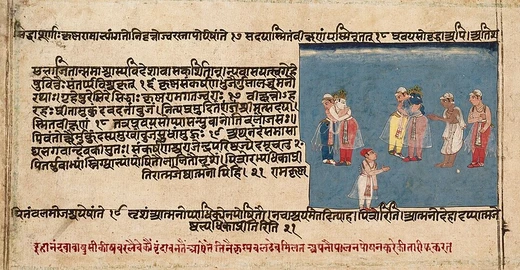
Kunti
Last updated
Kunti, also known as Pritha, is a central female figure in the Mahabharata, an ancient Sanskrit epic. She is the wife of King Pandu and the mother of the three eldest Pandava brothers—Yudhishthira, Bhima, and Arjuna—as well as the mother of Karna from a premarital union. Her life story, marked by divine boons, strategic decisions, and moral complexities, makes her one of the epic's most significant characters.
Literary background
Kunti appears in the Mahabharata, a Sanskrit epic that narrates the conflict between the Pandavas and the Kauravas. The text is a composite work shaped through centuries of revisions, editing, and interpolations, with the oldest portions likely dating to around 400 BCE. Manuscripts exist in numerous versions, with substantial variations in details of key characters and events, except for the Bhagavad Gita, which remains notably consistent. Significant differences exist between Northern and Southern recensions, the latter generally being more elaborate.
A critical edition has been compiled, primarily drawing from the Bombay, Poona, Calcutta, and South Indian editions, with the version led by Vishnu Sukthankar at the Bhandarkar Oriental Research Institute being the most widely accepted. Kunti is introduced in the Adi Parva, the first of the eighteen books, and quickly emerges as a foundational female figure. Scholar Alf Hiltebeitel notes that she becomes the rising star of the narrative spanning chapters 103 to 119.
An entire chapter is devoted to her childhood, making her the only woman marrying into a central royal line in either the Mahabharata or the Ramayana whose girlhood is explored in such depth. Quantitative evidence shows that between chapters 103.9 and 119.12, the text allocates 195 verses to Kunti, compared to 85 for Madri and 36 for Gandhari.
Etymology
The feminine epithet Kunti is a patronymic derivative, acquired through her adoption by Kuntibhoja. It has its roots in the masculine noun Kunti, which originally referred to a group of people, appearing in classical Sanskrit texts such as the Kathaka Samhita, Panini's Ashtadhyayi, and the Mahabharata. The male variant of the epithet also denotes rulers or princes of this lineage. Kunti's original name is Pritha.
According to scholar Alf Hiltebeitel, this name means 'the Wide', evoking both the goddess Prithivi (the Broad Earth) and the description of her as a girl with wide eyes in the Mahabharata, reinforcing a symbolic alignment with the vastness and nurturing aspect of the Earth. Madeleine Biardeau observes that while other prominent women in the epic derive their identities from specific geographic regions, Kunti's name Pritha links her to the Earth as a whole.
Linguist Monier-Williams derives Pritha from the root pritha, related to prith, suggesting it can also mean 'the flat or palm of the hand'. Sociologist Irawati Karve interpreted the name to suggest a physical characteristic, writing that it shows she was apparently a large big-boned girl, though Lavanya Vemsani contests this interpretation, arguing there is neither linguistic nor textual justification since the Mahabharata explicitly describes Kunti as a woman of stunning beauty.
Biography
Kunti, originally named Pritha, is born into the Yadava clan as the eldest child of Shurasena. Shurasena had promised to give his eldest child to his childless cousin Kuntibhoja, so Pritha is adopted and becomes known as Kunti. She is raised in Kuntibhoja's royal household, trained in royal duties without a maternal presence. Later in life, she reveals resentment over this adoption, recalling that she was merely playing with a ball when her father transferred her like wealth.
During her adolescence, Kuntibhoja entrusts her to the care of the sage Durvasa, who arrives seeking hospitality. Kuntibhoja warns Kunti that any lapse in service could bring dishonour. Despite the pressure, Kunti serves the sage with devotion, enduring his sharp speech without complaint. After a year, Durvasa offers her a boon, and though she initially expresses contentment, she accepts his insistence on granting her a mantra that enables her to summon any deity.
Compelled by fear of his curse, she receives the spell. Durvasa then departs, leaving Kuntibhoja astonished by his daughter's endurance. Kunti later uses the mantra to invoke the sun god Surya out of curiosity, resulting in the concealed birth of her first son, Karna, whom she abandons due to societal stigma. After marrying Pandu, who is cursed to die if he engages in intercourse, she uses the boon to bear Yudhishthira, Bhima, and Arjuna by invoking Dharma, Vayu, and Indra.
Reconciliation with Karna
She shares the boon with her co-wife Madri, who gives birth to Nakula and Sahadeva. Following Pandu's death and Madri's self-immolation, Kunti raises all five children in Hastinapura. A misunderstanding on her part results in the polyandrous marriage of Draupadi to all five Pandava brothers. Prior to the Kurukshetra War, Kunti meets Karna, discloses his true parentage, and urges him to join the Pandava side; he refuses but agrees to spare all her sons except Arjuna.
Later life and death
After the Pandavas' victory, she reveals Karna's identity to them and later retires to the forest, dying in a forest fire.
Assessment
Kunti is often seen as a quiet, dutiful wife and mother who mostly stays in the background, but she steps forward at crucial moments. She first shows her independence by choosing Pandu at her svayamvara and then loyally follows him into exile, even after he takes a second wife, Madri. When Pandu asks her to have children by other men, she refuses at first, showing her strong principles, but eventually gives in. However, she has no say in which gods father her sons—that decision is Pandu’s, revealing her limited power in the marriage.
She later hides her pre-marital son, Karna, to protect Pandu’s honor and her own reputation, a move that contrasts with Satyavati, who openly used her pre-marital son Vyasa to continue the royal line. Kunti also refuses to have a fourth child, citing scripture, which lets her assert her dignity and autonomy. In the court of Hastinapura, she relies on Vidura to navigate dangers. Her strategic thinking is clear when she arranges for Draupadi to marry all five Pandavas, a decision based on northern Kuru customs that keeps her sons united and focused.
Her motherly pragmatism appears in her plea to Karna before the war, where she gets him to promise to spare all the Pandavas except Arjuna. Though Karna rejects her, her determination to protect her sons shows her selfless devotion and emotional strength.
More in Characters in the Bhagavata Purana
Sources
Compiled from Wikipedia and the sources listed below. Text from Wikipedia is available under CC BY-SA 4.0; this entry is adapted from it.
- Wikipedia: Kunti (CC BY-SA 4.0).
Spotted an error? Know more?
Reader corrections go straight into our review queue. Suggest an edit · How this site is sourced