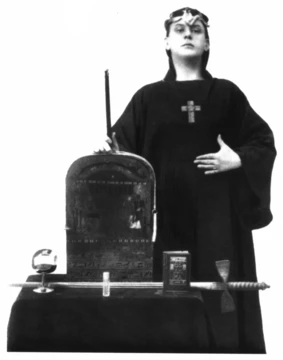
Athame
A ritual blade for directing psychic energy, not physical cutting.
Last updated
An athame is a ceremonial blade, typically with a black handle, used as a primary ritual implement in ceremonial magic, neopagan witchcraft, and satanic traditions. It is one of the four elemental tools in modern occultism, representing fire for witches and air for ceremonial magicians. The athame appears in Renaissance grimoires such as the Key of Solomon and was emphasized by Gerald Gardner in the 1950s as the most important tool of the New Forest Coven.
Quick Facts
- Elemental association (witchcraft)
- Fire
- Elemental association (ceremonial magic)
- Air
- Handle color (traditional)
- Black
- First prominent modern proponent
- Gerald Gardner
- Related grimoire
- Key of Solomon
- Other elemental tools
- Wand
- pentacle
- cup/chalice
Facts from the source article.
Appearance
An athame can take many forms and is not required to have a double-edged blade or specially colored handle, though many practitioners choose a double edge for symbolic reasons. Some witches select a single edge and use the straight side to ring a bell.
The handle is usually black, especially in Gardnerian and Alexandrian traditions, and may be inscribed with specific symbols. Janet and Stewart Farrar suggested dulling the point to prevent accidental harm. Eclectic witches may decorate handles with astrological glyphs or runes, while ceremonial witches use purple and yellow to represent air and inscribe specific sigils.
Use
The athame's primary use is to channel and direct psychic energy, often conceived as etheric fire, and it is not intended to harm or draw blood. For cutting herbs or cords, a boline is used instead. In traditional coven practice, casting the magic circle is done with a ritual sword or athame, though wands or staffs may substitute in public settings to avoid legal issues.
The circle is considered cast in etheric fire, envisioned as blue, indigo, or violet. After casting, purification is done with the remaining three elements—air (incense), water (salt-water), and earth (salt)—since fire has already been imbued. The athame is also used to invoke elemental guardians by drawing invoking pentagrams at each quarter.
Associations
Some Wiccan traditions associate the black-handled athame with the masculine principle and the element of fire, as Gardner did, while the wand is linked to air. Other traditions reverse these associations, using the athame for air and the wand for fire. Farrar and Farrar suggested this discrepancy arose from the Golden Dawn releasing false information to prevent correct ritual use, and advised witches to choose the association that feels most correct.
Fire and water are considered polar opposites and the two primordial elements, whose combination gave earth and air. Covens that associate the athame with air may use the wand to bless the wine chalice instead, as the union of fire and water carries the symbolic significance of the conjunctio oppositorum. Such covens may also cast the circle with the wand if they conceive of casting as projecting etheric fire, or purify with fire, water, and earth if they view casting as cutting air.
Etymology
The word "athame" comes from the late Latin term "artavus," which referred to a small quill knife used by scribes for sharpening pens. This term appears in medieval Latin manuscripts of the Key of Solomon. In some French and Italian copies, it was left untranslated and became corrupted into forms like artavo, arthana, artanus, arthany, or arthame. The origin of "artavus" is uncertain; Johannes Balbus de Janua linked it to the Latin "arto," meaning to narrow, while de Garlande around 1225 connected it to "ars" (art or craft), since artisans used the knife.
Idries Shah proposed an Arabic origin from "al-dhammé" (blood-letter), but this is disputed and appears in a work by Daraul, likely a pseudonym for Shah. Robert Graves suggested an Arabic derivation from "al thame," meaning "the arrow." Gerald Gardner probably took "athame" from modern French versions of the Key of Solomon, specifically through de Givry in 1931, who mistakenly applied the term to the main ritual knife.
Did You Know?
- The Javanese kris is a ritual knife regarded as having magical powers, and Gerald Gardner was a recognized authority on these knives before his involvement in Wicca.
- Zoroastrian priests traditionally used a knife, spear, or forefinger to draw ritual furrows for delineating protected sacred space.
- The Tibetan phurba is a three-sided ceremonial dagger also known as the magical dagger or kīla.
More in Ceremonial Magic
Sources
Compiled from Wikipedia and the sources listed below. Text from Wikipedia is available under CC BY-SA 4.0; this entry is adapted from it.
- Wikipedia: Athame (CC BY-SA 4.0).
Spotted an error? Know more?
Reader corrections go straight into our review queue. Suggest an edit · How this site is sourced