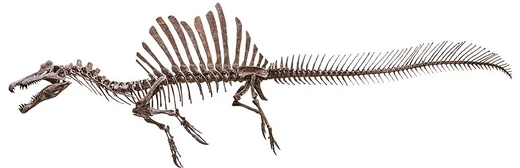
Carcharodontosaurus
A giant shark-toothed theropod from Cretaceous North Africa.
Last updated
Carcharodontosaurus ("shark-toothed lizard") is a genus of large theropod dinosaur that lived in Northwest Africa during the Cenomanian age of the late Cretaceous period, approximately 100 to 94 million years ago. It was one of the largest known theropod dinosaurs, with a lightly built skull and serrated teeth resembling those of the great white shark. The genus was first established in 1931 by Ernst Stromer based on a partial skeleton from Egypt and teeth from Algeria.
Scientific classification
- KingdomAnimalia
- PhylumChordata
- ClassReptilia
- CladeDinosauria
- CladeSaurischia
- Clade
- Family
- Genus†Carcharodontosaurus
Named by Stromer, 1931
Sources: Wikipedia taxobox: Carcharodontosaurus (CC BY-SA 4.0)
Quick Facts
- Type species
- Megalosaurus saharicus
- Subdivision
- C. iguidensis?, Brusatte & Sereno, 2007
Facts from the source article.
Discovery and species
In 1924, two teeth were unearthed from wall cuts in foggaras near Timimoun, French Algeria, from the Continental intercalaire Formation. Captain Burté gave them to French paleontologist Charles Depéret, who with Justin Savornin described them in 1925 as a new species, Megalosaurus saharicus. The specific name refers to the Sahara Desert. Friedrich von Huene accidentally named the same teeth M. africanus, a junior synonym.
The original teeth are now lost. A partial skeleton was found in April 1914 by Richard Markgraf in marls of the Bahariya Formation near Ain Gedid, Egypt, for Ernst Stromer. Due to World War I, the skeleton (SNSB-BSPG 1922 X 46) did not reach Munich until 1922, and Stromer described it in 1931, establishing the genus Carcharodontosaurus with C. saharicus as the only species. This skeleton was destroyed in World War II and later redescribed as Tameryraptor in 2025.
In 1995, a large incomplete skull from the Kem Kem Beds of Morocco was proposed as the neotype in 2007. Fossils from the Farak Formation of Niger were named C. iguidensis in 2007, though it may belong to a different genus.
Description
Stromer originally estimated C. saharicus at 8–9 m long, similar to Gorgosaurus, based on the Egyptian skeleton (now Tameryraptor), which was about 15% smaller than the neotype. The neotype reached 12–12.5 m in length and 5–7 metric tons in body mass, making it one of the largest theropods. C. iguidensis was smaller at 10 m and 4 MT. The skull was large and lightly built, with a triangular snout and greatly expanded fossae and fenestrae that reduced weight but made it more fragile than tyrannosaurid skulls.
Bite force was relatively low compared to other large theropods. In 1996, Paul Sereno estimated the skull at 1.60 m, similar to Giganotosaurus and possibly longer than Tyrannosaurus specimen "Sue". Matthew Carrano and colleagues in 2012 estimated 1.42 m, still slightly longer than the largest Tyrannosaurus. Gregory S. Paul suggested in 2010 that carcharodontosaur skulls had been reconstructed as too long.
In 2007, François Therrien and Donald M. Henderson estimated Carcharodontosaurus at 13.3 m and 15.1 MT, surpassing Tyrannosaurus. In 2022, Canale and colleagues estimated skull length at 1.4–1.6 m based on the relative Meraxes. The skeleton is incompletely known but thought to have small forelimbs, powerful hind limbs, and a long balancing tail.
Classification
Carcharodontosaurus is the type genus of the family Carcharodontosauridae and subfamily Carcharodontosaurinae, which also includes Giganotosaurus, Mapusaurus, Meraxes, and Tyrannotitan in the tribe Giganotosaurini. Stromer created Carcharodontosauridae for Carcharodontosaurus and Bahariasaurus, noting similarities to Allosaurus and Tyrannosaurus. From the 1950s to the 1980s, it was placed in Megalosauridae. In 1995, Oliver Rauhut analyzed the systematics based on material now assigned to Tameryraptor, suggesting Carcharodontosauridae may have originated in Tanzania from "Allosaurus" tendagurensis and "Megalosaurus" ingens, but later studies did not support this.
Paul Sereno's 1996 description revealed a transcontinental clade of carcharodontosaurids. In 2004, Thomas R. Holtz and colleagues defined the group as all allosauroids closer to Carcharodontosaurus than Allosaurus or Sinraptor. Carcharodontosaurus is less well-known than Meraxes and Giganotosaurus, which are represented by nearly complete skeletons. Carcharodontosaurians are recognized from the Late Jurassic to Mid-Cretaceous of every continent except Antarctica.
Paleobiology
A 2015 biomechanical analysis by Donald Henderson and Robert Nicholls used 3D models of Carcharodontosaurus and a subadult sauropod Limaysaurus, similar to rebbachisaurids from the Kem Kem Beds, to study lifting capabilities. An adult C. saharicus could hold a maximum of 424 kg, half the weight of an adult Limaysaurus, while two adults could lift 850 kg together. Carcharodontosaurid teeth are uniquely thin and blade-like, with straight edges, slightly recurved tips, and sinusoidal shapes, making them prone to bending or snapping on hard surfaces like bone.
Despite this, their overall size made them more robust than smaller theropod teeth. Carcharodontosaurus had a high tooth replacement rate, allowing damaged teeth to be replaced easily. A 2015 X-ray microscopy study of dinosaur tooth function found that Carcharodontosaurus enamel had cracked enamel tufts near the dentinoenamel junction, which may have made teeth more damage resistant and crack shielding, similar to human teeth. Evidence of bone-crunching bites is observed in Allosaurus, including ritual face-biting and bites into Stegosaurus pelves.
Did You Know?
- Isotopes from Carcharodontosaurus and Spinosaurus fossils suggest the Kem Kem Beds experienced a temporary monsoon season.
- Carcharodontosaurus teeth resemble those of the great white shark (genus Carcharodon).
More in Cenomanian Dinosaurs
Sources
Compiled from Wikipedia and the sources listed below. Text from Wikipedia is available under CC BY-SA 4.0; this entry is adapted from it.
- Wikipedia: Carcharodontosaurus (CC BY-SA 4.0).
- Word definitions: the , each quoted from its Wikipedia article.
Spotted an error? Know more?
Reader corrections go straight into our review queue. Suggest an edit · How this site is sourced