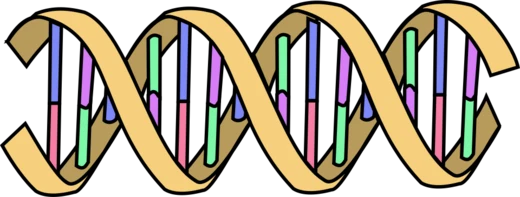
Nucleotide
Nucleotides are the monomeric units of DNA and RNA.

Nucleotides are organic molecules built from three parts: a nitrogenous base, a five-carbon sugar, and a phosphate group. They are the monomeric units that make up the nucleic acid polymers DNA and RNA, which are essential biomolecules in all life on Earth. The body gets nucleotides from food, and the liver can also synthesize them from common nutrients.
Each nucleotide has three subunit molecules: a nucleobase, a five-carbon sugar (either ribose or deoxyribose), and a phosphate group that can contain one, two, or three phosphates. In DNA, the four nucleobases are guanine, adenine, cytosine, and thymine (G, A, C, T). RNA uses uracil (U) instead of thymine.
Beyond building nucleic acids, nucleotides are central to cellular metabolism. They supply chemical energy in the form of nucleoside triphosphates—ATP, GTP, CTP, and UTP—which power many cellular functions, such as synthesizing amino acids, proteins, and cell membranes, moving the cell and its parts, and cell division. Nucleotides also participate in cell signaling through cyclic forms like cGMP and cAMP, and they are incorporated into key enzymatic cofactors, including coenzyme A, FAD, FMN, NAD, and NADP+. In experimental biochemistry, nucleotides can be radiolabeled with radionuclides to create radionucleotides. Additionally, 5-nucleotides are used as flavor enhancers to boost umami taste, often in yeast extracts.
**Structure**
A nucleotide consists of three distinct chemical subunits: a five-carbon sugar, a nucleobase (together called a nucleoside), and one phosphate group. Depending on how many phosphates are in the group, a nucleotide can be called a nucleoside monophosphate, diphosphate, or triphosphate. In nucleic acids, the nucleobase is either a purine or a pyrimidine. If the sugar is ribose, the nucleotide is a ribonucleotide; if it is deoxyribose, it is a deoxyribonucleotide. Adjacent nucleotides link together when phosphate molecules connect the sugar rings, forming a long chain. These sugar-phosphate joins create a backbone for a single or double helix. The chain's directionality runs from the 5'-end to the 3'-end, referring to carbon sites on the sugar. In a double helix, the two strands run in opposite directions, allowing base pairing and complementarity essential for DNA replication and transcription.
Nucleic acids are polymeric macromolecules assembled from nucleotide monomers. The purine bases adenine and guanine, and the pyrimidine base cytosine, appear in both DNA and RNA. Thymine is found only in DNA, and uracil only in RNA. Adenine pairs with thymine using two hydrogen bonds, while guanine pairs with cytosine using three.
As individual molecules, nucleotides also store and provide cellular energy, participate in signaling, supply phosphate groups to modulate protein activity, and act as enzymatic cofactors in redox reactions. Signaling cyclic nucleotides form when the phosphate group binds twice to the same sugar, bridging the 5'- and 3'-hydroxyl groups. Some signaling nucleotides have multiple phosphate groups attached at different positions on the sugar. Nucleotide cofactors can include additional chemical groups, like nicotinamide or flavin, attached via a glycosidic bond; in the case of flavin, the ribose sugar is linear rather than ring-shaped.
**Synthesis**
Nucleotides can be synthesized both in vitro and in vivo. In the lab, protecting groups are used to create phosphoramidites from purified nucleosides, which can then produce unnatural analogues or oligonucleotides. In living organisms, nucleotides are made de novo or recycled through salvage pathways. The components for de novo synthesis come from biosynthetic precursors of carbohydrate and amino acid metabolism, as well as from ammonia and carbon dioxide. Cellular bicarbonate metabolism can be regulated by mTORC1 signaling. The liver is the main organ for de novo synthesis of all four nucleotides. Pyrimidines and purines follow different pathways. Pyrimidines are synthesized first from aspartate and carbamoyl-phosphate in the cytoplasm, forming the precursor orotic acid, to which a phosphorylated ribosyl unit is attached. Purines are built starting from the sugar template, with the ring synthesized onto it. Both pathways use several enzymes in the cytoplasm, not within a specific organelle. Nucleotides break down so that useful parts can be reused in new synthesis reactions.
- composition
- Three subunit molecules: nucleobase, five-carbon sugar (ribose or deoxyribose), and phosphate group (one to three phosphates)
- nucleobases_in_DNA
- Guanine, adenine, cytosine, thymine (G, A, C, T)
- nucleobases_in_RNA
- Guanine, adenine, cytosine, uracil (G, A, C, U)
- key_functions
- Energy storage (ATP, GTP, CTP, UTP), cell signaling (cGMP, cAMP), enzymatic cofactors (coenzyme A, FAD, FMN, NAD, NADP+)
- synthesis_sites
- Liver (de novo); cytoplasm (pyrimidine and purine pathways)
Lore & Background
Nucleotides are composed of three distinctive chemical sub-units: a five-carbon sugar molecule, a nucleobase (together called a nucleoside), and one phosphate group. With all three joined, a nucleotide is also termed a nucleoside monophosphate, diphosphate, or triphosphate depending on the number of phosphates. In nucleic acids, nucleotides contain either a purine or a pyrimidine base, and are termed ribonucleotides if the sugar is ribose, or deoxyribonucleotides if the sugar is deoxyribose. Individual phosphate molecules repetitively connect the sugar-ring molecules in adjacent nucleotide monomers, creating a backbone strand for a single- or double helix. In a double helix, the two strands are oriented in opposite directions, permitting base pairing and complementarity essential for replicating or transcribing encoded information.
Reader's Guide
Nucleotides are fundamental to all life on Earth as the building blocks of DNA and RNA, the molecules that store and transmit genetic information. Beyond their structural role, they are central to cellular metabolism, providing chemical energy in the form of nucleoside triphosphates such as ATP, GTP, CTP, and UTP. They also participate in cell signaling through cyclic nucleotides like cGMP and cAMP, and are incorporated into important enzymatic cofactors including coenzyme A, FAD, FMN, NAD, and NADP+. In experimental biochemistry, nucleotides can be radiolabeled to yield radionucleotides. Additionally, 5-nucleotides are used as flavor enhancers to enhance umami taste, often in the form of yeast extract. The synthesis of nucleotides occurs both de novo and through salvage pathways, with the liver being the major organ for de novo synthesis. Pyrimidine and purine nucleotides are synthesized via distinct pathways in the cytoplasm, involving multiple enzymatic steps.
Did You Know?
- Nucleotides are composed of a nucleobase, a five-carbon sugar (ribose or deoxyribose), and a phosphate group.
- The four nucleobases in DNA are guanine, adenine, cytosine, and thymine; in RNA, uracil replaces thymine.
- Nucleotides provide chemical energy in the form of ATP, GTP, CTP, and UTP.
- 5-nucleotides are used as flavor enhancers to enhance umami taste, often in yeast extract.
More in Cell And Molecular Biology 1-24
Spotted an error? Know more?
This is a living reference — every entry is fact-audited, and reader corrections feed straight into our audit queue. Suggest an edit · See this site's audit record