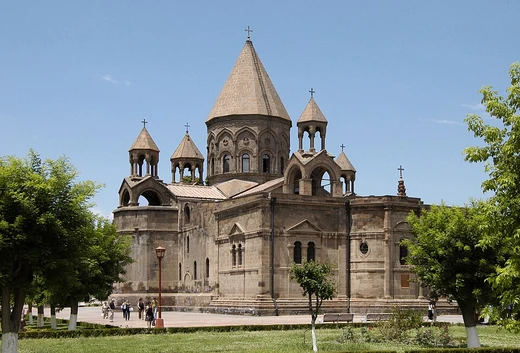
Amiens Cathedral
Largest Gothic cathedral by volume in France.

via Wikipedia: Amiens Cathedral · see source
Here is the rewritten encyclopedia entry:
Amiens Cathedral, officially the Cathedral of Our Lady of Amiens, serves as the home church for the Bishop of Amiens. Perched on a low ridge above the River Somme, it stands in Amiens, the main city of France's Picardy region, about 120 kilometers north of Paris. Its construction took place almost entirely between 1220 and roughly 1270—an unusually fast timeline for a Gothic cathedral, which gives the building a remarkable stylistic consistency. The cathedral represents an early example of the High Gothic period and features the Rayonnant style, visible in the triforium and clerestory begun in 1236, as well as in the enlarged choir windows added in the mid-1250s. Its builders aimed to maximize interior space to reach toward heaven and let in more light, making Amiens the largest French cathedral by volume at 200,000 cubic meters—more than twice the size of Notre Dame in Paris.
Local tradition holds that Christianity reached Amiens in the third century through two martyrs, Firmin the Martyr and Firmin the Confessor. Saint Martin was baptized here in 334. The church was suppressed during Vandal invasions and only revived near the end of the fifth century with the baptism of Clovis I in 498 or 499. The first known bishop, Edibus, attended a council in 511. Documents mention an early cathedral with two churches dedicated to the two Fermins on the current site, but no archaeological proof exists. Bishop Salvius, around 600, is credited with building that cathedral, though his biography is highly unreliable. A fire destroyed both churches and much of the town, leading to a Romanesque replacement built between 1137 and 1152. That cathedral hosted the 1193 wedding of King Philip II of France. In 1206, Amiens acquired a celebrated relic—the reputed head of John the Baptist, purchased in Constantinople—which turned the city into a major pilgrimage destination and a source of significant revenue. The original reliquary was destroyed during the French Revolution, but a 1876 recreation by a Paris jeweler, incorporating some original rock crystal, is now displayed in the treasury.
A fire in 1218 destroyed the Romanesque cathedral. Master-builder Robert de Luzarches drafted plans for a new one, and Bishop Evrard de Fouilloy laid the first stone in 1220. Luzarches revolutionized Gothic construction by using standardized stone pieces instead of unique ones for each function. He served as architect until 1228, followed by Thomas de Cormont until 1258, and then Thomas's son Renaud de Cormont until 1288. Unusually, construction proceeded from west to east, starting with the nave. Renaud de Cormont gave the structure its striking dimensions and harmony through the grand arcades and upper windows. The nave was finished in 1236, and by 1269 the choir's upper windows were in place. The transept arms were completed by the end of the 13th century, and the facades and upper towers were finished in the early 14th century. During this time, chapels were added between the buttresses and at the transept angles.
The original flying buttresses around the choir were placed too high to counter the outward thrust of the ceiling arch, putting excessive lateral force on the vertical columns. The structure was saved only when masons added a second row of stronger buttresses connecting lower on the outer wall. In 1497, the four transept crossing pillars and two left columns of the chevet began cracking. Experts examined and repaired the damage, but cracks persisted. Pierre Tarisel solved the problem in 1498 by installing a wrought iron chain around the level to resist outward pressure; the chain was placed red hot to tighten as it cooled and remains in place. In 1503, Tarisel similarly reinforced parts of the choir entrance.
During the 16th century, the cathedral endured fires, windstorms, and an explosion from a nearby powder mill without major harm. It also underwent stylistic updates, including a new Flamboyant Gothic rose window in the south transept, full of curls and counter-curls. In the 18th century, modifications followed new doctrines from the Council of Trent: the old medieval rood screen was replaced with an ornate iron choir screen so parishioners in the nave could see the altar, and the altar itself was altered, removing twelve massive candelabras and twelve relic chests of martyred saints. Major work also strengthened the flying buttresses.
Like many French cathedrals, Amiens suffered considerable damage during the French Revolution, with much of its sculpture smashed. Despite losing most of its original stained glass, the cathedral is famous for the quality and quantity of early 13th-century Gothic sculpture on the main west façade and the south transept portal, as well as for a large collection of later polychrome sculpture inside. It has been a UNESCO World Heritage Site since 1981.
- Location
- Amiens, Picardy, France
- Construction period
- 1220–c. 1270
- Volume
- 200,000 cubic metres (260,000 cu yd)
- Style
- High Gothic, Rayonnant
- UNESCO listing
- 1981
- Architects
- Robert de Luzarches, Thomas de Cormont, Renaud de Cormont
Verified Timeline
Lore & Background
According to local tradition, Christianity was brought to Amiens in the third century A.D. by two Christian martyrs, Firmin the Martyr and Firmin the Confessor. An earlier Romanesque cathedral on the site hosted the wedding of King Philip II of France in 1193. In 1206, Amiens received a celebrated relic, the reputed head of John the Baptist, purchased in Constantinople, making the cathedral a major pilgrimage destination. A fire destroyed the Romanesque cathedral in 1218. A plan for a new cathedral was made by master-builder Robert de Luzarches, and in 1220 Bishop Evrard de Fouilloy laid the first stone. Luzarches revolutionised Gothic construction by using pieces of stone of standardised sizes and forms. He was architect until 1228, followed by Thomas de Cormont until 1258, then Thomas's son Renaud de Cormont until 1288. The nave was completed in 1236, and by 1269 the upper windows of the choir were in place. In 1498, master mason Pierre Tarisel installed a wrought iron bar chain around the triforium level to resist outward forces; the chain was installed red hot to act as a cinch, tightening as it cooled, and is still in place.
Reader's Guide
Amiens Cathedral is a masterpiece of the High Gothic period, built in a remarkably short period that gave it an unusual unity of style. Its Rayonnant features appear in the triforium and clerestory begun in 1236, and in the enlarged high windows of the choir added in the mid-1250s. The builders maximized internal dimensions to reach for the heavens and bring in more light, resulting in a volume of 200,000 cubic metres, more than double that of Notre Dame of Paris. The cathedral is renowned for the quality and quantity of early 13th-century Gothic sculpture in the main west façade and the south transept portal, and a large quantity of polychrome sculpture from later periods inside. It has been listed as a UNESCO World Heritage Site since 1981. Although it lost much of its original stained glass, the cathedral survived both world wars with only minor damage, though some windows stored for protection were destroyed in a 1920 fire. Major restoration in the 19th century was supervised by Eugène Viollet-le-Duc from 1849 to 1874, aiming to return the building to its medieval spirit.
Did You Know?
- Amiens Cathedral is the largest by volume in France at 200,000 cubic metres, more than double the volume of Notre Dame of Paris.
- The cathedral was built from west to east, an unusual sequence, beginning with the nave.
- In 1498, master mason Pierre Tarisel installed a wrought iron chain red hot around the triforium to stabilize the structure; it is still in place.
- The reputed head of John the Baptist, brought from Constantinople in 1206, made Amiens a major pilgrimage destination.
- The cathedral's construction used standardized stone pieces, a revolutionary method introduced by master-builder Robert de Luzarches.
Common Misconceptions (Editorial)
- Some assume a cathedral as vast as Amiens must have taken centuries to complete, but it was built almost entirely between 1220 and c. 1270, an unusually short period for a Gothic cathedral. - It is sometimes thought that the cathedral’s construction followed the typical east-to-west sequence, but it was actually built from west to east, beginning with the nave. - The stabilizing iron chain around the triforium is often presumed to be a modern addition, yet it was installed red hot in 1498 by master mason Pierre Tarisel and remains in place today.
Why It Matters (Editorial)
Amiens Cathedral endures not only as a marvel of medieval engineering but as a testament to the ambition and innovation of High Gothic architecture. Its revolutionary use of standardized stone pieces and its rapid, unified construction continue to inspire awe, reminding us how faith, artistry, and ingenuity can transform a city’s skyline — and its identity — for nearly 800 years.
Frequently Asked Questions
Who is Amiens Cathedral?
Amiens Cathedral, formally the Cathedral of Our Lady of Amiens, is a Catholic cathedral perched on a ridge above the River Somme in Amiens, Picardy, France, about 120 kilometers north of Paris. It serves as the official seat of the Bishop of Amiens.
What are Amiens Cathedral's key stats and style?
With an interior volume of roughly 200,000 cubic metres, it is the largest Gothic cathedral by volume in France. Its construction was carried out almost entirely between 1220 and around 1270, and its design is classified as High Gothic with strong Rayonnant characteristics.
Who are the architects credited with building Amiens Cathedral?
The cathedral's design is attributed to Robert de Luzarches, Thomas de Cormont, and Renaud de Cormont, who oversaw the project across its roughly fifty-year build. Their work produced one of the most structurally ambitious achievements of the medieval period.
What is Amiens Cathedral's role in the broader canon?
Listed as a UNESCO World Heritage Site in 1981, it stands as a defining monument of the Rayonnant Gothic era and a benchmark for cathedral architecture that followed. It represents the peak of what medieval French builders could achieve in combining scale, height, and interior light.
Why is Amiens Cathedral considered a standout entry in the Great Cathedrals series?
Its sheer volume, its nearly complete construction within a single generation, and its commanding position in the Picardy landscape make it a natural anchor point in any ranking of great cathedrals. It is the go-to example whenever fans discuss the upper limits of Gothic engineering in France.
More in Great Cathedrals 1-20
Spotted an error? Know more?
This is a living reference — every entry is fact-audited, and reader corrections feed straight into our audit queue. Suggest an edit · See this site's audit record