York Minster
Seat of the archbishop of York and mother church of the province.

Mtaylor848 · CC BY-SA 4.0
York Minster—officially called the Cathedral and Metropolitical Church of St Peter in York—is an Anglican cathedral located in York, North Yorkshire, England. It functions as the seat of the archbishop of York, who holds the second-highest office in the Church of England, and it acts as the mother church for both the diocese of York and the province of York. The dean and chapter oversee its administration. The building is a Grade I listed structure and a scheduled monument.
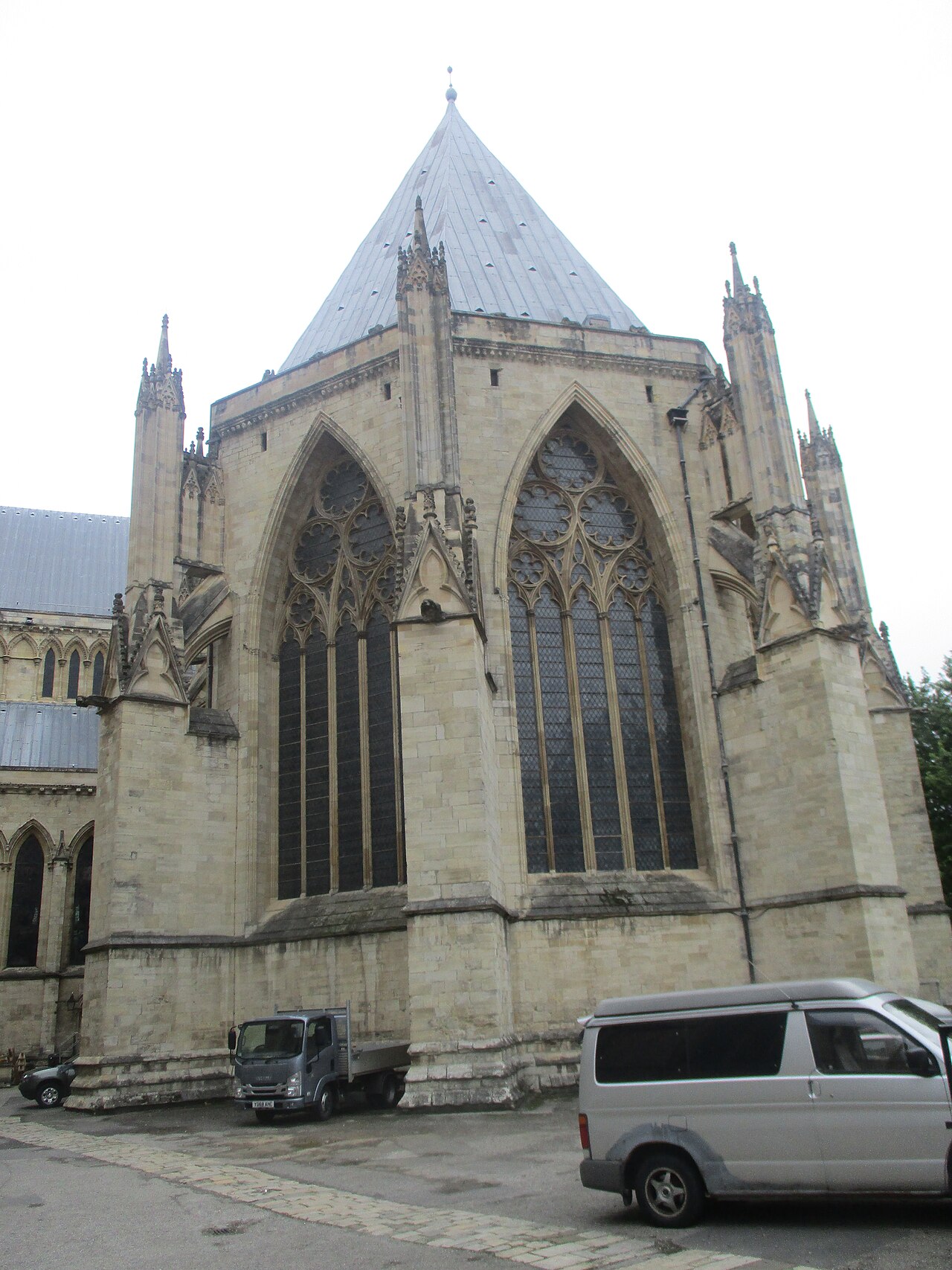
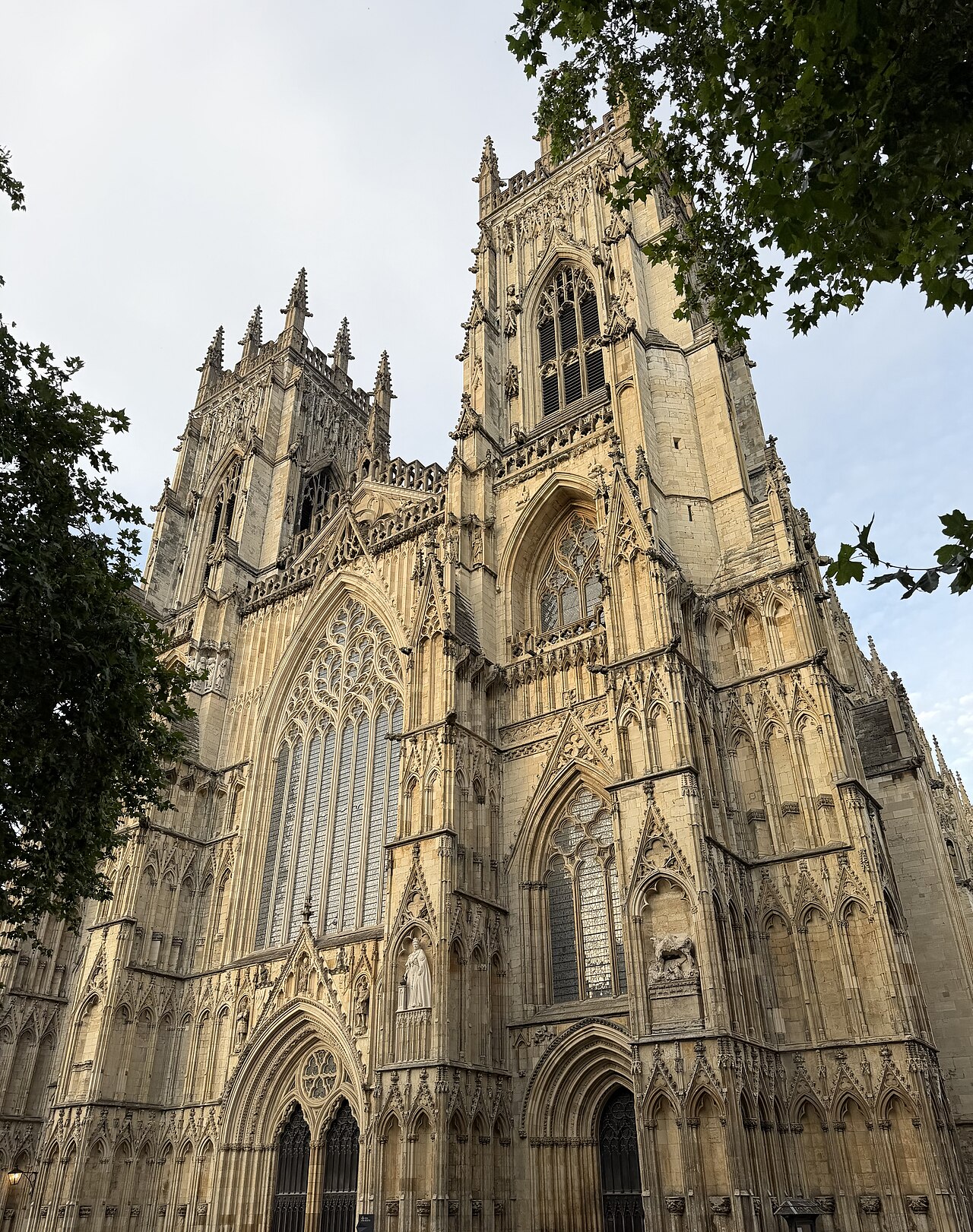
A church first appears in records on this spot in 627. The term "minster" goes back to the Anglo-Saxon period, originally meaning a missionary teaching church; today it is an honorific title. While the undercroft contains reused material from around 1160, most of the current structure was built between 1220 and 1472. The north and south transepts are Early English Gothic, the nave and chapter house are Decorated Gothic, and the eastern arm and central tower are Perpendicular Gothic.
Much of the medieval stained glass has survived here, which is unusual among European churches. The east window, showing the Last Judgment, is the largest expanse of medieval stained glass anywhere in the world. In the north transept, the Five Sisters window consists of five lancets, each over 53 feet (16.3 m) tall, filled with grisaille glass.
**History**
A bishop of York was called to the Council of Arles in 314, which suggests a Christian community existed in York then, though archaeological evidence for Christianity in Roman York is scarce. The first recorded church was a wooden structure built quickly in 627 to baptise Edwin, King of Northumbria. Where that church—and its successors before 1080—stood is unknown. It was probably inside or next to the old Roman principia (the military headquarters), which the king may have used when in York. Archaeological work shows the principia partly lay under the post-1080 Minster site, but excavations in 1967–73 found no remains of the pre-1080 churches. So Edwin’s church and its immediate successors were likely near the current Minster (possibly to the north, under today’s Dean’s Park) rather than directly on the same spot.
Plans for a more substantial building began soon after Edwin’s baptism. According to Bede, Edwin started building a larger stone church meant to surround the original wooden chapel where he was baptised. Oswald completed this stone structure in 637 and dedicated it to Saint Peter. By 670, when Saint Wilfrid became archbishop of York, the church had fallen into disrepair. He repaired and renewed it, adding lead roofs, glass windows, and rich furnishings. The attached school and library were established and, by the 8th century, ranked among the most important in Northern Europe.
A fire in 741 may have damaged or destroyed the cathedral, but any harm was short-lived. Alcuin, who does not mention the fire or rebuilding, wrote at length about the building’s wealth and grandeur. Yet the Annals of Yorkshire say that in 741, “Archbishop Egbert, assisted by Albert, a learned native, took it entirely down after the fire” and that Eanbald and Alcuin helped rebuild it “in the most magnificent style.” Albert succeeded Egbert and added many books to Egbert’s library, especially those he had gathered abroad as a youth; he died in 781, ten days after the new cathedral was consecrated. During his time, a grand altar covered with precious metals and jewels was erected over the site of Edwin’s baptism. A spectacular chandelier hung above the altar, and the cathedral possessed a rich silver cross and a golden cruet. The cathedral, along with the rest of the city, then passed through the hands of many invaders, and its history is unclear until the 10th century. Archbishop Wulstan (who died in 955, according to the annals) was temporarily imprisoned by King Edred for supporting Anlaff (and/or Eric). A series of Benedictine archbishops followed, including Saint Oswald of Worcester, Wulfstan, and Ealdred, who travelled to Westminster to crown William the Conqueror in 1066. Ealdred died in 1069 and was buried in the cathedral.
In January 1069, a rebellion backing Edgar Ætheling led to a brutal crackdown by William. The Anglo-Saxon Chronicle reports that William’s forces “ravaged the town, and made St Peter’s Minster a disgrace.” Later that year, Danish invaders supporting the Ætheling sailed up the Humber and Ouse; they attacked the city, starting a fire that burned the cathedral. Whatever remained of the cathedral may then have been further damaged by William’s Harrying of the North. The first Norman archbishop, Thomas of Bayeux, arrived in 1070 and apparently organised repairs, but in 1075 another Danish force sailed up the river, “travelled to York and broke into St Peter’s Minster, and there took much property, and so went away.” Building of a new Norman cathedral began in 1080 and was finished before Thomas’s death in 1100. This new cathedral was likely built immediately south of the old Saxon one, which was probably demolished once the new structure was complete—a similar approach was taken at Winchester around the same time. Built in the Norman style, the new cathedral was 364.173 ft (111 m) long and decorated with white and red lines. Fire damaged it in 1137, but it was soon repaired. The choir and crypt were remodelled in 1154, and a new chapel was added, all in the Norman style.
The Gothic style for cathedrals arrived in the mid-12th century. Walter de Gray became archbishop in 1215 and ordered the construction of a Gothic building to rival Canterbury; work started in 1220. The north and south transepts were the first new parts, completed in the 1250s, both built in the Early English style.
- location
- York, North Yorkshire, England
- denomination
- Anglican
- architectural_style
- Early English Gothic, Decorated Gothic, Perpendicular Gothic
- notable_feature
- Largest expanse of medieval stained glass in the world (east window)
- status
- Grade I listed building and scheduled monument
Lore & Background
The attached school and library became among the most substantial in Northern Europe by the 8th century. The cathedral passed through numerous invaders, and its history is obscure until the 10th century.
Reader's Guide
York Minster is a central monument of English ecclesiastical history, representing over eight centuries of continuous architectural development. Its construction spanned the Early English, Decorated, and Perpendicular Gothic styles, making it a textbook of medieval building techniques. The minster survived the English Reformation, which led to looting and destruction of tombs, windows, and altars, and the English Civil War, during which Thomas Fairfax prevented further damage. Excavations during that work uncovered remains of the Roman Principia under the south transept. The minster remains an active place of worship, a major tourist attraction, and a symbol of York's heritage.
Did You Know?
- The east window, depicting the Last Judgment, is the largest expanse of medieval stained glass in the world.
- The north transept contains the Five Sisters window, consisting of five lancets each over 53 feet high filled with grisaille glass.
Origins and the Early Christian Community
The story of York Minster begins far before the Gothic spires that define its silhouette today. Its exact location is lost to history, though it likely stood near the old Roman military headquarters, possibly beneath what is now Dean's Park. He also established an attached school and library that, by the eighth century, ranked among the most substantial in Northern Europe.
A Palimpsest of Gothic Styles
The cathedral that rose between the twelfth and fifteenth centuries is a layered record of shifting architectural fashion. The north and south transepts, finished in the 1250s, showcase Early English Gothic but differ noticeably in their wall elevations. A substantial central tower with a wooden spire followed. Construction then shifted to the eastern arm and its chapels, where the Norman choir was demolished to make way for Perpendicular Gothic design.
Stained Glass as a Living Heritage
Few European cathedrals can claim the extraordinary survival of medieval stained glass that York Minster retains. Its east window, depicting the Last Judgment, stands as the largest single expanse of medieval stained glass anywhere in the world, a breathtaking testament to the skill of medieval glaziers and the care of successive generations who preserved it. In the north transept, the Five Sisters window commands attention through sheer scale and restraint: five lancets, each rising over 53 feet, are filled entirely with grisaille glass—pale, uncoloured panels that allow natural light to flood the space in a cool, silvery glow. The contrast between the narrative richness of the east window and the austere luminosity of the Five Sisters illustrates the range of medieval glassmaking artistry housed within these walls. That so much original medieval glass remains intact in a building that has endured fires, invasions, and centuries of use makes York Minster a singular survivor in the broader landscape of European ecclesiastical art.
Institutional Authority and Protected Status
Formally known as the Cathedral and Metropolitical Church of St Peter, York Minster occupies a place of singular importance within the Church of England. It serves as the seat of the Archbishop of York, the second-highest office in the national church, and functions as the mother church for both the diocese of York and the wider province of York. Day-to-day governance rests with its dean and chapter, a structure that has maintained continuity through centuries of political and religious upheaval. The very word 'minster' in its name is a relic of the Anglo-Saxon period, when it originally described a missionary teaching church; today it survives purely as an honorific. The building's significance is formally recognised through its designation as a Grade I listed building and a scheduled monument, the highest levels of statutory protection available in England. These designations underscore that the minster is not merely a functioning place of worship but a national heritage asset of the first order.
Common Misconceptions (Editorial)
Some believe York Minster is a Catholic cathedral, but it is an Anglican cathedral and the seat of the Church of England’s archbishop of York. Others assume its stained glass is largely modern or reconstructed, but the minster retains most of its medieval stained glass, including the world’s largest expanse of it in the east window.
Why It Matters (Editorial)
York Minster matters not only as a living center of Anglican worship and authority, but as a rare architectural and artistic record of medieval craftsmanship that survived centuries of political upheaval. Its vast expanse of original stained glass offers an irreplaceable window—literally—into the beliefs, aesthetics, and technical skill of the Middle Ages, making it a monument of enduring cultural and historical significance.
Gallery
Frequently Asked Questions
What is York Minster?
York Minster is the Anglican cathedral in York, North Yorkshire, formally called the Cathedral and Metropolitical Church of St Peter. It is a Grade I listed building and scheduled monument, representing one of England's most significant medieval structures.
What role does York Minster play in the Church of England?
It serves as the seat of the Archbishop of York, the second-highest ecclesiastical office in the Church of England. The cathedral also functions as the mother church for both the diocese and the broader province of York.
What is York Minster's most famous feature?
The cathedral holds the largest surviving expanse of medieval stained glass in the world, centred on its great east window. This collection has remained largely intact, a rare survival among European churches.
Why is York Minster considered important?
Beyond its three-century span of Gothic architecture, it anchors the spiritual and administrative life of the northern half of the Church of England. Its medieval stained glass and unbroken worship lineage back to the 7th century make it a unique cultural and religious landmark.
More in Great Cathedrals 1-20
Spotted an error? Know more?
This is a living reference — every entry is fact-audited, and reader corrections feed straight into our audit queue. Suggest an edit · See this site's audit record