Hwaseong Fortress
Last updated
Where it is
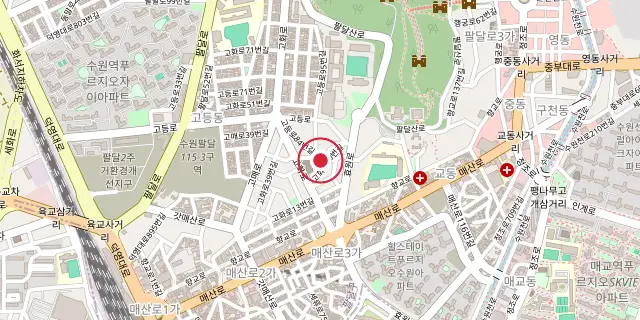
Coordinates: 37°16′19″N 127°00′29″E (37.2720, 127.0080) · Open in OpenStreetMap
Coordinates and connected clubs: the infobox of Wikipedia: Hwaseong Fortress (CC BY-SA 4.0). Map: drawn by Codexery from OpenStreetMap tiles.
Hwaseong Fortress is a fortified wall surrounding the center of Suwon, South Korea, built to honor Prince Sado, the father of King Jeongjo.[1][2] The fortress wall is 5.74 kilometers long and 4-6 meters high.[1]
Geography and history
The architect Chŏng Yagyong designed the fortress and later became a renowned leader of the Silhak movement.[3] There were 48 structures along the wall, including gates, turrets, and floodgates.[3] Paldalmun, the South Gate, sits in a roundabout on a busy road and houses a bell cast in 1080.[4] King Jeongjo of Joseon ordered the construction of Hwaseong Fortress between 1794 and 1796, with the purpose of housing and honoring the remains of his biological father, Crown Prince Sado.[2]
The Silhak movement, whose name translates to "practical learning," promoted the application of science and industry, and its principles were incorporated into the fortress design by architect Chŏng Yagyong.[3] The original Namsumun floodgate was destroyed by a major flood in 1846, and after being restored, it was washed away again by a flood in 1922.[5]
What the cited sources add
The Seoul Guide states that Hwaseong became a UNESCO World Heritage site in 1997.[1] The same source notes that secret gates were used for people, animals, and war munitions.[1] There are ten chi structures projecting from the wall, used to survey and attack enemies.[1] Five gate turrets, all built of brick, protrude beyond the fortress walls to thwart advancing enemies.[1]
Five sentry posts, also of brick, are positioned on protruding turrets.[1] One of two floodgates, Buksumun, allows the Suwoncheon stream to flow through the fortress.[1]
References
- "Hwaseong Fortress", The Seoul Guide. theseoulguide.com
- Wikipedia, "Hwaseong Fortress" (CC BY-SA 4.0), which cites: "Hwaseong Fortress (Summary)", Cultural Heritage Administration (original not read by us) en.wikipedia.org
- Wikipedia, "Hwaseong Fortress" (CC BY-SA 4.0) en.wikipedia.org
- Wikipedia, "Hwaseong Fortress" (CC BY-SA 4.0), which cites: "Paldalmundongjong", South Korean Government Cultural Properties Administration (original not read by us) en.wikipedia.org
- Wikipedia, "Hwaseong Fortress" (CC BY-SA 4.0), which cites: "Realization of Ecological Suwon Stream", Human City Suwon, Notice and News, 2011-06-28; "Floodgate of Hwaseong Fortress Restored", KBS World (English), 2012-06-09 (original not read by us) en.wikipedia.org
Each numbered sentence above was checked against the source it cites before publication. Sentences citing Wikipedia adapt text from the English Wikipedia article Hwaseong Fortress (contributors), used under CC BY-SA 4.0; this entry is available under the same licence. Other sources were used for facts only.
More in Castles in South Korea
Sources
Compiled from Wikipedia and the sources listed below. Text from Wikipedia is available under CC BY-SA 4.0; this entry is adapted from it.
- Wikipedia: Hwaseong Fortress (CC BY-SA 4.0).
Spotted an error? Know more?
Reader corrections go straight into our review queue. Suggest an edit · How this site is sourced