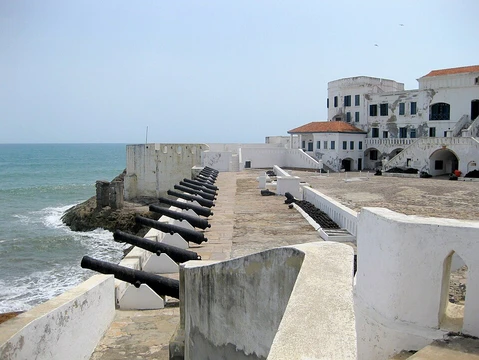
Cape Coast Castle
A former slave castle on Ghana's coast, now a UNESCO site.
European traders constructed approximately forty "slave castles" along the Gold Coast of West Africa, and Cape Coast Castle is counted among them.[1] This fortification sits within Ghana's Central Region.[1] Because it bears witness to the Atlantic gold and slave trades, the castle appears on the UNESCO World Heritage List.[2]
Quick Facts
- Location
- Central Region
- Part of
- Forts and Castles
- Volta
- Greater Accra
- Central and Western Regions
Facts from the source article.
Geography and history
The site was originally a Portuguese trading post named Cabo Corso, established in 1555.[1] After the Dutch captured the former English headquarters at Kormantsin, Cape Coast became the new capital of English possessions on the Gold Coast.[3] In 1757, a French naval squadron badly damaged the castle, leading to a major reconstruction that demolished most of the 17th-century fort.[4] After Britain outlawed the slave trade in 1807, the castle became the administrative center for the British Gold Coast colony.[5]
Upon Ghana's independence in 1957, the Ghana Museums and Monuments Board assumed responsibility for the castle.[6]
What the cited sources add
The Cape Coast Castle Museum account states that the origins date to 1653, when the Swedish Africa Company built a timber fortification named Carolusborg.[7] By April 1663, the entire Swedish Gold Coast, including Carolusborg, was seized by the Danish and incorporated into the Danish Gold Coast.[7] The museum notes that by 1844 the site officially became the seat of colonial government for the British Gold Coast.[7] The Slavery and Remembrance account explains that large permanent trading factories like Cape Coast Castle gave European traders competitive advantages in the marketplace.[8]
That same source states that when the castle's commerce became dependent on supplying slave cargoes, dungeons were added to hold larger numbers of captives.[8] The Explorers Almanac account reports that the castle also played a role in the introduction of Christianity and the establishment of the first formal education system through the Castle Schools.[5] The Zamani Project documented Cape Coast Castle with terrestrial 3D laser scanning in 2015, creating a permanent record for research and conservation.[9][10]
References
- Wikipedia, "Cape Coast Castle" (CC BY-SA 4.0), which cites: "Cape Coast Castle Photo, Located, History, Dungeons, & Facts Britannica", www.britannica.com (original not read by us) en.wikipedia.org
- Wikipedia, "Cape Coast Castle" (CC BY-SA 4.0), which cites: "Ghana's Slave Castles: The Shocking Story of the Ghanaian Cape Coast", theculturetrip.com; "Forts and Castles, Volta, Greater Accra, Central and Western Regions", UNESCO World Heritage Convention (original not read by us) en.wikipedia.org
- Wikipedia, "Cape Coast Castle" (CC BY-SA 4.0), which cites: Van Dantzig 1999, p. 23–24 (original not read by us) en.wikipedia.org
- Wikipedia, "Cape Coast Castle" (CC BY-SA 4.0), which cites: Van Dantzig 1999, p. 23–24; Van Dantzig 1999, p. 23–24 (original not read by us) en.wikipedia.org
- "Cape Coast Castle - A Haunting Journey Through Ghana's Slave Trade History - Explore the World with Explorers Almanac", 2024-07-27. facts only, no text reused. explorersalmanac.com
- Wikipedia, "Cape Coast Castle" (CC BY-SA 4.0), which cites: "cape coast castle restoration", Daily Graphic (original not read by us) en.wikipedia.org
- "cape coast castle building history", cape coast castle museum. facts only, no text reused. capecoastcastlemuseum.com
- "cape coast castel cultural reference", slavery and remembrance. facts only, no text reused. slaveryandremembrance.org
- Wikipedia, "Cape Coast Castle" (CC BY-SA 4.0), which cites: "Site – Cape Coast Castle", zamaniproject.org; Chris Giles, "Meet the scientists immortalizing African heritage in virtual reality", CNN (original not read by us) en.wikipedia.org
- Wikipedia, "Cape Coast Castle" (CC BY-SA 4.0), which cites: Rüther, "An African heritage database, the virtual preservation of Africa's past", www.isprs.org; Rajan, "Building a Digital Library of Scholarly Resources from the Developing World: An Introduction to Aluka", African Arts, 2007-05-30, p. 1–7; Rüther, "Documenting African Sites: The Aluka Project", Journal of the Society of Architectural Historians, December 2007, p. 437–443 (original not read by us) en.wikipedia.org
Each numbered sentence above was checked against the source it cites before publication. Sentences citing Wikipedia adapt text from the English Wikipedia article Cape Coast Castle (contributors), used under CC BY-SA 4.0; this entry is available under the same licence. Other sources were used for facts only; no text or images are copied from them.
More in Castles in Ghana
Spotted an error? Know more?
Reader corrections go straight into our review queue. Suggest an edit · How this site is sourced