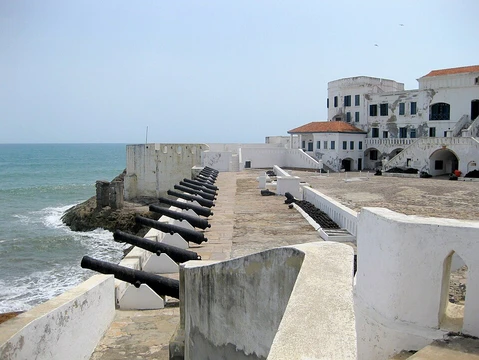
Fort Batenstein
Dutch fort on the Gold Coast, site of the Treaty of Butre.
The Dutch built Fort Batenstein near Butre in 1656 as a trading post on the Gold Coast. The Treaty of Butre was signed there with the Ahanta that same year. Britain took over the fort in 1872 when it acquired the entire Dutch Gold Coast. In 1979, UNESCO listed it as a World Heritage Site alongside other Ghanaian forts for its role in European trade and exploitation.
Quick Facts
- Part of
- Dutch Gold Coast
- Built
- 1656
- Occupants
- Netherlands (1656–1872)
- United Kingdom (1875–1957)
- Ghana (1957–Present)
Facts from the source article.
Name
The name Batenstein literally translates to "profit fort." Historian Albert van Dantzig saw this as evidence of a cynical sense of humour among the directors of the Dutch West India Company, noting that the fort at Komenda, site of the fierce Komenda Wars, was named Vredenburgh ("peace borough"), the commercially unsuccessful fort at Senya Beraku was named Goede Hoop ("Good Hope"), and the fort at Apam, which took five years to build due to local resistance, was named Lijdzaamheid ("Patience").
History
The Dutch West India Company built Fort Batenstein not for trade, but to stop the Swedish Africa Company from setting up posts on the Gold Coast. A former Dutch employee, Hendrik Carloff, had started a trading lodge at Butre in 1650. In 1652, the people of Encasser attacked it at the Dutch’s urging. To keep the Swedes out for good, the Dutch constructed a fort on the hill above Butre bay, finishing it by 1656.
At that time, they made a treaty with the locals, where the people of Upper Ahanta and Butre placed themselves under Dutch West India Company rule. This treaty’s wording was very different from the earlier Treaty of Axim, which had described the relationship as one of shared duties and legal authority. In the 1700s, a sawmill was built at the fort, supplying wood for repairing other forts and ships. For many years, the fort was not very significant.
That changed in 1837, when the Dutch–Ahanta War made it the center of Dutch military operations on the coast. After the war, the Dutch turned Ahanta into a protectorate, and the fort’s commander became the vice governor, using the 1656 Treaty of Butre as justification. Later, the Dutch tried to start a gold mine near Butre, but it never yielded any gold. When the Dutch sold their Gold Coast holdings to Britain in 1872, the people of Butre objected.
In 1873, they protested in the streets, waving Dutch flags and firing guns. That October, the British shelled Butre in response to an attack on Dixcove, which had always been a British trading post.
More in Castles in Ghana
Spotted an error? Know more?
Reader corrections go straight into our review queue. Suggest an edit · How this site is sourced