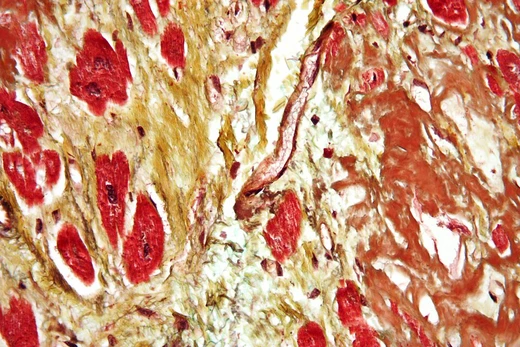
Cardiovascular disease
Cardiovascular disease is the top global killer, largely preventable.
Last updated
CVDs include coronary artery diseases, heart failure, hypertensive heart disease, and many other conditions.[1] Disorders of the heart or blood vessels are collectively termed cardiovascular disease (CVD).[1]
Key facts and history
Age is the most important risk factor, with approximately a tripling of risk with each decade of life.[2] Prevention of up to 90% of CVD cases is considered possible.[3] Roughly 13% of deaths from CVD are attributed to high blood pressure.[4] 53% of CVD deaths are linked to dietary risk factors.[5]
Men have approximately a 50% higher likelihood of developing CVD than women when comparing individuals of the same age.[6] In nations with high incomes, the typical age for a first CVD diagnosis is about 70 years.[6]
What the research sources say
In Denmark, after mandating restrictions on industrially-produced trans fats, cardiovascular disease deaths declined more quickly than in comparable OECD countries.[7] A 2015 SBU-report found an association between mentally stressful work with a lack of control and cardiovascular disease.[8] People with generalized anxiety disorder seem to suffer higher rates of heart attack and other cardiac events.[9] According to the World Health Organization, over 500,000 cardiovascular disease deaths occur annually due to trans fat consumption.[7]
The SBU report indicates a connection between heart disease and occupational contact with silica dust, engine exhaust, or welding fumes.[10] Individuals with anxiety tend to have reduced omega-3 fatty acid levels, a condition potentially associated with an elevated risk for heart disease.[9]
References
- Wikipedia, "Cardiovascular disease" (CC BY-SA 4.0), which cites: "Global Atlas on Cardiovascular Disease Prevention and Control", World Health Organization in collaboration with the World Heart Federation and the World Stroke Organization, 2011, p. 3–18; "Global Atlas on Cardiovascular Disease Prevention and Control", World Health Organization in collaboration with the World Heart Federation and the World Stroke Organization, 2011, p. 3–18; "Global, regional, and national age-sex specific all-cause and cause-specific mortality for 240 causes of death, 1990-2013: a systematic analysis for the G en.wikipedia.org
- Wikipedia, "Cardiovascular disease" (CC BY-SA 4.0), which cites: "Mortality from ischaemic heart disease by country, region, and age: statistics from the World Health Organization and the United Nations", International Journal of Cardiology, September 2013, p. 934–45; "Atherogenic dyslipidemia and cardiovascular risk factors in obese children", International Journal of Endocrinology, 2015; "American Heart Association To be a relentless force for a world of longer, healthier lives", www.heart.org; Mackay, "The Atlas of Heart Disease and Stroke", World Health Organization and U. S. Centers for D en.wikipedia.org
- Wikipedia, "Cardiovascular disease" (CC BY-SA 4.0), which cites: "Preventing heart disease in the 21st century: implications of the Pathobiological Determinants of Atherosclerosis in Youth (PDAY) study", Circulation, March 2008, p. 1216–27; "Global and regional effects of potentially modifiable risk factors associated with acute stroke in 32 countries (INTERSTROKE): a case-control study", Lancet, August 2016, p. 761–75; "Global Atlas on Cardiovascular Disease Prevention and Control", World Health Organization in collaboration with the World Heart Federation and the World Stroke Organization, 2 en.wikipedia.org
- Wikipedia, "Cardiovascular disease" (CC BY-SA 4.0), which cites: "Global Atlas on Cardiovascular Disease Prevention and Control", World Health Organization in collaboration with the World Heart Federation and the World Stroke Organization, 2011, p. 3–18; "Global Atlas on Cardiovascular Disease Prevention and Control", World Health Organization in collaboration with the World Heart Federation and the World Stroke Organization, 2011, p. 3–18 (we also read that source) en.wikipedia.org
- Wikipedia, "Cardiovascular disease" (CC BY-SA 4.0), which cites: "Global Atlas on Cardiovascular Disease Prevention and Control", World Health Organization in collaboration with the World Heart Federation and the World Stroke Organization, 2011, p. 3–18; Petersen, "Diet quality assessment and the relationship between diet quality and cardiovascular disease risk", Nutrients, 2021-11-28, p. 4305; "Global Atlas on Cardiovascular Disease Prevention and Control", World Health Organization in collaboration with the World Heart Federation and the World Stroke Organization, 2011, p. 3–18; "Global Atla en.wikipedia.org
- Wikipedia, "Cardiovascular disease" (CC BY-SA 4.0), which cites: Conrad, "Trends in cardiovascular disease incidence among 22 million people in the UK over 20 years: population based study", BMJ, 26 June 2024; Institute of Medicine of the National Academies, "Promoting cardiovascular health in the developing world: a critical challenge to achieve global health", National Academies Press, 2010; Conrad, "Trends in cardiovascular disease incidence among 22 million people in the UK over 20 years: population based study", BMJ, 26 June 2024; "Global Atlas on Cardiovascular Disease Prevention and Con en.wikipedia.org
- "WHO plan to eliminate industrially-produced trans-fatty acids from global food supply", World Health Organization, 14 May 2018. facts only, no text reused. who.int
- Wikipedia, "Cardiovascular disease" (CC BY-SA 4.0), which cites: Swedish Agency for Health Technology Assessment and Assessment of Social Services (SBU), "Occupational Exposures and Cardiovascular Disease", www.sbu.se, 2015-08-26; Swedish Agency for Health Technology Assessment and Assessment of Social Services (SBU), "Occupational Exposures and Cardiovascular Disease", www.sbu.se, 2015-08-26; Swedish Agency for Health Technology Assessment and Assessment of Social Services (SBU), "Occupational Exposures and Cardiovascular Disease", www.sbu.se, 2015-08-26; Swedish Agency for Health Technology en.wikipedia.org
- "Calm your anxious heart", Harvard Health, 2015-06-11. facts only, no text reused. health.harvard.edu
- Wikipedia, "Cardiovascular disease" (CC BY-SA 4.0), which cites: Swedish Agency for Health Technology Assessment and Assessment of Social Services (SBU), "Occupational health and safety – chemical exposure", www.sbu.se; Taylor, "A new study says the global toll of lead exposure is even worse than we thought", NPR, November 20, 2023; Swedish Agency for Health Technology Assessment and Assessment of Social Services (SBU), "Occupational health and safety – chemical exposure", www.sbu.se; Swedish Agency for Health Technology Assessment and Assessment of Social Services (SBU), "Occupational health en.wikipedia.org
Each numbered sentence above was checked against the source it cites before publication. Sentences citing Wikipedia adapt text from the English Wikipedia article Cardiovascular disease (contributors), used under CC BY-SA 4.0; this entry is available under the same licence. Other sources were used for facts only; no text or images are copied from them.
More in Cardiovascular & Blood
Sources
Compiled from Wikipedia and the sources listed below. Text from Wikipedia is available under CC BY-SA 4.0; this entry is adapted from it.
- Wikipedia: Cardiovascular disease (CC BY-SA 4.0).
- Word definitions: the , each quoted from its Wikipedia article.
Spotted an error? Know more?
Reader corrections go straight into our review queue. Suggest an edit · How this site is sourced