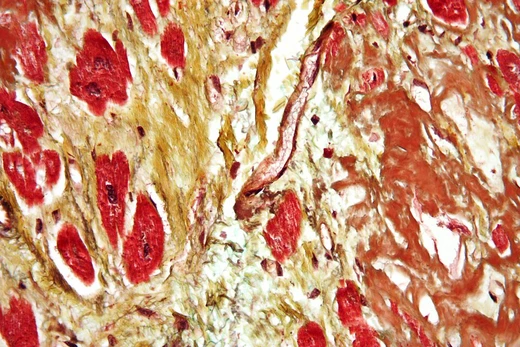
Arteriosclerosis
Hardening of the arteries, a set of vascular disorders.
Last updated
The disease process gradually restricts blood flow to body organs and tissues.[1] Atherosclerosis, caused by fatty plaque buildup, is a common type of arteriosclerosis.[2] The term "arteriosclerosis" serves as a broad category for vascular conditions where artery walls undergo abnormal thickening, hardening, and elasticity loss.[1]
Key facts and history
The term "arteriosclerosis" was coined by Jean Lobstein while he analyzed calcified arterial lesions.[3] The name derives from Greek words meaning "artery" and "hardened"[3] The lesions of arteriosclerosis begin when the intima of an artery fills with deposition of cellular wastes.[4] Only in the 20th century did physicians begin to understand how to diagnose this condition and recognize its clinical consequences.[3]
A person's likelihood of developing arteriosclerosis is increased by a family history of the disease, by smoking, and by being obese.[5] According to genetic-epidemiologic research, a family history of coronary artery disease represents the strongest independent risk factor for that condition.[6] Stiffening of the arterial vessels and thickening of the arterial walls are characteristics shared by all forms of the disease.[4]
What the research sources say
The MedlinePlus account clarifies that arteriosclerosis is hardening of the arteries, meaning arteries thicken and become less flexible.[2] The same source notes that atherosclerosis, which develops from plaque buildup, is a common type of arteriosclerosis.[2]
References
- Wikipedia, "Arteriosclerosis" (CC BY-SA 4.0), which cites: Yokobori, "Correlation between the characteristics of acceleration and visco elasticity of artery wall under pulsatile flow conditions (physical meaning of I * as a parameter of progressive behaviors of atherosclerosis a; (original not read by us) en.wikipedia.org
- "Atherosclerosis", MedlinePlus. facts only, no text reused. medlineplus.gov
- Wikipedia, "Arteriosclerosis" (CC BY-SA 4.0), which cites: Mayerl, "Atherosclerosis research from past to present—on the track of two pathologists with opposing views, Carl von Rokitansky and Rudolf Virchow", Virchows Archiv, 2006, p. 96–103; Copstead-Kirkhorn, "Pathophysiology", Elsevier Health Sciences, 2014-06-25, p. 322 (original not read by us) en.wikipedia.org
- Wikipedia, "Arteriosclerosis" (CC BY-SA 4.0), which cites: Rubin, "Rubin's Pathology: Clinicopathologic Foundations of Medicine", Lippincott Williams & Wilkins, 2011-02-01; Insull, "The Pathology of Atherosclerosis: Plaque Development and Plaque Responses to Medical Treatment", The American Journal of Medicine, 2009, p. S3–S14; Diehm, "Color Atlas of Vascular Diseases", Springer Science & Business Media, 2013-11-11 (we also read that source) en.wikipedia.org
- Wikipedia, "Arteriosclerosis" (CC BY-SA 4.0), which cites: "Arteriosclerosis - Symptoms and Causes", Penn Medicine (original not read by us) en.wikipedia.org
- Wikipedia, "Arteriosclerosis" (CC BY-SA 4.0), which cites: Bachmann, "Association Between Family History and Coronary Heart Disease Death Across Long-Term Follow-Up in Men", Circulation, 2012-06-26, p. 3092–3098 (original not read by us) en.wikipedia.org
Each numbered sentence above was checked against the source it cites before publication. Sentences citing Wikipedia adapt text from the English Wikipedia article Arteriosclerosis (contributors), used under CC BY-SA 4.0; this entry is available under the same licence. Other sources were used for facts only; no text or images are copied from them.
More in Cardiovascular & Blood
Sources
Compiled from Wikipedia and the sources listed below. Text from Wikipedia is available under CC BY-SA 4.0; this entry is adapted from it.
- Wikipedia: Arteriosclerosis (CC BY-SA 4.0).
- Word definitions: the , each quoted from its Wikipedia article.
Spotted an error? Know more?
Reader corrections go straight into our review queue. Suggest an edit · How this site is sourced