Skat (card game)
Three-player trick-taking game, national card game of Germany.
Last updated

Achim Raschka · CC BY-SA 4.0
Skat, historically called Scat, is a three-player trick-taking card game from the ace–ten family. It was devised around 1810 in Altenburg, then part of the Duchy of Saxe-Gotha-Altenburg.
Germany’s national game, it is also the most popular card game in Germany and Silesia, and one of the most popular in the rest of Poland, alongside Doppelkopf. A 19th-century variant was once common in the United States. John McLeod calls it one of the best and most interesting three-player card games, while Kelbet dubbed it “the king of German card games.” The German Skat Association estimates that about 25 million Germans play it—more than play football.
The game was developed by members of a local Tarock club, the Brommesche Tarok-Gesellschaft, around 1810–1813 in Altenburg, now in Thuringia, Germany. It draws on the three-player Tarot game Grosstarock and the four-player game Schafkopf (a forerunner of American Sheepshead).
In the earliest known form, the first player received twelve cards, the other two ten each. That player then discarded two cards to form the Skat and announced a contract. The key innovation was the bidding process.
The earliest recorded rules for “Scat” date to 1835, by which time it was already popular in the Kingdom of Saxony, especially in Altenburg and its surroundings. These rules describe a three-player game using German-suited cards. Each player received ten cards in packets of three, two, three, and two, with the remaining two cards dealt to the table as a talon called the Scat. Only two contracts existed—Frage and Solo—and forehand opened the bidding or passed.
A Frage bid could be overcalled by a Solo, and either could be overcalled by the same contract in a higher-ranking suit, with suits ranking as in the modern game. The declarer needed 61 card points to win. Bonuses existed for scoring 90 (Schneider), taking all tricks (Schwarz), and optionally for holding or lacking matadors in an unbroken sequence from the top. The four Unters were permanent trumps, ranking above the trump suit.
The first rulebook, Das Scatspiel: Nebst zwei Liedern, was published in 1848 by one of the game’s inventors, secondary school teacher J. F. L. Hempel. Rules still varied by region until a congress of Skat players met on 7 August 1886 in Altenburg to standardize them. These first official rules were published in book form in 1888 by Theodor Thomas of Leipzig. The current rules, followed by the International Skat Players Association, the German Skat Federation, and the British Skat Association, date from 1 January 1999.
The word Skat comes from a Tarock term derived from the Latin scarto, scartare, meaning to discard or reject, and its derivative scatola, a box or place for safe-keeping. The word scarto is still used in some Italian card games today. Skat is completely unrelated to the American game called Scat.
Distribution
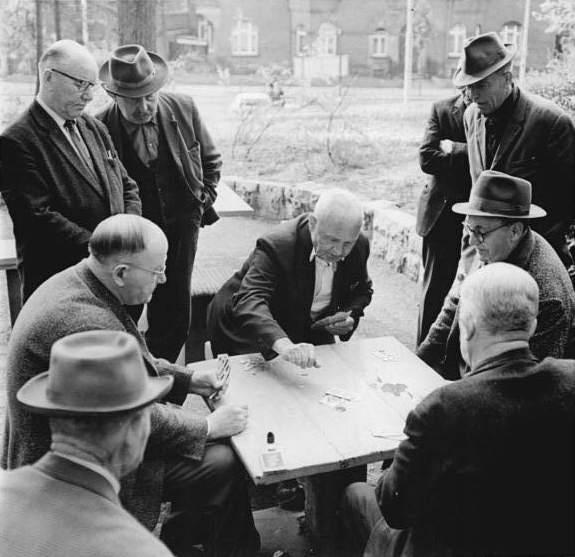
Skat is especially popular in Germany. Tournament Skat is regularly held in restaurants.
Unlike most card games, Skat is organized as a sport, with associations, clubs, ranking lists, and even a national league. Most German Skat clubs belong to the German Skat Association (DSkV), which runs championships. The global International Skat Players Association organizes the World and European Championships, while its German subdivision, ISPA Germany, like the DSkV, runs its own German individual and team championships and leagues.
Skat is played on a smaller scale in countries bordering Germany, including the Netherlands, Denmark (especially southern Jutland), Poland, and Austria. ISPA member countries include Argentina, Australia, Austria, Belgium, Brazil, Canada, Chile, Denmark, France, Germany, Namibia, Netherlands, Paraguay, Poland, South Africa, Spain, Switzerland, the United Arab Emirates, Uruguay, and the United States.
General principles
The game involves three players: forehand, middlehand, and rearhand (who also deals). At the start of each round, or deal, one player becomes declarer, and the other two form the defending team.
Defenders may not communicate except through their choice of cards. With four players, the dealer sits out that round, and the player to the dealer’s right takes the dealer’s role. Players may agree in advance how many rounds they will play.
A central feature is the three coexisting game types: suit, grand, and null games. These differ in suit order, scoring, and overall goal. Each round begins with a bidding phase to determine the declarer and the required minimum game value. Then ten tricks are played.
Each card has a point value (except in null games), and the player winning a trick collects those points. The total value of all cards is 120 points. The declarer must take at least 61 points in tricks to win the round; otherwise, the defending team wins. Trick points are not added to players’ overall scores directly but only determine the outcome, though winning by certain margins may increase the score.
More in Card & Tabletop Games
Sources
Compiled from Wikipedia and the sources listed below. Text from Wikipedia is available under CC BY-SA 4.0; this entry is adapted from it.
- Wikipedia: Skat (card game) (CC BY-SA 4.0).
Spotted an error? Know more?
Reader corrections go straight into our review queue. Suggest an edit · How this site is sourced