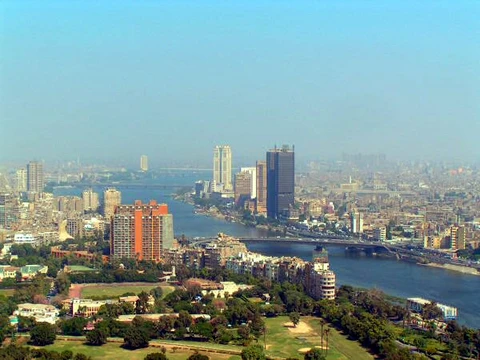
Libreville
Capital and largest city of Gabon, on the Gabon Estuary.
Last updated
Where it is
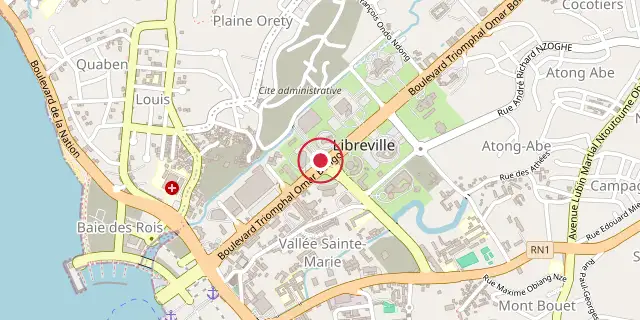
Coordinates: 0°24′29″N 9°26′24″E (0.4080, 9.4400) · Open in OpenStreetMap
Coordinates and connected clubs: the infobox of Wikipedia: Libreville (CC BY-SA 4.0). Map: drawn by Codexery from OpenStreetMap tiles.
Libreville is the capital and largest city of Gabon, located on the Gabon Estuary in the northwestern province of Estuaire. As of the 2013 census, its population was 703,904, and it now houses one-third of the national population. The city serves as a major port near the Gulf of Guinea.
History
The Mpongwé people inhabited the area before colonization. In 1839, French admiral Édouard Bouët-Willaumez negotiated a trade and protection treaty with the local Mpongwé ruler Antchoué Komé Rapontcombo, known as King Denis. American missionaries from New England established a mission at Baraka in 1842. In 1846, the Brazilian slave ship L'Elizia, carrying slaves from the Congo, was captured near Loango by the French navy.
Fifty-two freed slaves were resettled on the site in 1849, and the settlement was named Libreville, French for "Freetown." Following the French Revolution of 1848, the former slaves elected a former slave named Mountier as mayor in 1849. Libreville served as the administrative capital of France's Congo-Gabon colony from 1888 to 1904, when the capital moved to Brazzaville. In 1910, Gabon became part of French Equatorial Africa.
Construction of the Congo–Ocean Railway began in 1921, and Libreville was surpassed by the growth of Pointe-Noire. The city received its first bank branch in 1930 when Banque de l'Afrique Occidentale opened.
In 1940, Libreville was the focus of the Battle of Gabon as Free French forces, supported by the Royal Navy, consolidated control. Léon M'ba won Libreville's first free mayoral election in 1956 and later became Gabon's first president. The population was 32,000 at independence in 1960 but grew rapidly thereafter.
Geography
Major districts from north to south include Batterie IV, Quartier Louis, Mont-Bouët, Nombakélé, Glass, Oloumi, and Lalala. Quartier Louis is known for its nightlife, while Mont-Bouët and Nombakélé are busy commercial areas. Glass was the first European settlement in Gabon. Oloumi is a major industrial area, and Lalala and Batterie IV are residential areas.
The city's port and train station on the Trans-Gabon Railway line to Franceville lie in Owendo, south of the main built-up area. Inland from these districts are poorer residential areas. Libreville is located in northwestern Gabon, north-west of Equatorial Guinea. The Komo River passes through the city and empties into the ocean, and it stands as a potential hydroelectric power source.
The city has a tropical monsoon climate with a lengthy wet season from September through May and a short dry season from June through August, caused by the cold Benguela Current. Average high temperatures remain around 29 °C throughout the year.
Education
Libreville is Gabon's principal center of higher education. It hosts Omar Bongo University, the country's oldest public university, founded in 1970 as the National University of Gabon and renamed in 1978. Other institutions include the University of Health Sciences and the African Institute of Computer Science. The city has a mix of public, private, and international schools, such as the American International School of Libreville, the Lycée Blaise Pascal de Libreville, and the International School of Gabon Ruban Vert.
Economy
Libreville is the principal economic centre of Gabon and one of the most concentrated urban economies in Central Africa. It functions as the seat of government, the primary commercial, financial and administrative hub, and the leading gateway for non-oil imports and exports through the port complex of Owendo. The city concentrates the bulk of Gabon's formal private sector employment, banking assets, service industries and light manufacturing. Its economy rests on public administration, the ports at Owendo, timber processing and export from the Nkok Special Economic Zone, light industry including cement, brewing, food processing, shipbuilding and sawmilling, a retail and informal sector centred on Marché du Mont-Bouët, banking led by BGFIBank, construction and real estate, and the transport hub of Léon-Mba International Airport and the Trans-Gabon Railway.
Libreville is consistently ranked among the most expensive cities in Africa for expatriates. The urban economy is marked by sharp inequality, significant informal employment, a housing deficit estimated at 200,000 units, and structural dependence on oil revenues.
Also in the Codexery
More in Capital Cities Of Africa
Sources
Compiled from Wikipedia and the sources listed below. Text from Wikipedia is available under CC BY-SA 4.0; this entry is adapted from it.
- Wikipedia: Libreville (CC BY-SA 4.0).
- Word definitions: the , each quoted from its Wikipedia article.
Spotted an error? Know more?
Reader corrections go straight into our review queue. Suggest an edit · How this site is sourced