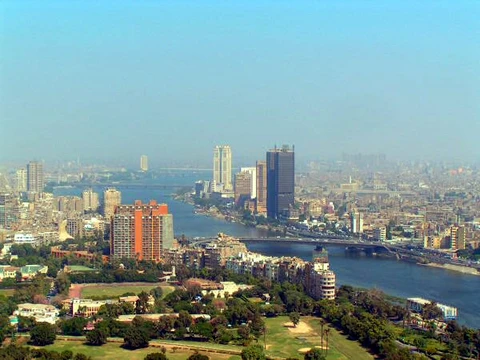
Djibouti City
Capital and largest city of the Republic of Djibouti.
Last updated
Where it is
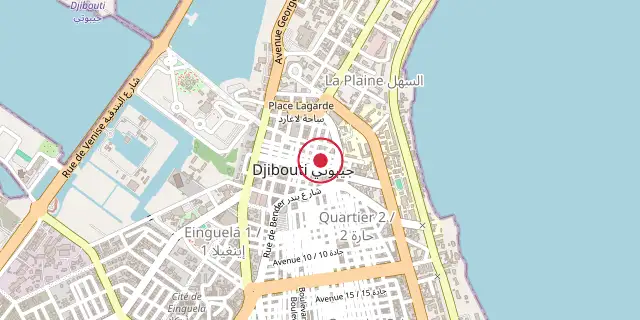
Coordinates: 11°35′38″N 43°08′53″E (11.5940, 43.1480) · Open in OpenStreetMap
Coordinates and connected clubs: the infobox of Wikipedia: Djibouti City (CC BY-SA 4.0). Map: drawn by Codexery from OpenStreetMap tiles.
Djibouti City, also known as Djibouti or Jibuti in early Western texts, is the capital of the Republic of Djibouti. Located on the Gulf of Tadjoura in the coastal Djibouti Region, it was founded in 1888 by the French on land leased from Somali and Afar Sultans. The city served as the capital of French Somaliland and later the French Territory of the Afars and Issas, and today holds about 73% of the country's population.
History
Evidence of human settlement on the eastern coastline of Djibouti dates to the Bronze Age. From 1862 to 1894, the land north of the Gulf of Tadjoura, called Obock, was ruled by Issa and Afar Sultans; France signed treaties with them between 1883 and 1887 to gain a foothold. Franco-British notes of 2 and 9 February 1888 fixed the territorial limit, leaving the southern coasts of the Gulf of Tadjoura under French authority, including the strategic Ras Djibouti peninsula.
The French founded Djibouti in 1888 on a previously uninhabited stretch of coast, chosen for its harbour and proximity to Harar. Ambouli, a small village about 3 km south of Ras Djibouti, has been identified with the city of Canbala on Muhammad al-Idrisi's 1192 map and with Cambaleh, where the Venetian traveler Bragadino resided for eight years. In 1896, the settlement became the capital of French Somaliland.
Demographics
Djibouti is a multi-ethnic town with around 777,000 residents in 2024, including suburbs like Balbala, making it the largest settlement in the country. The largest ethnic group is Somali, followed by Afars, both Cushitic-speaking peoples. The population grew exponentially through waves of immigrants and refugees from Ethiopia and Somalia in 1985 and 1991, and from Yemen in 2015. In 2001, many undocumented immigrants were expelled; in 2023, the government launched a major campaign to combat illegal immigration.
The city was nicknamed the 'French Hong Kong in the Red Sea' for its cosmopolitan urbanism. Most residents speak Somali (303,100) or Afar (101,200) as a first language, both Afroasiatic. Official languages are Arabic and French; about 40,000 speak Ta'izzi-Adeni Arabic, and 14,200 speak French as a first language. Immigrant languages include Omani Arabic (38,900) and Amharic (1,400).
The population is predominantly Muslim (94% as of 2012); the remaining 6% are Christian, with the Diocese of Djibouti serving about 7,000 Catholics in 2006. Places of worship include mosques, Ethiopian Orthodox Tewahedo Church, Roman Catholic Diocese of Djibouti, and Protestant and Evangelical churches.
Economy
Djibouti City's economy is dominated by trade, with most local businesses headquartered in the city. Djibouti Telecom, the largest telecommunications company, is based here, as was Djibouti Airlines during its existence. The city is the financial hub for industries including construction, retail, import/export, money transfer, and Internet cafés. Its main trading ports link Europe, the Far East, the Horn of Africa, and the Persian Gulf, with an estimated 2,500 ships passing through daily.
The Djibouti International Free Trade Zone (DIFTZ) is a special economic zone west of the city. The port is the terminus for Ethiopian oil transport and export, and increased railway infrastructure has enabled Ethiopian and Eritrean oil products to reach the capital. The banking sector, with total assets of 265 billion DJF (10.2% of GDP), has grown dramatically since the early 2000s, driven by exchange agencies and remittances, and was not affected by the international financial crisis.
Tourism centers on city landmarks, historic buildings, two public squares, and the Hall of the People; private companies offer organized tours. Maskali and Moucha islands, an hour by boat, feature madreporic mangroves, rich seabed, and fish such as groupers, jacks, and barracuda.
Transport
Djibouti is a major transportation hub with a comprehensive public transport network. Roads connect the city to other national localities, Somalia, and Ethiopia. Public transportation is provided through buses at the Djibouti Bus Service Enterprise, and the city serves as an intersection for main roads and highways. Public and private transportation is available 24/7.
Many residents use informal minibuses and a fleet of 400 green-and-white taxis. The main bus hub is the Central Bus Station at the crossing of Rue de Bender. Djibouti-Ambouli International Airport, the second largest in the Horn of Africa, is located about 6 km from the city centre and opened in 1948. Originally modest, it grew considerably after independence through successive renovations.
Outbound international travel from this airport accounts for the majority of air passengers to and from Djibouti, and it acts as a civil aviation hub for the country, with frequent departures and arrivals.
Did You Know?
- Djibouti has an arid climate (Köppen: BWh) with average high temperatures ranging from 29°C in winter to about 42°C in July.
- The Djibouti Region, which contains the capital, is the smallest province in the country, occupying an area of 200 km².
- The city's administration is divided into three municipalities: Ras-Dika, Boulaos, and Balbala.
More in Capital Cities Of Africa
Sources
Compiled from Wikipedia and the sources listed below. Text from Wikipedia is available under CC BY-SA 4.0; this entry is adapted from it.
- Wikipedia: Djibouti City (CC BY-SA 4.0).
- Word definitions: the , each quoted from its Wikipedia article.
Spotted an error? Know more?
Reader corrections go straight into our review queue. Suggest an edit · How this site is sourced