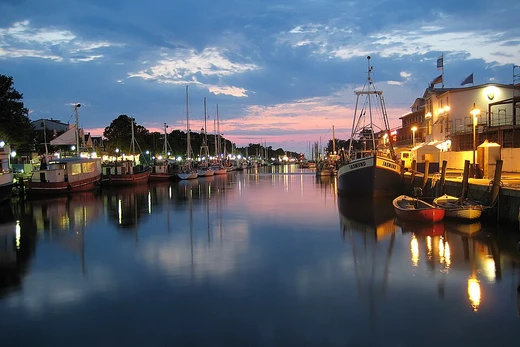
Elbe–Lübeck Canal
Modern canal linking the Elbe and Trave rivers.

The Elbe–Lübeck Canal, also called the Elbe–Trave Canal, is a man-made waterway in eastern Schleswig-Holstein, Germany. It links the Elbe and Trave rivers, providing an inland route that crosses the drainage divide between the North Sea and the Baltic Sea. Stretching 64 kilometers (40 miles) between Lübeck to the north and Lauenburg to the south, the canal passes through the Mölln lakes and features seven locks. Built in the 1890s, it took the place of the medieval Stecknitz Canal, which had previously connected the same two rivers.
The older Stecknitz Canal had first joined Lauenburg and Lübeck along the Old Salt Route by connecting the small Stecknitz River (a Trave tributary) with the Delvenau River (an Elbe tributary). Constructed between 1391 and 1398, it was Europe’s first summit-level canal and one of the continent’s earliest artificial waterways.
After Germany unified in the late 1800s, canal construction surged within the new empire. The Stecknitz Canal had served for centuries, but larger vessels required deeper, wider channels, and modern engineering made it possible to rebuild and enlarge the old route. In 1893, the German government closed the Stecknitz Canal to barge traffic, and in 1895 work began on a widened, straightened waterway that reused parts of the original canal’s course. The new Elbe–Lübeck Canal was inaugurated by Emperor Wilhelm II and opened to shipping in 1900. It still carries substantial freight today and also serves as a scenic route for recreational boats.
The canal’s seven locks include two that lift boats from the Elbe to the canal’s highest point and five that lower them from that high point to the Trave. Each lock measures 80 meters (260 feet) in interior length and 12 meters (39 feet) in interior width.
- length
- 64 kilometres (40 mi)
- locks
- 7
- location
- eastern Schleswig-Holstein, Germany
- connects
- Elbe and Trave rivers
- opened
- 1900
- predecessor
- Stecknitz Canal (1398–1893)
Verified Timeline
Lore & Background
The older Stecknitz Canal had first connected Lauenburg and Lübeck on the Old Salt Route by linking the tiny rivers Stecknitz (a tributary of the Trave) and Delvenau (a tributary of the Elbe). Built between 1391 and 1398, the Stecknitz Canal was the first European summit-level canal and one of the earliest artificial waterways in Europe. After German unification in the late nineteenth century, there was a burst of canal-building within the new German Empire. The Stecknitz Canal had been in service for centuries, but newer vessels demanded deeper and wider canals, and modern engineering offered the possibility of rebuilding and enlarging the venerable waterway. In 1893 the German government closed the Stecknitz Canal to barge traffic, and in 1895 construction began on a widened and straightened waterway which includes some of the old canal's watercourse. The new Elbe–Lübeck Canal was inaugurated by German Emperor Wilhelm II and opened to shipping traffic in 1900. Today it continues to carry substantial freight traffic, as well as offering a scenic route for pleasure craft.
Reader's Guide
The Elbe–Lübeck Canal represents a key infrastructure upgrade in late 19th-century Germany, replacing the centuries-old Stecknitz Canal to accommodate larger vessels. Its construction reflects the broader canal-building boom following German unification. The canal's seven locks, each built with an interior length of 80 metres (260 ft) and an interior width of 12 metres (39 ft), enabled efficient transit between the North Sea and Baltic Sea via the Elbe and Trave rivers. By incorporating parts of the older watercourse, it preserved a historical link to medieval trade routes like the Old Salt Route. Today, the canal remains active for freight and recreational boating, demonstrating the enduring utility of inland waterways. Its inauguration by German Emperor Wilhelm II underscores its national significance at the time.
Did You Know?
- The Elbe–Lübeck Canal is also known as the Elbe–Trave Canal.
- The canal runs for 64 kilometres (40 mi) between the cities of Lübeck and Lauenburg by way of the Mölln lakes.
- The older Stecknitz Canal, built between 1391 and 1398, was the first European summit-level canal.
- The new Elbe–Lübeck Canal was inaugurated by German Emperor Wilhelm II and opened to shipping traffic in 1900.
- Each of the canal's seven locks was built with an interior length of 80 metres (260 ft) and an interior width of 12 metres (39 ft).
More in Canals And Artificial Waterways 1-19
Spotted an error? Know more?
This is a living reference — every entry is fact-audited, and reader corrections feed straight into our audit queue. Suggest an edit · See this site's audit record