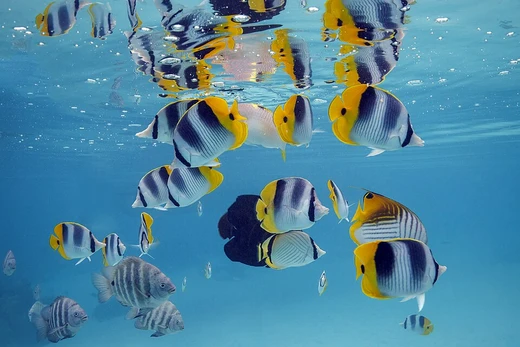
Vagabond butterflyfish
A chevron-patterned butterflyfish of Indo-Pacific reefs.
Last updated

Dr. Dwayne Meadows, NOAA/NMFS/OPR · via Wikipedia: Vagabond butterflyfish · Public domain
A whitish body is marked by two sets of thin, dark, perpendicular diagonal lines that create a chevron pattern on the vagabond butterflyfish.[1] Maximum total length reaches 23 cm, but 15 cm is the more usual size.[2]
Scientific classification
- KingdomAnimalia
- PhylumChordata
- ClassActinopterygii
- DivisionTeleostei
- OrderAcanthuriformes
- FamilyChaetodontidae
- GenusChaetodon
- GenusChaetodon
- SpeciesChaetodon vagabundus
Named by Linnaeus, 1758
Close relatives
Other species of Chaetodon with a Codexery entry.
- Indian vagabond butterflyfish Chaetodon decussatus
- Threadfin butterflyfish Chaetodon auriga
- Banded butterflyfish Chaetodon striatus
- Black butterflyfish Chaetodon flavirostris
- Blackback butterflyfish Chaetodon melannotus
- Blacktail butterflyfish Chaetodon austriacus
- Bluecheek butterflyfish Chaetodon semilarvatus
- Bluelashed butterflyfish Chaetodon bennetti
Sources: Wikipedia taxobox: Vagabond butterflyfish (CC BY-SA 4.0) · order, family and genus agree with WoRMS AphiaID 218754 (CC BY 4.0)
Conservation status
Least Concern (LC)
- LC▲ this species
- NT
- VU
- EN
- CR
- EW
- EX
Source: IUCN Red List assessment · GBIF copy of the Red List category
How big is it?
Largest length in the source, 0.23 m, next to a 1.8 m person.
Diagram: drawn by Codexery, schematic shapes to scale (not a likeness). Length: Wikipedia: Vagabond butterflyfish
Where the vagabond butterflyfish has been recorded
Each dot is a place where the species has been observed and reported (8,936 records, half-degree grid) — not a modelled range. 33 inland records left out (institution coordinates).
Map: drawn by Codexery. Data: GBIF occurrence search (records CC0 / CC BY) · Natural Earth basemap (public domain)
Biology and range
It tolerates turbid waters and freshwater plumes near stream mouths.[1] The Indian and Pacific Oceans are home to this species.[3] Reef areas such as inner coastal reef flats, lagoons, and outer seaward reef slopes are where the vagabond butterflyfish lives.[1][4] Algae, coral polyps, crustaceans, and worms make up the omnivorous diet of these fish.[1]
Stable pairs that jointly defend a feeding territory are formed by these oviparous, monogamous fish.[2] Near the posterior end of the soft-rayed part of the dorsal fin, a black dot is present on juveniles.[1]
What the specialist sources record
The Fishes of Australia account notes the species is widespread and often abundant in the Indo-west-central Pacific.[4] It gives the dorsal fin formula as XIII, 23-15 and the anal fin formula as III, 19-22.[4] The World Register of Marine Species lists the species as Chaetodon vagabundus Linnaeus, 1758, family Chaetodontidae, order Acanthuriformes.[5] GBIF records 10,103 occurrence records for this taxon as of 7 October 2026.[6]
References
- Wikipedia, "Vagabond butterflyfish" (CC BY-SA 4.0), which cites: Dianne J. Bray, "Chaetodon vagabundus", Fishes of Australia (we also read that source) en.wikipedia.org
- Wikipedia, "Vagabond butterflyfish" (CC BY-SA 4.0) en.wikipedia.org
- Wikipedia, "Vagabond butterflyfish" (CC BY-SA 4.0), which cites: Myers, R.F., "Chaetodon vagabundus", 2010 (original not read by us) en.wikipedia.org
- Dianne J. Bray, "Chaetodon vagabundus", Fishes of Australia. facts only, no text reused. fishesofaustralia.net.au
- World Register of Marine Species, Chaetodon vagabundus (AphiaID 218754). CC BY 4.0. marinespecies.org
- GBIF Backbone Taxonomy and occurrence index, Chaetodon vagabundus (taxon key 2385564). CC BY 4.0 (backbone); counts are facts. gbif.org
Each numbered sentence above was checked against the source it cites before publication. Sentences citing Wikipedia adapt text from the English Wikipedia article Vagabond butterflyfish (contributors), used under CC BY-SA 4.0; this entry is available under the same licence. Other sources were used for facts only; no text or images are copied from them.
More in Butterflyfish
Test yourself
Three questions drawn from this entry’s sources. Pick an answer to check it.
Answers checked against the source article
Sources
Compiled from Wikipedia and the sources listed below. Text from Wikipedia is available under CC BY-SA 4.0; this entry is adapted from it.
- Wikipedia: Vagabond butterflyfish (CC BY-SA 4.0).
- Classification: the source article's taxobox; order, family and genus checked against WoRMS, the World Register of Marine Species (CC BY 4.0).
- Conservation status: IUCN Red List assessment.
- Occurrence records: GBIF (CC0 / CC BY). Basemap: Natural Earth (public domain).
- Word definitions: the , each quoted from its Wikipedia article.
Spotted an error? Know more?
Reader corrections go straight into our review queue. Suggest an edit · How this site is sourced