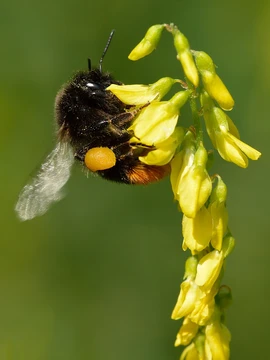
Bombus sylvarum
A small bumblebee with a high-pitched buzz and carding nest-building behavior.
The shrill carder bee, also called the knapweed carder-bee, is a bumblebee species ranging widely across Europe, from the Ural Mountains west to Great Britain, Ireland, and southern Scandinavia. Its name comes from its unusually high-pitched buzz and its nest-building technique, where it cards plant material into a fabric-like structure.
Quick Facts
- Parent
- Bombus (Thoracobombus)
- Species
- sylvarum
Facts from the source article.
Did You Know?
- It is mostly pale yellowish with a black band across the thorax, two black bands across the abdomen, and an orange tip to the abdomen.
- It flies rapidly and queens produce a high-pitched buzz.
- In the United Kingdom, it was common until the early 20th century but is now restricted to a few small areas in southern England and south and west Wales.
Behaviour
The queen emerges from hibernation in spring and builds a nest on or slightly below the ground surface among open vegetation, sometimes using an old mouse or vole nest. By summer, the nest may contain around 100 workers, and each nest requires about 10 km² of suitable habitat. The bee occurs in herb-rich grassland, feeding on nectar and pollen from flowers with complex or long corollae, including knapweed, woundwort, clover, vetch, red bartsia, and narrow-leaved bird's-foot trefoil.
More in Bumblebee
Spotted an error? Know more?
Reader corrections go straight into our review queue. Suggest an edit · How this site is sourced