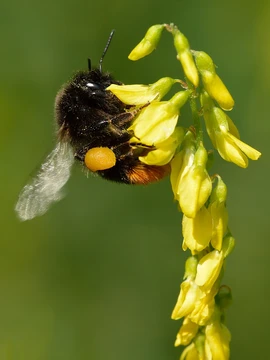
Bombus monticola
A highland bumblebee with a short tongue and broad head.
Bombus monticola, called the bilberry, blaeberry, or mountain bumblebee, is a European species with a broad head, short tongue, and a black thorax marked by a yellow collar and a yellow-to-red abdomen.
Quick Facts
- Parent
- Bombus (Pyrobombus)
- Species
- monticola
Facts from the source article.
Description
The bilberry bumblebee has a compact body, a broad head, and a short tongue. Queen bees measure 16 mm long with a 32 mm wingspan, while workers are 12 mm and males 14 mm. For the main subspecies, the thorax is black aside from a yellow collar and a yellow edge on the scutellum. The first abdominal segment and the front of the second are black, along with the very last segment; the rest of the abdomen ranges from yellow to red.
Ecology
Normally a highland species, it is often found on bilberry, cranberry, and cowberry. It is a pollen storer, feeding larvae from a central pollen storage. Nests underground in abandoned small mammal burrows, typically housing fewer than 50 workers with a 3–4 month life cycle. In Great Britain, queens emerge in April, workers in May, and males and new queens from July to early October. The cuckoo bumblebee Bombus sylvestris is likely parasitic on this species.
Taxonomy
Closely related to Bombus lapponicus but with a more eastern distribution. Several subspecies are recognized: B. m. monticola (dark, British Islands), B. m. scandinavicus (dark, Scandinavia), B. m. alpestris (Alps and Balkans), B. m. rondoui (Cantabrian Mountains and Pyrenees), and B. m. konradini (Apennines, light with a zebra-striped thorax in white, black, and white).
Distribution
Found in most mountainous areas of Europe, including northern Scandinavia, the Alps, Cantabrian Mountains, Pyrenees, Apennines, and the Balkans. It also occurs in lowlands of northern Norway, the Kola peninsula, and the British Islands. In Britain, it lives on upland moorland in Dartmoor, Exmoor, Welsh uplands, Peak District, North York Moors, and Scottish mainland. It is a recent arrival in Ireland (first recorded in the 1970s), restricted to upland areas of counties Antrim, Dublin, Wicklow, Carlow, and Wexford. Its decline in England led Natural England to include it in its Species recovery Programme.
More in Bumblebee
Spotted an error? Know more?
Reader corrections go straight into our review queue. Suggest an edit · How this site is sourced