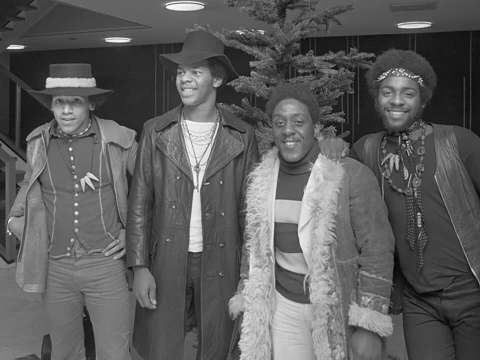
The Foundations
First multi-racial group to top UK charts in the 1960s.
The Foundations were a British soul band primarily active between 1967 and 1970. Their 1967 debut single "Baby Now That I've Found You" reached number one in the UK and Canada, and number eleven in the US. The group was the first multi-racial group to have a number one hit in the UK in the 1960s.
Quick Facts
- Origin
- London, England
- Genre
- Soul
- pop
- rock
- Years active
- 1966–1970
- Label
- Pye
- Castle
- Uni
- Astor
- Repertoire
- Spinoffs
- Development; Clem Curtis & the Foundations
- Spinoff of
- The Ramong Sound
Facts from the source article.
Did You Know?
- The origins of the Foundations go back to an R&B and ska outfit called the Ramong Sound, aka Ramongs, which had two lead singers: Raymond Morrison and Clem Curtis.
- At some stage Morrison was imprisoned for six months; in his absence, a friend suggested future psychedelic shock rocker Arthur Brown as a replacement.
- In 1975, Clem Curtis recorded a disco version of "Unchained Melody" which spent three weeks in the Record Mirror UK Disco Chart, peaking at no. 75.
Background
The Foundations drew attention for their unusual lineup, which brought together musicians of different ages, ethnicities, and musical backgrounds. The oldest member, Mike Elliott, was 38, while the youngest, Tim Harris, was just 18 and fresh out of school. The West Indian horn section featured Jamaican-born Elliott and Pat Burke on saxophones, along with Dominican-born Eric Allandale on trombone. All three were seasoned professionals with roots in jazz and rock and roll.
Allandale had previously led the New Orleans Knights, releasing two singles, and had played with Edmundo Ros, the Terry Lightfoot and Alex Welsh bands, and Romeo Z. Burke had been playing in groups since moving to the UK at 15 and studied at the London Music Conservatorium. Clem Curtis, born in Trinidad, worked as an interior decorator and professional boxer, with a background in wrestling and weight-lifting. Elliott joined after hearing the group needed a tenor saxophonist; he had performed with Tubby Hayes, Ronnie Scott, and the Cabin Boys, and had recorded for Sonny Roberts' Planetone label.
Keyboardist Tony Gomez was a former clerk in County Hall's architect's department. Drummer Tim Harris, born in St. John's Wood, London, had worked as a deckhand on a timber ship in the merchant navy, traveling to places like Siberia, before returning to the UK to join bands.
Career
The 4 February 1967 issue of Melody Maker shows a booking for the Ramong Sound (mis-spelt as Ramog Sound) to play at the All-Star Club on Sunday, 5 February. After the band was forced out of their club by a protection racket gang who tied up Clem Curtis and held a knife to his throat, they moved next door to a run-down former mini-cab office. According to Alan Warner in a 2011 interview, this is where they were discovered. The biography on AllMusic stated that Barry Class was the first to discover them, while other sources claim they were discovered by Ron Fairway, who managed the group the Ways and Means.
Ron Fairway told the group he would get them a gig at Herne Bay, but this job never materialized. The Foundations sourced their own gigs, including a Caribbean club along Edgware Road. They were booked to appear at Eel Pie Island on Sunday 14 May 1967 as a support act, paid £10. Arthur Brown appears to have left the group between the first and second quarter of 1967; according to a 1993 interview, Brown could have signed with the Foundations but did not want to be with the group for two years.
Other versions of band
Since late 1970, Barry Class attempted to revive the Foundations name. The band had Graham Preskett as musical director and on electric violin and guitar, Jean Roussel on keys, Roger Cawkwell on sax and flute, and Colin Young on vocals. The group agreed with management to appear as The Foundations but between gigs Colin Young would explain they were becoming a new outfit called Development. They toured Latin America and played at the Expo-Show in Buenos Aires, continuing into early 1971.
In 1971, Colin Young had a single "Any Time at All" credited to Colin Young introducing Development, which appeared in Billboard's Top 60 Pop Spotlight. The last record credited to The Foundations in the early 1970s was "Stoney Ground" b/w "I'll Give You Love" on MCA in 1971; it debuted on the Billboard Bubbling Under the Hot 100 chart, peaking at no. 113. As reported in March 1972, Development alternated between that name and The Foundations when gigging in the UK.
Colin Young released an album on Stateside titled In the Beginning credited to Colin Young's Development. Two more singles credited to The Foundations were released in the late 1970s, featuring Clem Curtis once more as lead vocalist.
Discography
From the band's beginning to their breakup towards the end of 1970, the Foundations released ten singles in the United Kingdom, including two versions of the same song. Most were composed by Tony Macaulay and John Macleod. They had four significant hits plus a minor hit with their own composition "Born to Live, Born to Die". "My Little Chickadee" was a minor hit in the United States. Other titles announced but never recorded or released include "Our Love Went Thataway", "Tear Jerker, Music-worker, You", and "No Place On Earth Could Find You". In 1971, "Stoney Ground" was released, believed to be by Colin Young and his backing band Development. In the mid and late 1970s, two more singles were released under the Foundations' name: "Where Were You When I Needed Your Love?" and "Closer to Loving You", which featured the Northern Soul classic "Change My Life" as the B side.
Frequently Asked Questions
Where is The Foundations from?
The Foundations originated in London, England.
When was The Foundations active?
The Foundations was active from 1966 to 1970.
Which record labels has The Foundations released music on?
The Foundations has released music on Pye, Castle, Uni, Astor and Repertoire.
More in British Soul Musical Groups
Spotted an error? Know more?
Reader corrections go straight into our review queue. Suggest an edit · How this site is sourced