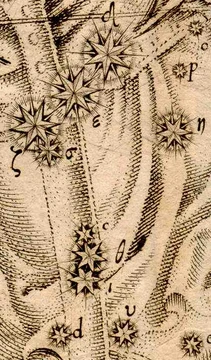
Gamma Delphini
A wide binary with contrasting orange and lime components.
Gamma Delphini, Latinized from γ Delphini, is a wide binary star system in the northern constellation Delphinus. The star marks one corner of the asterism Job's Coffin and is visible to the naked eye with a combined apparent visual magnitude of 3.87. The pair can be split with a modest amateur telescope and are noted for their contrasting orange and lime appearance.
Quick Facts
- Combined apparent visual magnitude
- 3.87
- Distance from sun
- 115 light-years
- Radial velocity
- −7 km/s
- Orbital period
- 3,249 years
- Eccentricity
- 0.88
- X-ray emission
- high probability
Facts from the source article.
Did You Know?
- Dhanishta is one of the 27 nakshatras in Indian astronomy; its asterism corresponds to the constellation Delphinus.
- The IAU Working Group on Star Names adopted the name Dhanishta for γ1 Delphini on 16 July 2026.
Space motion
Gamma Delphini is a binary star system about 115 light-years from Earth, moving closer at a speed of 7 kilometers per second. It belongs to the thin disk population and is thought to be part of the Wolf 630 moving group. The double nature of the star was first noticed by Christian Mayer, and William Herschel observed it on September 27, 1779. It later appeared as STF 2727 in F. G. W. Struve’s catalog and is listed under that name in the Washington Double Star Catalog. At that time, the two stars had an angular separation along a position angle of 280 degrees; by 2019, the separation had shifted to a position angle of 265 degrees. The dimmer component, Gamma-1 Delphini, shines at magnitude 5.03, while its brighter companion, Gamma-2 Delphini, has magnitude 4.360. Orbital calculations give a period of 3,249 years and a high eccentricity of 0.88, with the physical distance between them varying from about 40 astronomical units outward.
Physical properties
γ1 Delphini has a stellar classification of F7V, an F-type main-sequence star with a yellow-white hue. It is about 1.8 billion years old, spins with a projected rotational velocity of 7.8 km/s, and has 1.6 times the mass and 2.6 times the radius of the Sun. It radiates 10 times the Sun's luminosity at an effective temperature of 6,295 K. γ2 Delphini has an orange hue and class K1IV, being the more massive and more evolved star on the subgiant branch. It has double the mass of the Sun but has expanded to over eight times the Sun's radius, radiating 33 times the luminosity at 4,798 K. Its projected rotational velocity is 3.6 km/s, and it displays a radial acceleration with a periodicity of 1.44 years, possibly due to an orbiting companion. The system is a source of X-ray emission with high probability.
Search for planets
Back in 1999, radial velocity shifts in Gamma2 Delphini hinted at a possible planet. If real, it would be at least 0.7 times Jupiter's mass, orbit every 1.44 years, and sit about 1.5 astronomical units from its star—roughly Mars's distance from the Sun. This candidate remains unconfirmed. Researchers at McDonald Observatory have since placed upper mass limits on any planets circling Gamma2 Delphini.
More in Bright Stars by Bayer Designation
Spotted an error? Know more?
Reader corrections go straight into our review queue. Suggest an edit · How this site is sourced