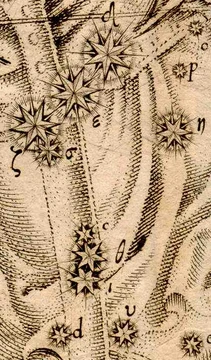
Pi1 Gruis
A semiregular variable S star in Grus.
Pi1 Gruis (π1 Gruis) is a semiregular variable star in the constellation Grus, located roughly 590 light-years from Earth. It forms a close double star with π2 Gru, separated by four arc-minutes. The star is notable as one of the brightest members of the S star class.
Quick Facts
- Bayer designation
- π1 Gruis
- Constellation
- Grus
- Distance from earth
- 590 light-years
- Spectral type
- S5
- Apparent magnitude range
- 5.3 to 7.0
- Variability period
- 198.8 days
- Diameter relative to sun
- 334 times
Facts from the source article.
Characteristics
Pi1 Gruis is an asymptotic giant branch star of spectral type S5, making it one of the brightest known S stars. It is a semiregular variable, with apparent magnitude fluctuating between 5.3 and 7.0 over 198.8 days. The aging star is transitioning from a red giant toward a planetary nebula. A shell of ejected material lies 0.91 light-years away, estimated to have been released 21,000 years ago. A cavity closer to the star suggests a reduction in mass loss over the past 90 years. The star's measured diameter of 18.37 milliarcseconds corresponds to 334 times the Sun's size.
Companions
Pi1 Gruis has two gravitationally bound companion stars. The inner companion, Pi1 Gruis C, follows a circular orbit with an 11-year period and is likely a main sequence star accreting matter from the red giant, possessing its own accretion disk. The outer companion, Pi1 Gruis B, is a yellow main sequence star of spectral type G0V with apparent magnitude 10.9, similar to the Sun, and is thought to be gravitationally bound to the primary.
History of observations
This star was first cataloged in 1756 by Nicolas Louis de Lacaille, though he gave the Bayer designation π Gruis to another star, π2. Thomas Brisbane later assigned it the designation π1. Annie Jump Cannon was the first to note its unusual spectrum, sending a plate from 1895 to Paul W. Merrill and pointing out its resemblance to R Andromedae. Merrill chose these two stars, along with R Cygni, as the three prototypes for the S star class. In 1922, π1 Gruis became one of the first 17 stars Merrill classified as S-stars, and it was the only one not observed from Mount Wilson because of its southern position. Its spectrum showed bands of technetium and oxides of zirconium, lanthanum, cerium, and yttrium, but lacked titanium and barium, which have been seen in other S stars.
More in Bright Stars by Bayer Designation
Spotted an error? Know more?
Reader corrections go straight into our review queue. Suggest an edit · How this site is sourced