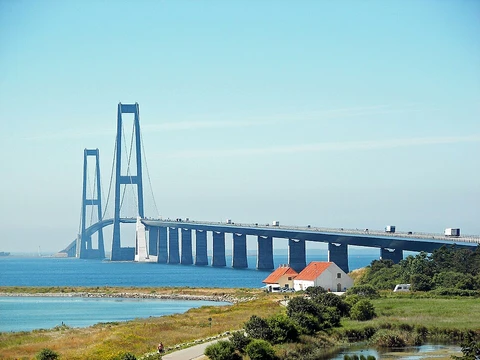
Pont du Gard
A Roman aqueduct bridge of exceptional preservation and architectural ingenuity.
Last updated
Where it is
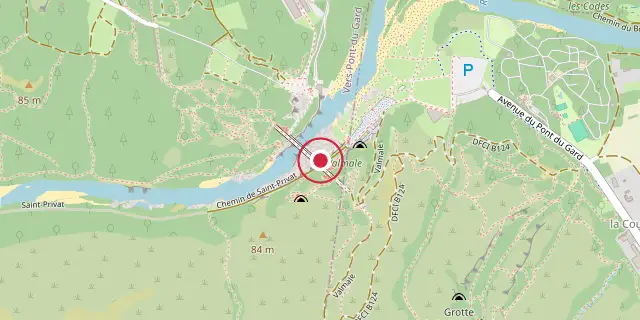
Coordinates: 43°56′49″N 4°32′10″E (43.9470, 4.5360) · Open in OpenStreetMap
Coordinates and connected clubs: the infobox of Wikipedia: Pont du Gard (CC BY-SA 4.0). Map: drawn by Codexery from OpenStreetMap tiles.
UNESCO inscribed the Pont du Gard on its World Heritage list in 1985, citing its outstanding state of preservation, historical significance, and architectural innovation as the reasons for its selection.[1]
Geography and history
The construction of the aqueduct has long been credited to Marcus Vipsanius Agrippa around 19 BC, but newer excavations suggest construction may have taken place between 40 and 60 AD.[2] A team led by Guilhem Fabre has argued the aqueduct was completed around the middle of the 1st century AD, taking about fifteen years to build with 800 to 1,000 workers.[3] The Pont du Gard remained largely intact because it was used as a toll bridge across the valley.[4] The city of Nemausus (modern Nîmes) presented challenges for water provision because water sources on the southern and eastern plains were situated at elevations too low for gravity-fed flow, while the terrain to the west posed insurmountable engineering obstacles.[5]
The sole viable option involved sourcing water from the northern region surrounding Ucetia (present-day Uzès), an area characterized by natural springs.[5] Water from the Fontaine d'Eure springs, located near Uzès, was conveyed by the Nîmes aqueduct to the castellum divisorum, the distribution basin, in Nemausus.[6] Although the direct distance between the spring and the city is roughly 20 km, the aqueduct's path meanders for approximately 50 km to navigate around the Garrigues de Nîmes.[6] The elevation of the Fontaine d'Eure is 76 meters above sea level, a mere 17 meters higher than the distribution basin in Nîmes, yet this difference provided an adequate slope for consistent water flow.[7]
The overall slope of the aqueduct averages a ratio of 1 in 3,000, which is considerably gentler than the typical gradient found in other Roman aqueducts.[7]
What the cited sources add
The same source notes that the aqueduct supplied the city with around 40,000 m3 of water a day that took nearly 27 hours to flow from the source to the city.[8][9] According to the "Encyclopedia of architectural and engineering feats", the stone blocks were cut with such precision that they were assembled using only friction and gravity, making mortar unnecessary.[10][9] The work "Divine domesticity" describes the conduit's walls as being made of dressed stone and its floor of concrete, with both surfaces finished in a stucco that contained tiny fragments of pottery and tile.[11][12] That same book explains that after the 4th century, the aqueduct fell into disrepair because a series of invading groups caused instability in the region, leading to a lack of maintenance.[11][12]
"Southern France" recounts that the Pont du Gard was preserved because it functioned as a toll bridge, and that during the 13th century, the French monarch granted the seigneurs of Uzès the authority to collect tolls from people crossing it.[4][13] The same source indicates that this toll-collecting right was subsequently transferred to the Bishops of Uzès, who, in exchange, were tasked with keeping the bridge in proper condition.[4][13]
References
- Wikipedia, "Pont du Gard" (CC BY-SA 4.0), which cites: "Pont du Gard (Roman Aqueduct)", UNESCO World Heritage Centre (original not read by us) en.wikipedia.org
- Wikipedia, "Pont du Gard" (CC BY-SA 4.0), which cites: Bromwich, "Roman Remains of Southern France: A Guide Book", Routledge, 2006, p. 110 (original not read by us) en.wikipedia.org
- Wikipedia, "Pont du Gard" (CC BY-SA 4.0), which cites: Fabre, "Interdisciplinary Research on the Aqueduct of Nimes and the Pont du Gard", Journal of Roman Archaeology, 1991, p. 63–88; Strachan, "Russia & Europe in the Nineteenth Century", Sphinx Fine Art, 2008, p. 60 (we also read that source) en.wikipedia.org
- Wikipedia, "Pont du Gard" (CC BY-SA 4.0), which cites: Cleere, "Southern France: an Oxford archaeological guide", Oxford University Press, 2001, p. 96 (we also read that source) en.wikipedia.org
- Wikipedia, "Pont du Gard" (CC BY-SA 4.0), which cites: Hodge, "Roman aqueducts & water supply", Duckworth, 2002, p. 184 (original not read by us) en.wikipedia.org
- Wikipedia, "Pont du Gard" (CC BY-SA 4.0), which cites: Chanson, "Hydraulics of Large Culvert beneath Roman Aqueduct of Nîmes", Journal of Irrigation and Drainage Engineering, 1 October 2002, p. 326–330 (we also read that source) en.wikipedia.org
- Wikipedia, "Pont du Gard" (CC BY-SA 4.0), which cites: Lewis, "Surveying instruments of Greece and Rome", Cambridge University Press, 2001, p. 187; Hodge, p. 185 (original not read by us) en.wikipedia.org
- Wikipedia, "Pont du Gard" (CC BY-SA 4.0), which cites: "Encyclopedia of architectural and engineering feats", Bloomsbury Academic, 2001, p. 254; Sobin, "Luminous debris: reflecting on vestige in Provence and Languedoc", University of California Press, 1999, p. 205 (we also read that source) en.wikipedia.org
- Open Library record, ISBN 157607112X ("Encyclopedia of Architectural and Engineering Feats"). CC0 (metadata); book content not read. openlibrary.org
- Wikipedia, "Pont du Gard" (CC BY-SA 4.0), which cites: "Encyclopedia of architectural and engineering feats", Bloomsbury Academic, 2001, p. 254 (we also read that source) en.wikipedia.org
- Wikipedia, "Pont du Gard" (CC BY-SA 4.0), which cites: O'Rourke Boyle, "Divine domesticity: Augustine of Thagaste to Teresa of Avila", Brill, 1997, p. 105 (we also read that source) en.wikipedia.org
- Open Library record, ISBN 9789004106758 ("Divine domesticity"). CC0 (metadata); book content not read. openlibrary.org
- Open Library record, ISBN 9780192880062 ("Southern France"). CC0 (metadata); book content not read. openlibrary.org
Each numbered sentence above was checked against the source it cites before publication. Sentences citing Wikipedia adapt text from the English Wikipedia article Pont du Gard (contributors), used under CC BY-SA 4.0; this entry is available under the same licence. Other sources were used for facts only; no text or images are copied from them.
Ranked in
More in Great Bridges
Sources
Compiled from Wikipedia and the sources listed below. Text from Wikipedia is available under CC BY-SA 4.0; this entry is adapted from it.
- Wikipedia: Pont du Gard (CC BY-SA 4.0).
Spotted an error? Know more?
Reader corrections go straight into our review queue. Suggest an edit · How this site is sourced