Gråbrødretorv 11
An 18th-century brewer's house in Copenhagen's Old Town.
Last updated
Where it is
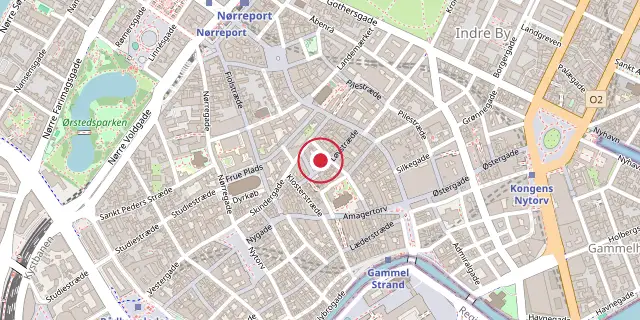
Coordinates: 55°40′48″N 12°34′34″E (55.6800, 12.5760) · Open in OpenStreetMap
Coordinates and connected clubs: the infobox of Wikipedia: Gråbrødretorv 11 (CC BY-SA 4.0). Map: drawn by Codexery from OpenStreetMap tiles.
Gråbrødretorv 11 stands on the south side of the square in Copenhagen’s Old Town. It began as a brewer’s house in 1731, was raised by one storey in the early 1840s, and around the same time gained a four-storey residential block at Valkendorfsgade 20 on the opposite side of the block. The whole complex has been listed in the Danish registry of protected buildings and places since 1932.
The site originally consisted of two smaller properties: one facing the square and one facing Valkendorfsgade. In the 1689 cadastre, the square-facing lot was listed as No. 133 in Frimand’s Quarter, owned by Master Anders Guntzow; the Valkendorfsgade property, with four tenancies, belonged to Master Andre’s hairs. A narrow alley, visible on Resen’s 1674 map, once separated these buildings from those to the west (now Gråbrødretorv 13), linking the square directly to the street.
1829 – 1789
Both properties were destroyed in the Copenhagen Fire of 1728 and later merged. The present building on the square was constructed in 1731 for brewer Bent Bentsen. By 1756 it was No. 123, owned by Johan Jørgen Holst, and later sold to Peler Christian Kinckel (1730–1800). In 1789, Kinckel sold it to Hans Svane for 21,000 rigsdaler.
Hans and Johanne Marie Swane, 1789-1808
Svane (1753–1803) was the son of sea captain Lars Swane and Johanne Marie Harboe; his parents had owned Gammel Strand 42 from 1764. His father had captained six expeditions to Canton and Tranquebar for the Danish Asiatic Company between 1757 and 1771. Hans Svane himself spent five years in Canton from 1773 to 1778, then visited China three more times with the company, last as acting supercargo in 1788. He married Johanne Marie Gad on 10 March 1788, seeking a steadier life as a brewer in Copenhagen.
At that time the property was a three-storey building with two gables facing the square. Svane lived with his family on the ground floor; the more stately upper-floor apartments were rented out.
The brewery occupied a perpendicular side wing, its facade featuring a wall dormer with a pulley. The ground-floor copper boiler held 14 barrels of malt; the basement was used for yeasting and cooling, while the upper floors stored malt and grain. The rear wing had a ground-floor passageway and residential quarters for servants and staff above.
Lore & Background
The site originally comprised two smaller properties, one facing the square and one towards Valkendorfsgade. Both were destroyed in the Copenhagen Fire of 1728 and subsequently merged. The present building on Gråbrødretorv was constructed for brewer Bent Bentsen in 1731. A narrow alley that once separated the buildings from those to the west can be seen on Resen's 1674 map of Copenhagen.
In 1789, the property was sold to Hans Swane, a former sea captain who had spent years in Canton for the Danish Asiatic Company. Swane operated a brewery in a perpendicular side wing, with a copper boiler capacity of 14 barrels of malt. The rear wing contained a passageway and residential quarters for servants. The building on Kokkegade (now Valkendorfsgade) housed stabling for four horses and storage for animal feed, firewood, and grain.
After Hans Swane's death in 1803, his widow Johanne Marie Swane retained the estate and later sold the property in 1806. The building was heightened by one storey in 1843–44. Notable residents over time included cookbook writer Anne Marie Mangor in 1856, artists Frants and Erik Henningsen from 1865, and the publishing house Th. Lind around 1880.
Reader's Guide
Gråbrødretorv 11 stands as a well-preserved example of an 18th-century Copenhagen brewer's house, adapted and expanded in the 1840s. Its history reflects the transition from small-scale brewing to mixed residential and commercial use in the Old Town. The property's listing in 1932 underscores its architectural and historical value.
The building's association with Hans Swane, a former Danish Asiatic Company supercargo who turned to brewing, illustrates the social mobility and economic networks of late 18th-century Copenhagen. Later residents, including the Henningsen brothers and Anne Marie Mangor, connect the address to Danish cultural and culinary history. The complex's dual frontage on Gråbrødretorv and Valkendorfsgade, along with its surviving 18th-century core and 19th-century modifications, makes it a notable landmark in the city's built heritage.
More in Breweries of Scandinavia and the Low Countries
Sources
Compiled from Wikipedia and the sources listed below. Text from Wikipedia is available under CC BY-SA 4.0; this entry is adapted from it.
- Wikipedia: Gråbrødretorv 11 (CC BY-SA 4.0).
Spotted an error? Know more?
Reader corrections go straight into our review queue. Suggest an edit · How this site is sourced