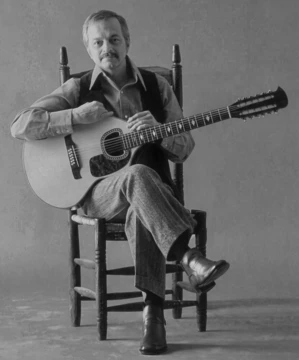
Baden Powell (guitarist)
Brazilian virtuoso guitarist and composer of bossa nova and samba.
Last updated
Baden Powell de Aquino, known as Baden Powell, was a Brazilian guitarist and composer active from 1937 to 2000. He blended classical guitar technique with popular harmony and swing, playing bossa nova, samba, Brazilian jazz, Latin jazz, and MPB. He is considered one of Brazil's finest guitarists.
Biography
Baden Powell de Aquino entered the world in Varre-Sai, a town in Rio de Janeiro state, Brazil. His father, a big fan of the Scouting movement, gave him the name of the movement's founder, Robert Baden-Powell. When the baby was just three months old, the family moved to the Rio suburb of São Cristóvão. Growing up, his home was a regular hangout for popular musicians.
He began studying guitar under Jayme Florence, a well-known choro guitarist from the 1940s. It didn't take long for him to show he was a child prodigy, racking up wins in numerous talent contests before he even hit his teens. By age fifteen, he was already a professional, backing up singers and bands across a range of styles. While he had a deep interest in swing and jazz, his core inspiration came from the Brazilian guitar tradition.
In 1955, Powell was performing with the Steve Bernard Orquestra at the Boite Plaza, a nightclub inside Rio's Plaza Hotel. His playing caught the ear of the jazz trio performing across the lobby at the Plaza Bar.
When Ed Lincoln needed to put together a new trio, he brought Powell in on guitar, forming the Hotel Plaza Trio. Powell recruited Luiz Marinho on bass and added a fourth member, singer Claudette Soares. Along with Lincoln, Powell and his fellow young musicians spent their nights in after-hours jam sessions, making a name for themselves in Rio's emerging jazz scene.
Powell's big break came in 1959 when he persuaded established singer-songwriter Billy Blanco to write lyrics for one of his tunes. The song, "Samba Triste," was an instant hit. It went on to be covered by many artists, including Stan Getz and Charlie Byrd on their landmark album Jazz Samba.
In 1962, Powell met Vinicius de Moraes, a poet and diplomat, sparking a partnership that produced some of the defining Brazilian music of the 1960s. While bossa nova was all the rage, the duo aimed to blend samba with Afro-Brazilian traditions like candomblé, umbanda, and capoeira. Their 1966 album Os Afro-Sambas de Baden e Vinicius was the result.
Playing style
Baden Powell made a pivotal decision at nineteen: he put down the electric guitar for good, dedicating the rest of his career to the classical instrument. The only exception came when he borrowed a steel-string acoustic for a series of albums, but that was as close as he ever got to straying from his chosen path as an adult.
His repertoire shows a remarkable breadth, covering every major style of 20th-century Brazilian popular music—samba, bossa nova, Afro-Bahian ritual music, frevo, choro, and the music of the Northeastern Sertão—alongside European and Japanese lullabies. Growing up in the 1940s and 1950s, he absorbed jazz deeply, particularly bebop and swing. He recorded Thelonious Monk’s “Round Midnight” twice and Jerome Kern’s “All the Things You Are” three times, including on his first solo album.
This background shaped a playing style that blends jazz harmonies with classical guitar technique, anchored by a distinctly Brazilian right hand—the hand that drives the rhythm. In solo classical settings, he was skilled in the works of Tárrega and Bach. In a group, he could accompany singers with quiet control or cut loose in a street samba, treating the guitar like a percussion instrument in a loose, party-like manner. Like Monk, he had a fondness for the minor second interval as a way to shift tonality, but his jazz roots meant he rarely bent the string; instead, he played the minor second using an adjacent open string.
Students of his approach should note his preference for chord voicings that use open-string extensions to punctuate phrases. Other trademarks include endless right-hand rhythmic variations, always keeping proper samba meter, and a signature move: a fast descending scale followed by a slower ascending arpeggio in the relative key. He also used vocalise and scat singing, often in unison with the melody line, especially when the melody was played on the bass strings.
His early teacher was “Meira” (Jayme Florence), and he was also influenced by Dilermando Reis and Garoto (Anibal Augusto Sardinha). He cited Les Paul, Django Reinhardt, and Jacques Loussier as additional inspirations.
Discography
Baden Powell began his career as a sideman on big band and samba records in the 1950s. His debut solo album was cut in 1959 but did not come out until 1961. Both his first and second albums mix jazz standards, contemporary Brazilian pop, and his own tunes. In 1962 he worked with flutist Herbie Mann and drummer Jimmy Pratt.
The following year he fronted small groups in Brazil and France. Many of his records were issued by French labels Barclay and Festival. In Germany, MPS/Saba put out his work with producer Joachim Berendt. In Brazil he recorded for Elenco, Forma, and Philips’ local branch.
After a handful of new releases in the 1980s, Powell went back to Brazilian studios for his final years. Those later albums feature either solo guitar or voice with guitar. He appeared on Herbie Mann’s Do the Bossa Nova with Herbie Mann (1962) and Latin Fever (1964), and on Miltinho com o Sexteto Sideral’s Um Novo Astro (1960).
Frequently Asked Questions
When and where was Baden Powell (guitarist) born?
Baden Powell was born on 6 August 1937 in Varre-Sai, Rio de Janeiro, Brazil.
When did Baden Powell (guitarist) die?
Baden Powell died on 26 September 2000 in Rio de Janeiro.
More in Brazilian Male Jazz Musicians
Test yourself
Three questions drawn from this entry’s sources. Pick an answer to check it.
Answers checked against the source article
Sources
Compiled from Wikipedia and the sources listed below. Text from Wikipedia is available under CC BY-SA 4.0; this entry is adapted from it.
- Wikipedia: Baden Powell (guitarist) (CC BY-SA 4.0).
Spotted an error? Know more?
Reader corrections go straight into our review queue. Suggest an edit · How this site is sourced