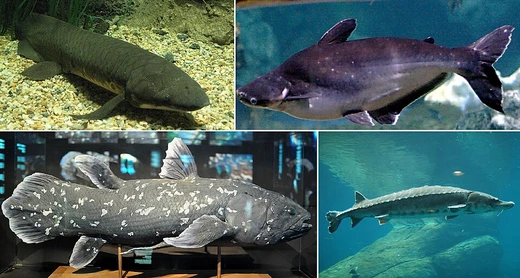
Burbot
The only freshwater cod, a coldwater benthic predator with a chin barbel.

The burbot (Lota lota), also known as bubbot, mariah, loche, cusk, freshwater cod, freshwater ling, freshwater cusk, the lawyer, coney-fish, lingcod, or eelpout, is a species of coldwater ray-finned fish native to the subarctic regions of the Northern Hemisphere. It is the only member of the genus Lota and the only freshwater species of the order Gadiformes, closely related to marine fish such as the common ling and cusk, all belonging to the family Lotidae (rocklings). The burbot is notable for its circumpolar distribution above 40° N, its unique chin barbel, and its role as a benthic predator in cold freshwater and brackish habitats.
The burbot’s name derives from the Latin *barba*, meaning beard, referencing its single chin whisker, or barbel; its scientific name *Lota lota* comes from the old French word for the fish. Its appearance resembles a cross between a catfish and an eel, with a serpent-like, elongated, laterally compressed body and a flattened head. It has a wide mouth lined with many small teeth, two soft dorsal fins (the first low and short, the second much longer), a low anal fin nearly as long as the dorsal fin, a rounded caudal fin, fan-shaped pectoral fins, and narrow pelvic fins with an elongated second ray. These small fins relative to body size indicate a benthic lifestyle with low swimming endurance, unable to withstand strong currents. Though appearing scaleless, the burbot bears minute, nearly microscopic scales. It is relatively long-lived and slow-growing; in Alaska, it generally takes five to seven years to reach 18 inches, with sexual maturity typically at six to seven years, and individuals over 20 years old are not uncommon.
Burbot inhabit large, cold rivers, lakes, and reservoirs, primarily in freshwater but also thriving in brackish environments for spawning. They live under ice for part of the year and require frigid temperatures to breed. During summer, they stay below the thermocline, and in Lake Superior they can live at depths exceeding 300 meters. As benthic fish, they tolerate substrates of mud, sand, rubble, boulder, silt, and gravel, and adults construct extensive burrows for daytime shelter. They are active crepuscular hunters. In winter, populations become adfluvial, migrating to near-shore reefs and shoals of sand or gravel to spawn. Unlike most freshwater fish, burbot spawn in mid to late winter, typically betw
- Scientific name
- Lota lota
- Family
- Lotidae (rocklings)
- Distribution
- Circumpolar above 40° N
- Habitat
- Large, cold rivers, lakes, reservoirs, and brackish waters
- Maximum weight
- 1.0 to 12 kg (2.2 to 26.5 lb)
Lore & Background
The burbot possesses a serpentine body that evokes a blend of catfish and eel, with a single whisker-like barbel on its chin as its most distinctive feature. Its head is flattened, and each nostril forms a small tube. The mouth is wide and lined with many small teeth. Two soft dorsal fins are present: the first is short and low, while the second is much longer. The anal fin is low and nearly as long as the second dorsal fin. The caudal fin is rounded, the pectoral fins fan-shaped, and the pelvic fins are narrow with an elongated second ray. These relatively small fins indicate a benthic lifestyle with limited swimming endurance, making the fish unable to withstand strong currents. Though appearing scaleless, the burbot is covered in minute, nearly microscopic scales. It is slow-growing and long-lived; in Alaska, reaching 18 inches typically takes five to seven years, and individuals often exceed 20 years of age. Burbot inhabit large, cold rivers, lakes, and reservoirs, primarily in freshwater but also tolerating brackish environments for spawning. They live under ice for part of the year and require frigid temperatures to breed. During summer, they stay in colder water below the thermocline, and in Lake Superior they can be found at depths exceeding 300 meters. As benthic fish, they tolerate mud, sand, rubble, boulder, silt, and gravel substrates, constructing burrows for daytime shelter. They are crepuscular hunters. In winter, they migrate to near-shore reefs and shoals with sand or gravel to spawn. Unlike most freshwater fish, spawning occurs mid to late winter, often under ice at temperatures between 1 and 5 °C. They are broadcast spawners, releasing eggs and sperm into open water where multiple males gather around one or two females in a writhing “spawning ball.” Fertilized eggs drift and settle into substrate cracks. Fecundity ranges from 63,000 to over 3.4 million eggs per clutch, depending on body size. Eggs are round with a large oil globule, about 1 mm in diameter. Larvae are pelagic, drifting passively, and juveniles are active at night, hiding under rocks by day.
Reader's Guide
The burbot holds significance as the only freshwater member of the cod order Gadiformes, occupying a unique ecological niche in cold northern waters. Its circumpolar distribution and ability to thrive under ice make it a key species in subarctic and boreal aquatic ecosystems. The burbot's diet, which includes invasive species like the round goby in Lake Erie, demonstrates its role in controlling non-native populations. In Finland, its roe and liver are regarded as delicacies, and its meat, when cooked, tastes similar to American lobster, earning it the nickname 'poor man's lobster.' Genetic analysis suggests the geographic pattern of burbot may indicate multiple species or subspecies, making the single taxon somewhat misleading.
Did You Know?
- The name burbot comes from the Latin word barba, meaning beard, referring to its single chin whisker.
- Burbot are the only freshwater species of the order Gadiformes.
- When cooked, burbot meat tastes very similar to American lobster, leading to its nickname 'poor man's lobster.'
Frequently Asked Questions
What is a burbot?
The burbot (Lota lota) is a coldwater ray-finned fish and the sole freshwater member of the order Gadiformes, making it the closest living relative to marine cods and lings. It is the only species in the genus Lota and belongs to the family Lotidae, commonly called the rocklings.
What makes the burbot stand out from other fish?
Its most distinctive trait is a single fleshy barbel dangling from its chin, which it uses as a sensory organ in dim, murky water. It is also the only freshwater species in the entire gadiform order, a group otherwise made up of marine fish like cod and ling.
Where can you find burbots in the wild?
Burbots enjoy a circumpolar range above 40° north latitude, living in large cold rivers, deep lakes, reservoirs, and brackish waters across the Northern Hemisphere. As a benthic species, they spend most of their time hovering near the bottom rather than in open water.
What role does the burbot play in its ecosystem?
As a benthic predator, the burbot feeds on smaller fish, crustaceans, and bottom-dwelling invertebrates in cold subarctic waters. It occupies a top-predator niche in lake and river systems, helping to keep populations of its prey in check.
More in Bony Fish 1-22
Spotted an error? Know more?
This is a living reference — every entry is fact-audited, and reader corrections feed straight into our audit queue. Suggest an edit · See this site's audit record