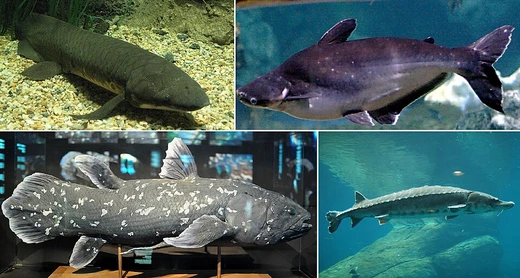
Barramundi
Catadromous fish of commercial and recreational value across the Indo-West Pacific.

The barramundi (Lates calcarifer) is a catadromous species belonging to the family Latidae, widely distributed across the Indo-West Pacific from the Middle East and South Asia through Southeast Asia and East Asia to Oceania. The common name "barramundi" is a loanword from an Aboriginal language of the Rockhampton area in Queensland, originally meaning "large-scaled river fish" and referring to different species (Scleropages leichardti and Scleropages jardinii). During the 1980s, the name was appropriated for marketing purposes, significantly raising the fish's profile; internationally it is often called Asian seabass, though also known as Australian seabass or giant sea perch. The species has an elongated, compressed body with a large, slightly oblique mouth, a serrated preoperculum with a strong spine, and ctenoid scales. Its dorsal and ventral fins possess both spines and soft rays, while the paired fins have only soft rays; the caudal fin is truncated and rounded. Barramundi are demersal, inhabiting coastal waters, estuaries, lagoons, and rivers in clear to turbid water, typically within a temperature range of 26–30 °C. They do not undertake extensive migrations between river systems, which has contributed to genetically distinct stocks in Northern Australia. The fish is euryhaline but stenothermal, spawning in estuaries and tidal flats at the start of the monsoon, with females laying several million eggs that require brackish water to develop; adults do not guard eggs or fry. The species is sequentially hermaphroditic: most individuals mature as males and become female after at least one spawning season, so larger specimens are usually female. Barramundi feed on crustaceans, molluscs, and smaller fish, including their own species.
- Scientific name
- Lates calcarifer
- Maximum length
- 1.8 m (5.9 ft)
- Average length
- 0.6–1.2 m (2.0–3.9 ft)
- Temperature range
- 26–30 °C
- Distribution
- Indo-West Pacific (Middle East to Oceania)
Quick Facts
- Taxon
- Lates calcarifer
Facts from the source article.
Lore & Background
The barramundi is a sequentially hermaphroditic species, with most individuals maturing as males and becoming female after at least one spawning season; larger specimens are therefore typically female. It is euryhaline but stenothermal, inhabiting rivers and descending to estuaries and tidal flats to spawn. At the start of the monsoon, males migrate downstream to meet females, which lay several million eggs each; the eggs and fry require brackish water to develop, and adults do not guard them. The species feeds on crustaceans, molluscs, and smaller fish, including its own kind; juveniles feed on zooplankton. Barramundi are demersal and do not undertake extensive migrations within or between river systems, which has influenced the establishment of genetically distinct stocks in Northern Australia. In captivity, they sometimes change sex at a smaller size and exhibit a higher proportion of protandry, with some males not undergoing sexual inversion.
Reader's Guide
The barramundi holds significant economic and cultural importance across its range. It is fished internationally and raised in aquaculture in countries including Australia, Saudi Arabia, Malaysia, India, Indonesia, Vietnam, Israel, Thailand, the United States, Poland, and the United Kingdom. In Australia, it is a prized sportfish, often caught on lines and lures, and is used to stock freshwater reservoirs for recreational fishing, with popular impoundments including Lake Tinaroo and Lake Moondarra. The species is also central to tourism and events such as the Million Dollar Fish competition in the Northern Territory. Culinarily, barramundi is valued for its mild flavour and white, flaky flesh. It features prominently in Bengali cuisine as bhetki machher paturi or fried fillets, in Goan cuisine as chonak prepared with recheado or rava, and in Thai cuisine as pla kapong, often steamed with lime and garlic. In the United States, farmed barramundi from the US and Vietnam has been deemed a 'Best Choice' by the Monterey Bay Aquarium's Seafood Watch program. The name 'barramundi' itself was appropriated for marketing in the 1980s, raising the fish's profile, though it originally referred to different species.
Did You Know?
- The name 'barramundi' is a loanword from an Australian Aboriginal language of the Rockhampton area, meaning 'large-scaled river fish'.
- Barramundi are sequentially hermaphroditic: most mature as males and become female after at least one spawning season.
- Barramundi are a favourite food of saltwater crocodiles, which have been known to take them from unwary fishermen.
Frequently Asked Questions
What is a barramundi?
The barramundi (Lates calcarifer) is a catadromous bony fish belonging to the family Latidae, native to the Indo-West Pacific. It goes by many names depending on the region, including Asian sea bass, giant sea perch, dangri, kalanji, and siakap.
Where does barramundi live?
Barramundi occupies coastal waters, estuaries, lagoons, and river systems spanning from the Middle East to Oceania. As a catadromous species, it alternates between saltwater spawning grounds and freshwater habitats during its life cycle.
How big can a barramundi grow?
Most individuals fall in the 0.6 to 1.2 meter range, but the species can reach a maximum length of 1.8 meters and a weight of about 60 kilograms under optimal conditions.
Why is barramundi important to people?
It is a highly sought-after species for both commercial harvest and recreational angling throughout the Indo-West Pacific. It also underpins large-scale aquaculture operations and is a staple in many regional cuisines.
What does it mean that barramundi is catadromous?
Catadromous means the fish reproduces in the ocean but then migrates into rivers, estuaries, and lagoons to feed and grow, the opposite of anadromous species like salmon. This dual-habitat lifestyle is a key part of its biology and ecology.
More in Bony Fish 1-22
Spotted an error? Know more?
This is a living reference — every entry is fact-audited, and reader corrections feed straight into our audit queue. Suggest an edit · See this site's audit record