
Monopoly
Economics-themed board game about property trading and monopolies.

Smirkybec · CC BY-SA 4.0
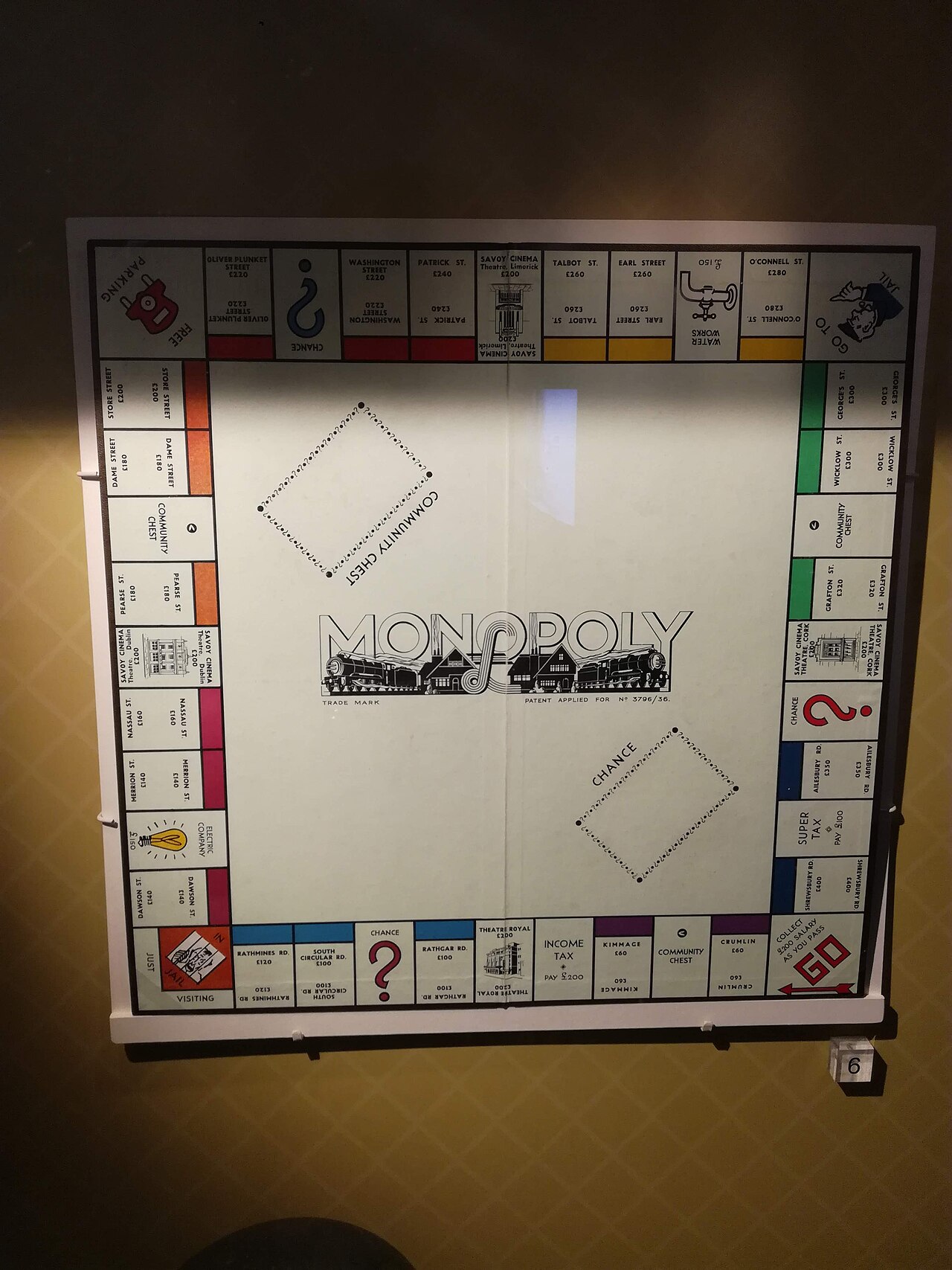
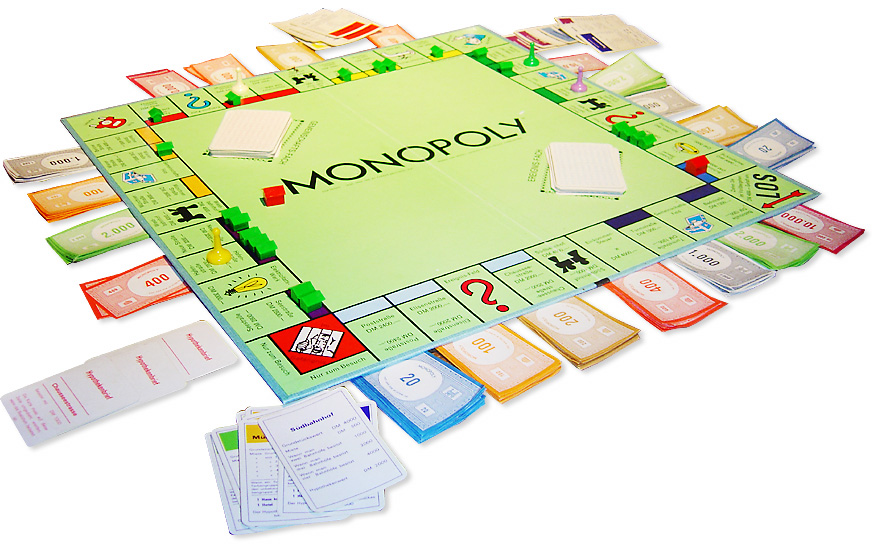
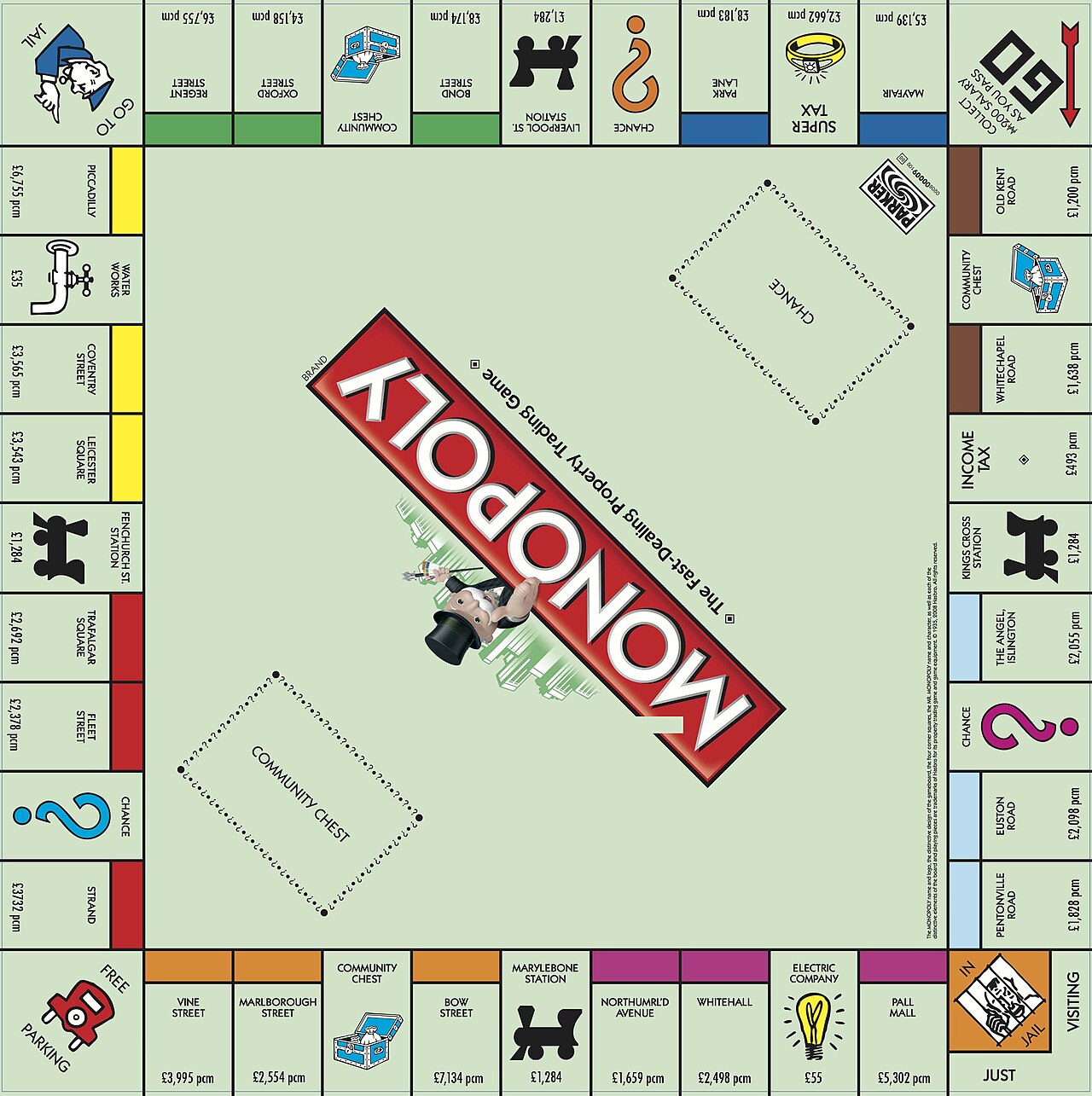
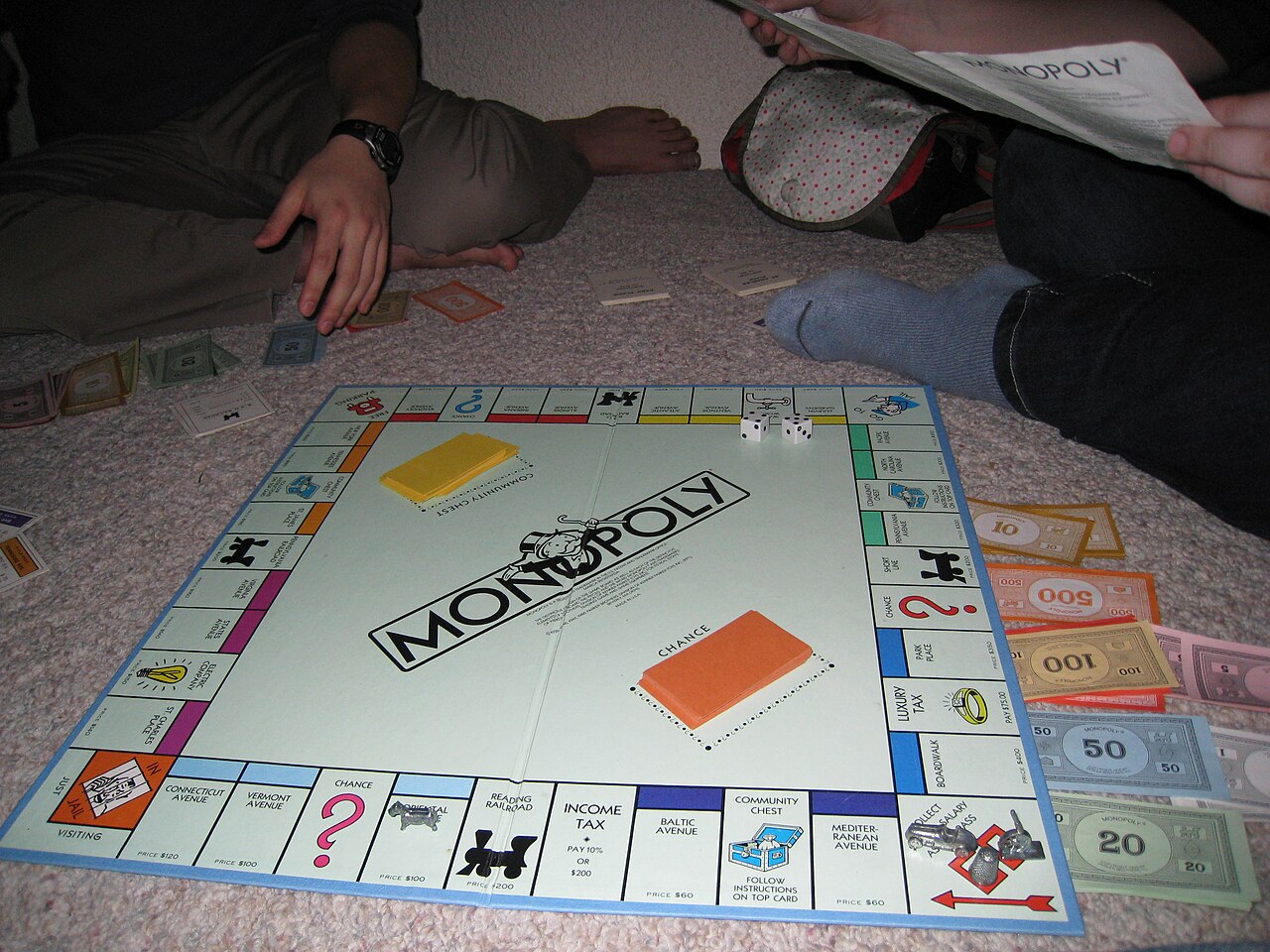
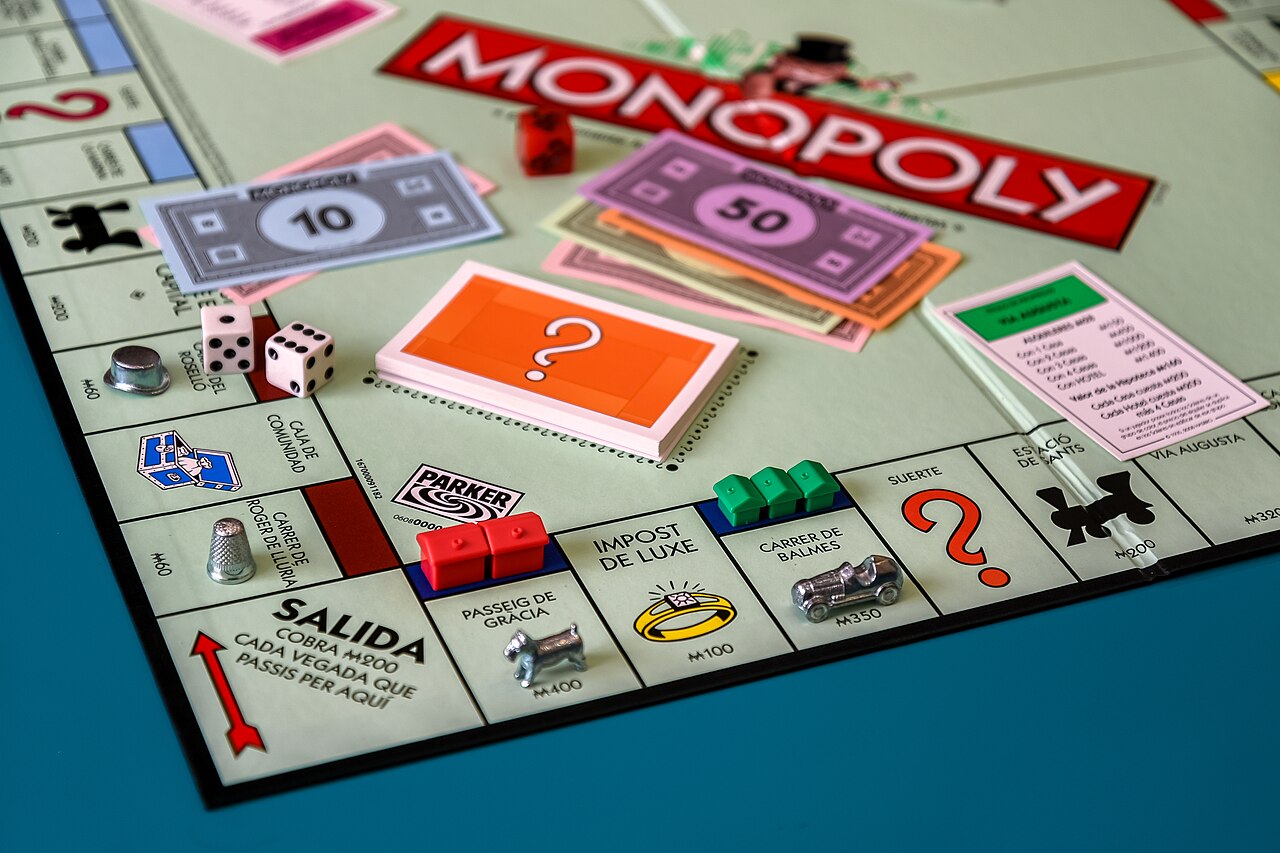
Monopoly is a multiplayer economics-themed board game in which players roll two standard dice (or, in some versions, an extra special red die) to move their token clockwise around a square board. The core objective is to buy and trade properties—including streets, railroads, and utility companies—and then develop them with houses and hotels. By collecting rent from opponents who land on these spaces, players aim to drive their rivals into bankruptcy. Money can also be gained or lost through Chance and Community Chest cards, as well as tax squares. Players receive a salary each time they pass the "Go" space, and they may be sent to jail, from which they cannot leave until they meet one of three specific conditions. The game has spawned hundreds of editions, numerous spin-offs, and a wide array of house rules and related media.
The original game board’s properties are named after locations in and around Atlantic City, New Jersey. The game’s title comes from the economic concept of a monopoly—the domination of a market by a single entity. A key strategy is to acquire all properties of a single color group or all the railroads. Monopoly is derived from *The Landlord's Game*, created in 1903 by American Lizzie Magie. She designed it as an educational tool to demonstrate that an economy rewarding individuals is superior to one where monopolies hold all wealth, promoting the single-tax theories of Henry George. Her original design featured two rule sets: one anti-monopolist, where all players benefited when wealth was created, and a monopolist set focused on crushing opponents. Parker Brothers first published the game as Monopoly in 1935, after acquiring the rights from Charles Darrow, who had learned of the game from friends. The company later bought Magie’s patent for $500. Monopoly has become a fixture of international popular culture, licensed in over 113 countries and printed in more than 46 languages, with estimated sales of 275 million copies worldwide.
- first_published
- 1935
- publisher
- Parker Brothers (later Hasbro)
- patent_holder
- Charles Darrow (1935)
- based_on
- The Landlord's Game
- game_type
- Board game
- original_board_locations
- Atlantic City, New Jersey
Lore & Background
Monopoly is a multiplayer board game centered on economic competition, where players roll two standard dice (or occasionally a special red die) to move their tokens clockwise around a square circuit. The board features a series of properties, railroads, and utilities, alongside Chance and Community Chest spaces, tax squares, and a corner marked "Go" that provides a salary each time a player passes it. Players can also land in jail, from which they cannot leave until one of three conditions is met. The game’s defining objective is to buy, trade, and develop properties—adding houses and hotels—to collect rent from opponents and drive them into bankruptcy. A core strategy involves acquiring all properties of a single color group or all the railroads. The original board’s properties were named after locations in and around Atlantic City, New Jersey. The game derives its name from the economic concept of monopoly, the domination of a market by a single entity. It evolved from Lizzie Magie’s 1903 creation, The Landlord’s Game, which was designed to illustrate the negative effects of land monopolies and promote Henry George’s single-tax theory. Magie’s game originally had two rule sets: one anti-monopolist where all players benefited from wealth creation, and a monopolist set aiming to crush opponents. Parker Brothers first published Monopoly in 1935 after acquiring rights from Charles Darrow, who had learned the game from friends and adapted it. The game has since become a global cultural staple, licensed in over 113 countries and printed in more than 46 languages, with estimated sales of 275 million copies. Numerous editions, spin-offs, and house rules have expanded its reach.
Reader's Guide
Monopoly's significance lies in its evolution from an educational tool about land taxation into a globally recognized board game. Its core strategy—buying up all properties of a certain color or all railroads—reflects the economic concept of monopoly. The game has spawned hundreds of editions, spin-offs, and house rules, and has been used in unusual contexts, such as a special edition for World War II prisoners of war containing escape aids. Legal battles over the trademark, including the 1970s case of Anti-Monopoly, shaped intellectual property law. Monopoly remains a staple of popular culture and a frequent subject of tournaments and licensed products.
Did You Know?
- The game is named after the economic concept of a monopoly—the domination of a market by a single entity.
- The original board game properties were named after locations in and around Atlantic City, New Jersey.
- Oriental Avenue is a standard property in the classic U.S. edition, but Hasbro briefly replaced it with Rhode Island Avenue in some U.S. editions in the 1990s.
From BBS Piracy to Licensed Products
Long before Hasbro or Parker Brothers sanctioned any digital adaptation, Monopoly had already found its way into the world of personal computing. As early as the late 1970s, unlicensed, non-commercial versions circulated on bulletin board systems, public-domain software disks, and academic computer networks. Parker Brothers remained oblivious to this underground distribution until a user brought to their attention a particular version whose title screen proudly declared it to be "A Parker Brother game." That single tip-off prompted the company to begin actively enforcing its copyright and trademark protections over the Monopoly name. The first legally licensed commercial video games arrived in 1985, developed by Leisure Genius for a quartet of early personal-computer platforms: the BBC Micro, Amstrad CPC, ZX Spectrum, and MSX. From that point forward, the franchise expanded steadily across decades and platforms, eventually reaching the NES, SNES, Game Boy, Game Boy Advance, Nintendo 64, GameCube, PlayStation, PlayStation 2, Master System, Genesis, Xbox, Xbox 360, PlayStation 3, PlayStation Portable, Wii, and Nintendo Switch, alongside mobile and PDA versions. Every licensed adaptation preserved the core rules of the tabletop game, offering both single-player matches against computer-controlled opponents and multiplayer sessions.
The Visual Evolution Across the 90s and 2000s
The late 1990s marked a pivotal shift in how Monopoly looked and felt on screen. In 1997, Gremlin Interactive crafted a PlayStation edition rendered in full 3D, while Westwood Studios simultaneously delivered a top-down perspective version for Windows and Macintosh. Despite their differing visual approaches, both titles shared a set of cinematic cutscenes in which the classic game pieces animated themselves across the board. The following year, Hasbro Interactive pushed the Windows experience further with a 3D-rendered title that also introduced a modem-based online multiplayer feature, a notable convenience for the era. That particular build ran on Windows 95 and remained compatible through Windows XP, though it broke on Vista and later. By 2008, Electronic Arts' Bright Light studio assembled a sprawling multi-platform release spanning the Wii, PlayStation 3, Xbox 360, and iPhone, with a slightly trimmed-down PlayStation 2 edition. This iteration offered a transatlantic selection of boards, including the newer Here and Now edition sets, and added a mode called Richest. Notably, however, it stripped out online play entirely, a departure from the 1998 title's modem connectivity.
Bundles, Ports, and the Mobile Expansion
From 2014 onward, the Monopoly video game franchise entered a phase defined by bundling, porting, and cross-platform expansion. Ubisoft's Monopoly Family Fun Pack, launched on November 18, 2014, for PlayStation 4 and Xbox One, packaged the digitally released Monopoly Plus alongside Monopoly Deal and the My Monopoly expansion. The two main titles shared identical UI elements and a common graphic engine, while My Monopoly functioned as downloadable content for Plus rather than a standalone product. In 2017, Ubisoft ported a more traditional Monopoly experience to the Nintendo Switch, built on the Monopoly Plus foundation and taking advantage of the Joy-Con controllers' HD Rumble feature for tactile feedback. That Switch build then served as the basis for the 2020 Stadia release. The 2024 Ubisoft edition, spanning Nintendo Switch, PC, PlayStation 4 and 5, Xbox One, and Xbox Series X/S, introduced custom colored dice and tokens. Meanwhile, the mobile landscape grew with titles like Monopoly GO! from Scopely in 2023 and Monopoly Madness from Engine Software in 2021, the latter launching across an impressive roster of platforms including Google Stadia, Luna, and both current-generation consoles.
Critical Reception and Enduring Commercial Presence
Critical reception of Monopoly video games has been notably uneven, with the 2008 Electronic Arts release serving as a case study in mixed results. On Metacritic, the PlayStation 3 version averaged a modest 54 percent, while the Xbox 360 edition fared only slightly better at 56 percent. The Wii version, however, climbed to 70 percent, and the UK publication Official Nintendo Magazine was particularly enthusiastic, describing the Wii edition as "great fun" in its Christmas 2008 issue. The EA title's lack of online features, a conspicuous omission given that the 1998 Hasbro Interactive Windows game had offered modem-based multiplayer, may have contributed to its middling scores. Beyond that single data point, the broader record shows a franchise that has maintained steady commercial presence for over three and a half decades. From the 1985 Leisure Genius multi-platform launch to the 2024 Engine Software release, Monopoly has appeared on virtually every major console generation, every significant PC operating system, and the full spectrum of mobile devices. The sheer volume of licensed titles, spanning 35-plus years and dozens of distinct developers and publishers, underscores the enduring commercial appeal of adapting a simple property-ownership board game into interactive digital form, even as critical enthusiasm has remained inconsistent.
Common Misconceptions (Editorial)
1. A common misconception is that Charles Darrow was the sole inventor of Monopoly. In fact, Parker Brothers purchased the game from Darrow in 1935, but later learned he was not the sole inventor and bought the patent for the original game, The Landlord's Game, from Elizabeth Magie for $500. 2. Many people believe the game was first marketed in November 1935, but that date actually marks the issuance of Darrow's patent; the game was first marketed in February 1935.
Why It Matters (Editorial)
Monopoly endures because it channels a universal human tension—the desire to build wealth versus the risk of being crushed by those who already have it. Its origins in The Landlord's Game, designed to critique inequality, add a layer of irony to its status as a best-selling celebration of capitalism. The game remains a cultural touchstone for family conflict, strategy, and the enduring appeal of watching your opponents go bankrupt.
Gallery
Frequently Asked Questions
What does it mean to have a 'monopoly' in the game?
A monopoly is secured when a single player owns every property in one color group. Holding a complete set unlocks the ability to build houses and hotels, which dramatically raises the rent charged to opponents who land on those spaces.
How does a game of Monopoly actually end?
The official win condition is that all other players are bankrupt and one player remains solvent. In practice, most real-world sessions end by group consensus or a time limit because a full run can stretch well past an hour.
What is the most expensive property on the standard board?
Boardwalk and Park Place, the two dark-blue spaces, carry the highest purchase prices in the American edition. Owning the full dark-blue set and placing a hotel on either space produces the largest single rent payment in the game.
More in Board Games 1-22
Spotted an error? Know more?
This is a living reference — every entry is fact-audited, and reader corrections feed straight into our audit queue. Suggest an edit · See this site's audit record