Northern clingfish
A small intertidal fish with a powerful suction disc.
Last updated

Coughdrop12 · CC BY-SA 4.0
The northern clingfish (Gobiesox maeandricus) is a small ray-finned fish that lives in the rocky intertidal zone along the eastern Pacific coast. It belongs to the Gobiesocidae family, a group known for a specialized suction disc that lets them hold onto rocks and other surfaces in the shifting tides. This fish has a flattened, elongated body and head, with smooth, scaleless, slimy skin. It has 12 to 14 anal soft rays and 13 to 16 dorsal soft rays, with no spined rays.
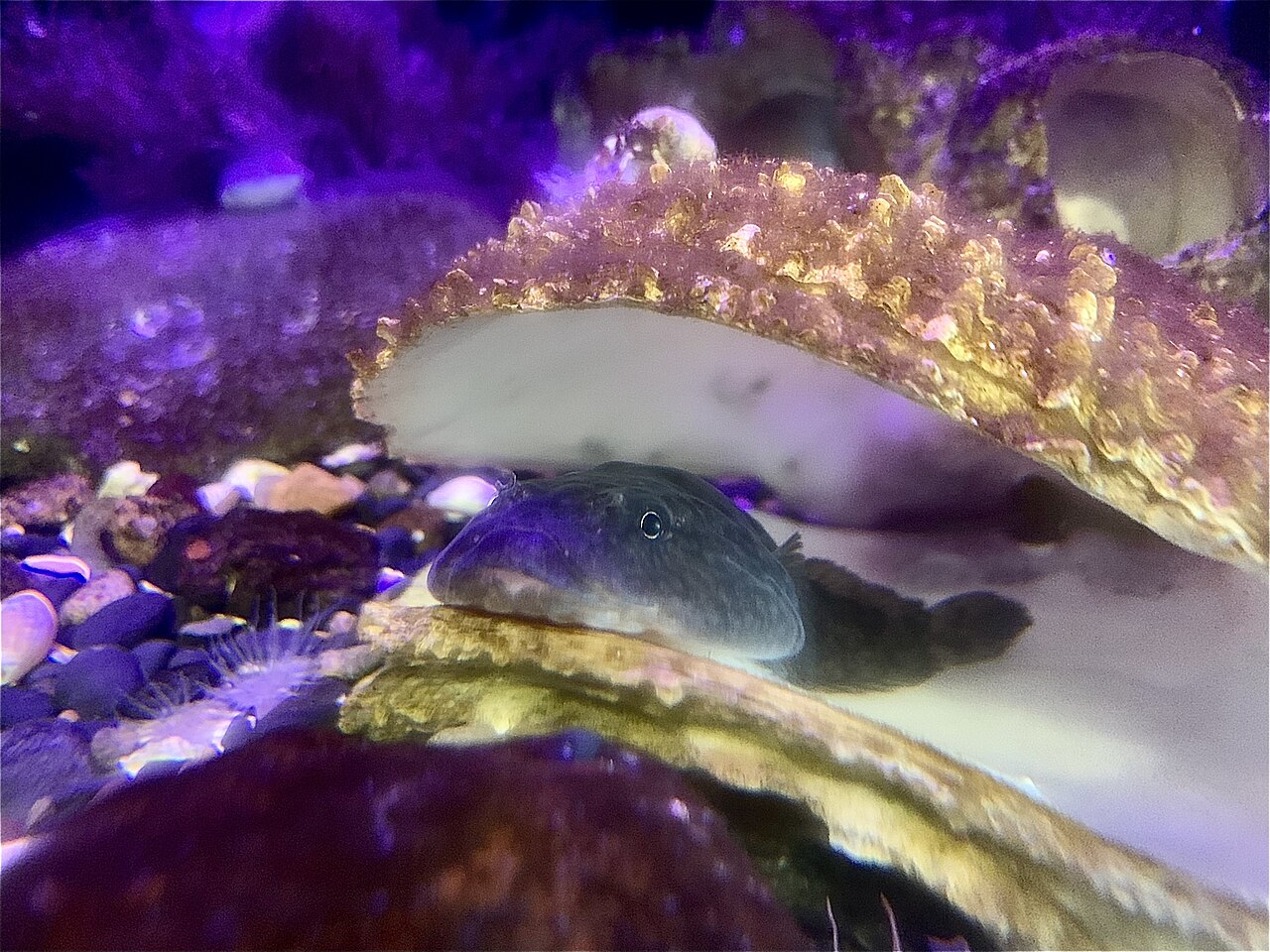
Its caudal fin is rounded, and its pectoral fins are short and wide, which helps with suction and movement. Adults usually reach about 7.6 cm (3 inches) long, but can grow up to 17 cm (6.5 inches). Their color ranges from brown to reddish, and juveniles have distinct white bars along the back and the edge of the tail fin. They have a reduced swim bladder and no stomach.
The clingfish’s most distinctive feature is its powerful suction disc, located on the underside of the body. This disc is formed from fused pelvic and pectoral fins. It allows the fish to stick to rough surfaces and withstand strong waves. The disc is covered with tiny, hair-like filaments called epidermal papillae, which create friction.
When the disc edges pull inward to attach, water tries to leak underneath, but these filaments block it. This mechanism lets the fish generate attachment forces 80 to 150 times its own body weight. Most rocks in its habitat are covered with a biofilm of algae, bacteria, and small invertebrates. This layer actually helps the clingfish stick better, because the disc anchors to the biological film rather than bare rock.
On clean, unfouled rocks, the disc may not hold well. The fish can attach to surfaces that are slippery or nonslippery, smooth or rough. Larger fish have more surface area for friction, so body size affects adhesive performance. Researchers study this suction ability to develop better adhesives.
Geographic distribution
Geographic distribution G. maeandricus lives in the rocky intertidal zone of the eastern Pacific Ocean. Its range stretches from southeastern Alaska, down the coasts of Canada and the United States, to southern California, and continues into Baja California, Mexico.
Some individuals are also found around Revillagigedo Island. As an intertidal species, it constantly experiences changes from the tides. It is abundant throughout its native range.
Scientific classification
- KingdomAnimalia
- PhylumChordata
- ClassActinopterygii
- DivisionTeleostei
- OrderBlenniiformes
- FamilyGobiesocidae
- GenusGobiesox
- SpeciesGobiesox maeandricus
Named by (Girard, 1858)
Sources: Wikipedia taxobox: Northern clingfish (CC BY-SA 4.0) · differs from this box at order: WoRMS AphiaID 275671 (CC BY 4.0)
Conservation status
Least Concern (LC)
- LC▲ this species
- NT
- VU
- EN
- CR
- EW
- EX
Source: IUCN Red List assessment · GBIF copy of the Red List category
How big is it?
Largest length in the source, 0.17 m, next to a 1.8 m person.
Diagram: drawn by Codexery, schematic shapes to scale (not a likeness). Length: Wikipedia: Northern clingfish
Where the northern clingfish has been recorded
Each dot is a place where the species has been observed and reported (68,974 records, half-degree grid) — not a modelled range. 22 inland records left out (institution coordinates).
Map: drawn by Codexery. Data: GBIF occurrence search (records CC0 / CC BY) · Natural Earth basemap (public domain) · place coordinates: Wikipedia (CC BY-SA 4.0)
Background
The northern clingfish has a flattened, elongated body and head with smooth, scaleless skin. Its coloration ranges from brown to reddish tones, and juveniles display distinctive white bars along the dorsal side and the edge of the caudal fin. It possesses a reduced swim bladder and lacks a stomach. The suction disc on its ventral side is formed by fused pelvic and pectoral fins, and features specialized epithelial microstructures called epidermal papillae—subdivided into tiny, hair-like filaments that prevent water from leaking under the disc during attachment.
This allows the fish to adhere to a wide range of surfaces, from slippery to nonslippery and smooth to rough. Most rocks in its habitat are fouled with biofilms, which enhance adhesion; on unfouled rocks, the disc may fail to adhere effectively. Body size influences adhesive performance, as larger fish have greater surface area for friction.
Geographically, G. maeandricus ranges from southeastern Alaska down to southern California and into Baja California, Mexico, with some individuals around Revillagigedo Island. It is abundant throughout its native range. As a cryptobenthic fish, it spends most of its life hidden among rocks and vegetation in shallow coastal waters from 0–8 meters deep, occupying microhabitats such as rocky tide pools and upper regions of the kelp canopy. Its solitary lifestyle is characterized by a lack of long-distance migration, limited dispersal, and reduced territorial behaviors, though it can exhibit territorial behavior when provoked.
Life history
During high tide, it actively explores and feeds on small crustaceans, mollusks, isopods, worms, and limpets, using its suction disc to pry prey from hard surfaces. During low tide, it shelters beneath rocks or in crevices to avoid predation and desiccation, and can respire in air for short periods.
Reproductively, G. maeandricus is oviparous, with spawning usually occurring in spring (April–June). Males construct nests in rocky crevices where females deposit adhesive eggs; males guard the eggs until they hatch. Larvae attach to kelp during early development before relocating into more dynamic intertidal regions. Predators such as gopher snakes have been documented feeding on these fish along the shores of the San Juan Islands.
Frequently Asked Questions
How big does a Northern clingfish get?
Most individuals measure roughly 7.6 centimeters (about 3 inches) in total length. The species can reach a maximum of around 17 centimeters (6.5 inches), but that is the upper extreme rather than the norm.
Where does the Northern clingfish live?
It is found in the rocky intertidal zone along the eastern Pacific coastline, the band of habitat that is alternately submerged and exposed as the tide rises and falls. This is a harsh, wave-battered environment where its suction disc is essential for survival.
What does a Northern clingfish look like?
It has a flattened, elongated body and head covered in smooth, scaleless, slimy skin, with a rounded caudal fin and short, broad pectoral fins. Its fin structure includes 13 to 16 dorsal soft rays and 12 to 14 anal soft rays, with no spined rays present.
More in Blennies
Test yourself
Three questions drawn from this entry’s sources. Pick an answer to check it.
Answers checked against the source article
Sources
Compiled from Wikipedia and the sources listed below. Text from Wikipedia is available under CC BY-SA 4.0; this entry is adapted from it.
- Wikipedia: Northern clingfish (CC BY-SA 4.0).
- Classification: the source article's taxobox; compare WoRMS, the World Register of Marine Species (CC BY 4.0).
- Conservation status: IUCN Red List assessment.
- Occurrence records: GBIF (CC0 / CC BY). Basemap: Natural Earth (public domain).
- Word definitions: the , each quoted from its Wikipedia article.
Spotted an error? Know more?
Reader corrections go straight into our review queue. Suggest an edit · How this site is sourced