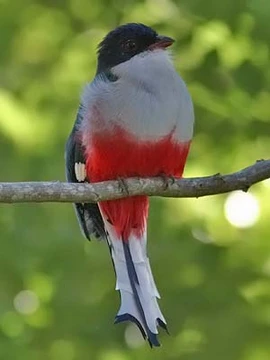
Northern flicker
Last updated
The northern flicker (Colaptes auratus) is a medium-sized woodpecker native to most of North America, parts of Central America, Cuba, and the Cayman Islands. It is one of the few woodpecker species that migrate and is known by over 100 common names, including yellowhammer, clape, and gaffer woodpecker.
Scientific classification
- KingdomAnimalia
- PhylumChordata
- ClassAves
- OrderPiciformes
- FamilyPicidae
- GenusColaptes
- SpeciesColaptes auratus
Named by (Linnaeus, 1758)
Sources: Wikipedia taxobox: Northern flicker (CC BY-SA 4.0) · order, family and genus agree with WoRMS AphiaID 1484379 (CC BY 4.0)
Conservation status
Least Concern (LC)
- LC▲ this species
- NT
- VU
- EN
- CR
- EW
- EX
Source: IUCN Red List assessment · GBIF copy of the Red List category
How big is it?
Largest length in the source, 0.54 m, next to a 1.8 m person.
Diagram: drawn by Codexery, schematic shapes to scale (not a likeness). Length: Wikipedia: Northern flicker
Where the northern flicker has been recorded
Each dot is a place where the species has been observed and reported (14,452,312 records, half-degree grid) — not a modelled range. 474 inland records left out (institution coordinates).
Map: drawn by Codexery. Data: GBIF occurrence search (records CC0 / CC BY) · Natural Earth basemap (public domain) · place coordinates: Wikipedia (CC BY-SA 4.0)
Subspecies
There are ten recognized subspecies of the northern flicker, though one is extinct and possibly invalid. The nine living subspecies were once split into two separate species: the yellow-shafted flicker, with four subspecies, and the red-shafted flicker, with six (five living, one extinct). Because they interbreed freely where their ranges meet, the American Ornithologists Union now treats them as a single species, illustrating the species problem.
The southern yellow-shafted flicker lives from Florida to Virginia. It has yellow under the tail and wings, yellow feather shafts, a gray cap, a beige face, and a red bar on the nape; males sport a black mustache. The northern yellow-shafted flicker ranges from central Alaska through most of Canada to southern Labrador, Newfoundland, and the northeastern United States. The Cuban yellow-shafted flicker is found only on Cuba.
The Grand Cayman yellow-shafted flicker lives only on Grand Cayman; its name honors Cuban naturalist Juan Gundlach. The western red-shafted flicker lives in western North America. It has red under the tail and wings, red feather shafts, a beige cap, a gray face, and males have a red mustache. Its subspecific name cafer came from a 1788 mistake by Johann Gmelin, who thought the bird lived in South Africa among the Xhosa people.
Proposals to rename it C. a. lathami have been brought to the American Ornithological Society, which as of September 2018 declined to support the change but may consult the ICZN.
Description
Adults sport brown feathers with black bars across their back and wings. This mid-to-large woodpecker ranges from 28 to 36 centimeters long, with a wingspan of 42 to 54 centimeters, and weighs between 86 and 167 grams. The heaviest individuals are found in northern areas like Alaska and Labrador, while the lightest come from Grand Cayman. A black, necklace-like patch marks the upper breast, and the lower breast and belly are beige with black spots.
Males have a mustache-like stripe at the base of the beak—black in the east, red in the west—which females lack. The tail is dark above, with a white rump that stands out during flight. Its call is a steady, laughing ki ki ki ki, and it drums on trees or metal objects to claim territory. The flight is undulating, a series of quick flaps followed by a pause, like a roller coaster.
Diet
Flickers are the only woodpeckers that frequently feed on the ground, probing with their beak and sometimes catching insects in flight. Their primary food is insects, with ants alone making up 45% of their diet; they also eat flies, butterflies, moths, beetles, and snails. They consume fruits, berries, seeds, and nuts, especially in winter, including poison ivy, poison oak, dogwood, sumac, wild cherry, grape, bayberries, hackberries, elderberries, sunflower, and thistle seeds.
Northern flickers often break into underground ant colonies to get at larvae, hammering at the soil, and have been observed breaking up cow dung to eat insects within. Their tongues can dart out 50 mm beyond the end of the bill to catch prey. They are natural predators of the European corn borer, an invasive moth. They also exhibit anting behavior, using formic acid from ants to assist in preening and keep free of parasites.
Lifespan
A study from 2006 examined mortality rates of male and female northern flickers over six years using capture-tag-recapture techniques, finding that only one to two birds out of every 300 adults were 7 or more years old, correlating with a mortality model predicting a 0.6% 7-year survival rate. No significant differences were found between male and female survival rates. The oldest known yellow-shafted flicker lived at least 9 years 2 months, and the oldest known red-shafted flicker lived at least 8 years 9 months.
The breeding habitat consists of forested areas across North America and as far south as Central America. It is a cavity nester, typically in trees, but may use posts and birdhouses; it prefers to excavate its own home but may reuse old nests created by belted kingfishers or sand martins. Abandoned northern flicker nests create habitats for other cavity nesters, though the flicker is sometimes driven away by common starlings. Breeding occurs from February to July depending on temperature; both mates stay together during the season but not after.
One to two weeks are needed to build the nest, and males attract females by head bobbing and a mating call described as woikawoikawoika.
Did You Know?
- The northern flicker was described and illustrated by English naturalist Mark Catesby in his book The Natural History of Carolina, Florida and the Bahama Islands, published between 1729 and 1732.
- Carl Linnaeus coined the binomial name Cuculus auratus for the northern flicker in the 10th edition of Systema Naturae in 1758.
- The northern flicker is the state bird of Alabama, and the colloquial name 'yellowhammer' originated during the American Civil War to describe Confederate soldiers from Alabama.
More in Birds of Cuba
Sources
Compiled from Wikipedia and the sources listed below. Text from Wikipedia is available under CC BY-SA 4.0; this entry is adapted from it.
- Wikipedia: Northern flicker (CC BY-SA 4.0).
- Classification: the source article's taxobox; order, family and genus checked against WoRMS, the World Register of Marine Species (CC BY 4.0).
- Conservation status: IUCN Red List assessment.
- Occurrence records: GBIF (CC0 / CC BY). Basemap: Natural Earth (public domain).
- Word definitions: the Codexery glossary, each quoted from its Wikipedia article.
Spotted an error? Know more?
Reader corrections go straight into our review queue. Suggest an edit · How this site is sourced