27 Canis Majoris
Binary system with a Be star and Gamma Cassiopeiae variable.
Last updated

Stephen.G.McAteer · CC BY-SA 3.0
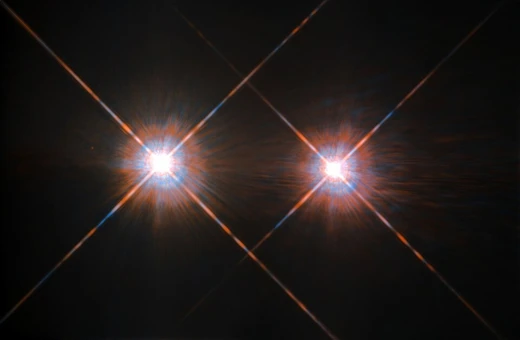
27 Canis Majoris, also known by its variable star designation EW Canis Majoris, is a binary star system in the northern part of the constellation Canis Major. It lies roughly 1,700 light-years from the Sun and is visible to the naked eye as a blue-white star of the 4th magnitude. The system is moving away from Earth at a heliocentric radial velocity of 16 km/s.
The two stars were first distinguished as separate objects by W. S. Finsen in 1953, and the gap between them has been increasing ever since. They orbit each other with a period of about 119 years, an eccentricity of 0.7, and a semimajor axis of 0.178 arcseconds. The primary star, component A, has a magnitude of 4.92 and is classified as a Be star of type B3 IIIpe. It spins rapidly, with a projected rotational velocity of 290 km/s, compared to a critical velocity of 389 km/s.
This star is also a Beta Cephei variable, pulsating with a period of 0.0919 days and an amplitude of 0.0080 in magnitude. The secondary, component B, has a magnitude of 5.39 and is classified as a Gamma Cassiopeiae type variable star. Because of this variability, the overall brightness of the system fluctuates between magnitudes +4.42 and +4.82.
Quick Facts
- Distance
- approximately 1,700 light years
- Apparent magnitude
- varies from +4.42 to +4.82
- Orbital period
- around 119 years
- Eccentricity
- 0.7
- Semimajor axis
- 0.178″
- Primary spectral type
- B3 IIIpe
- Primary projected rotational velocity
- 290 km/s
Facts from the source article.
More in Binary and Multiple Stars
Sources
Compiled from Wikipedia and the sources listed below. Text from Wikipedia is available under CC BY-SA 4.0; this entry is adapted from it.
- Wikipedia: 27 Canis Majoris (CC BY-SA 4.0).
Spotted an error? Know more?
Reader corrections go straight into our review queue. Suggest an edit · How this site is sourced