Gamma Cassiopeiae
Last updated
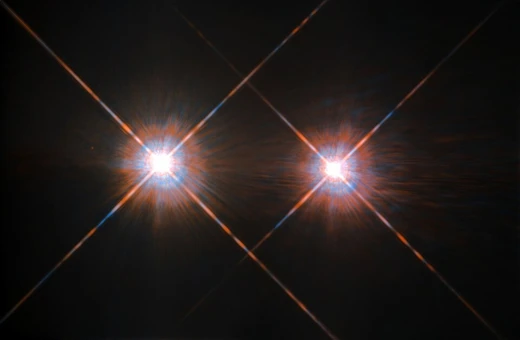
Gamma Cassiopeiae is a multiple star system at the center of the "W" asterism in Cassiopeia, located roughly 550 light-years from Earth based on Hipparcos parallax measurements.[1][2] It was the first star ever observed with emission lines, noted by Angelo Secchi in 1866, and is now classified as a Be star.[3] The system is one of the highest multiplicity systems known, potentially containing eight stars including its common-proper-motion companion HD 5408.[1]
Quick Facts
- Bayer designation
- γ Cassiopeiae
- Flamsteed designation
- 27 Cassiopeiae
- Apparent visual magnitude
- 2.47
- Distance
- roughly 550 light-years
- Spectral type
- B0.5 IVe
Facts from the source article.
Key facts and history
It has since gradually brightened back to around magnitude 2.2, with TESS observations in November 2019 showing amplitudes of no more than 2%.[4] The star has a spectral classification of B0.5 IVe, with the 'e' suffix indicating emission lines of hydrogen from a circumstellar disk.[5] The star was used as a navigational reference during space missions, and astronaut Gus Grissom nicknamed it Navi after his middle name spelled backwards.[6] During the late 1930s, a shell episode caused the star's brightness to exceed magnitude 2.0, then quickly fall to 3.4; at its peak, it was brighter than both Alpha Cassiopeiae (magnitude 2.25) and Beta Cassiopeiae (magnitude 2.3).[7]
With a projected rotational velocity of 389 km/s, the star spins rapidly, resulting in a noticeable equatorial bulge.[8] On 13 November 2025, the IAU Working Group on Star Names designated Gamma Cassiopeiae Aa as Tiansi, a name derived from the older Chinese name.[9] Older Chinese charts placed Gamma Cassiopeiae as one of four horses in the Wangliang asterism pulling the chariot, but later depictions reassigned Gamma to be the whip.[10] A periodic signal of 1.21 days suggests a magnetic field anchored on the rotating star's surface, indicating the presence of a strong disordered magnetic field.[11]
What the cited sources add
The IAU Catalog of Star Names records that Tiansi (Tiān Sì, Heavenly Quadriga) is an old Chinese asterism attested for at least 2000 years.[12] Ridpath's "Star Tales" describes Gamma Cassiopeiae as an erratic variable with no official name, and notes that in the Chinese asterism Wangliang, the four horses were Gamma, Eta, Alpha, and Zeta Cassiopeiae.[10]
References
- Wikipedia, "Gamma Cassiopeiae" (CC BY-SA 4.0), which cites: Hutter, "Surveying the Bright Stars by Optical Interferometry. III. A Magnitude-limited Multiplicity Survey of Classical Be Stars", The Astrophysical Journal Supplement Series, 2021, p. 69; Mamajek, "Gamma Cassiopeiae and HR 266: A Massive Septuplet Illuminating the IC 59 and IC 63 Nebulae at d = 168 pc", Journal of Double Star Observations, April 2017, p. 264–267 (original not read by us) en.wikipedia.org
- Wikipedia, "Gamma Cassiopeiae" (CC BY-SA 4.0), which cites: "IAU Catalog of Star Names" (we also read that source) en.wikipedia.org
- Wikipedia, "Gamma Cassiopeiae" (CC BY-SA 4.0), which cites: Secchi, "Schreiben des Herrn Prof.Secchi, Dir. Der Sternwarte des Collegio Romano, an den Herausgeber", Astronomische Nachrichten, 1867, p. 63–64; Mamajek, "Gamma Cassiopeiae and HR 266: A Massive Septuplet Illuminating the IC 59 and IC 63 Nebulae at d = 168 pc", Journal of Double Star Observations, April 2017, p. 264–267 (original not read by us) en.wikipedia.org
- Wikipedia, "Gamma Cassiopeiae" (CC BY-SA 4.0), which cites: Pollmann, "Long-term monitoring of Halpha emission strength and photometric V magnitude of gamma Cas", Information Bulletin on Variable Stars, 2014, p. 1; Labadie-Bartz, "Short-term variability and mass loss in Be stars – VI. Frequency groups in γ Cas detected by TESS", Monthly Notices of the Royal Astronomical Society, March 2021, p. 242–259 (original not read by us) en.wikipedia.org
- Wikipedia, "Gamma Cassiopeiae" (CC BY-SA 4.0), which cites: Merrill, "Discovery and Observations of Stars of Class Be", Astrophysical Journal, 1925, p. 389; Zorec, "On the evolutionary status of Be stars. I. Field Be stars near the Sun", Astronomy and Astrophysics, 2005, p. 235–248; Tetzlaff, "A catalogue of young runaway Hipparcos stars within 3 KPC from the Sun", Monthly Notices of the Royal Astronomical Society, 2011, p. 190 (original not read by us) en.wikipedia.org
- Wikipedia, "Gamma Cassiopeiae" (CC BY-SA 4.0), which cites: "Post-landing Activities", Apollo 15 Lunar Surface Journal; "Apollo 10 Flown CSM Star Chart Directly from the Personal Collection of Mission Command Module Pilot John Young", Heritage Auction Galleries (original not read by us) en.wikipedia.org
- Wikipedia, "Gamma Cassiopeiae" (CC BY-SA 4.0), which cites: Baldwin, "Light Curves of Gamma Cassiopeiae", Popular Astronomy, 1941, p. 127 (original not read by us) en.wikipedia.org
- Wikipedia, "Gamma Cassiopeiae" (CC BY-SA 4.0), which cites: Archer, "Measurement of the photosphere oblateness of γ Cassiopeiae via Stellar Intensity Interferometry with the VERITAS Observatory", The Astrophysical Journal, 2025-06-18, p. 191 (original not read by us) en.wikipedia.org
- Wikipedia, "Gamma Cassiopeiae" (CC BY-SA 4.0), which cites: 唐山 (Tángshān), "天文學太空航空學辭典", 廣文書局, 1967; Allen, "Star-names and their meanings", Dover Publications, 1963, p. 146; Ridpath, "Star Tales", James Clarke & Co., 1988; Sun, "The Chinese Sky During the Han: Constellating Stars and Society", Koninklijke Brill, 1997, p. 150, 168; Ridpath, "Star Tales", James Clarke & Co., 1988; Ridpath, "Star Tales", James Clarke & Co., 1988; "IAU Catalog of Star Names" (we also read that source) en.wikipedia.org
- Ridpath, "Star Tales", James Clarke & Co., 1988. facts only, no text reused. ianridpath.com
- Wikipedia, "Gamma Cassiopeiae" (CC BY-SA 4.0), which cites: Robinson, "X-Ray and Optical Variations in the Classical Be Star γ Cassiopeia: The Discovery of a Possible Magnetic Dynamo", Astrophysical Journal, 2002, p. 435–448 (original not read by us) en.wikipedia.org
- "IAU Catalog of Star Names". facts only, no text reused. exopla.net
Each numbered sentence above was checked against the source it cites before publication. Sentences citing Wikipedia adapt text from the English Wikipedia article Gamma Cassiopeiae (contributors), used under CC BY-SA 4.0; this entry is available under the same licence. Other sources were used for facts only; no text or images are copied from them.
More in Binary and Multiple Stars
Sources
Compiled from Wikipedia and the sources listed below. Text from Wikipedia is available under CC BY-SA 4.0; this entry is adapted from it.
- Wikipedia: Gamma Cassiopeiae (CC BY-SA 4.0).
Spotted an error? Know more?
Reader corrections go straight into our review queue. Suggest an edit · How this site is sourced