Bhagavad-Gītā As It Is
Last updated
A. C. Bhaktivedanta Swami Prabhupada, who founded the Hare Krishna movement (ISKCON), produced this translation and commentary of the Bhagavad Gita. It focuses on a devotional path to the personal deity Krishna. Macmillan Publishers first released the English version in 1968. Now available in close to sixty languages, the book is mainly circulated by ISKCON followers.
Quick Facts
- Author
- A. C. Bhaktivedanta Swami Prabhupada
- First english publication
- 1968
- Publisher
- Macmillan Publishers
- Original language
- English
- Languages available
- nearly sixty
- Year iskcon founded
- 1966
Facts from the source article.
Contents
Complete editions of this work present each verse with Devanagari script, a Latin transliteration, word-for-word Sanskrit-to-English meanings, and an English translation. Prabhupada provides detailed commentary throughout, drawing from Gaudiya Vaishnava sources such as the Ramanuja Bhasya, Visvanatha Chakravarti Thakura's Sarartha-varsini-tika, Baladeva Vidyabhushana's Gita-bhusana-tika, and Bhaktivinode Thakur's Bengali commentaries. The story centers on a conversation between Lord Krishna and the warrior Arjuna on the Kurukshetra battlefield.
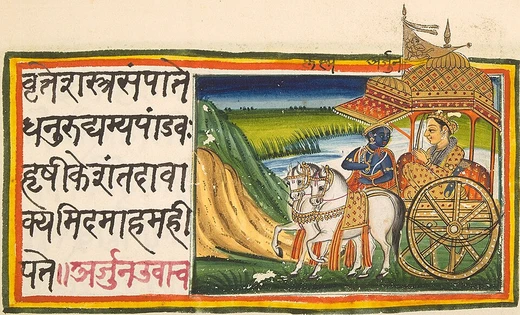
Krishna has come to earth to help Arjuna fight the Kauravas, acting as his charioteer. He shares divine insights about human life, the true nature of God, and how to achieve eternal progress and freedom from the cycle of death and rebirth through bhakti yoga. The teaching holds that reaching Krishna consciousness and understanding that all life stems from Krishna's eternal energy frees the soul from reincarnation. The narrative ends with Krishna showing Arjuna his universal form, which includes all existence.
When Arjuna sees his relatives in the enemy army and feels sorrow, Krishna explains that his duty to God and self-realization outweighs material attachments, and that nothing truly dies.
Substance
The work suggests a way of life for the contemporary Western world, derived from the Manu Smriti and other Hindu religious and social law texts. Ideal human society is described as divided into four varnas: brahmana (intellectuals), kshatriya (administrators), vaishya (merchants), and shudra (workers). Prabhupada supports the view that one becomes a member of a varna by personal qualities and work performed, not by birth.
Society is best ruled by a benevolent kshatriya sovereign governing according to scriptural tradition, with brahmanas as spiritual leaders. Brahmanas, elders, women, children, and cows deserve special protection, with cows preserved from slaughter. Prabhupada encouraged a lacto-vegetarian diet and agriculture as the ideal economic basis, concluding that society should be Krishna conscious.
Edition history
A. C. Bhaktivedanta Swami Prabhupada came to the United States in 1965 and started ISKCON the next year in a New York City storefront. He was eager to publish his Bhagavad-gita As It Is. Macmillan put out a 400-page version in 1968, but since the original manuscript was over 1000 pages, that first edition was called the Abridged Edition. Strong sales led Macmillan to release the Complete Edition in 1972.
After Prabhupada’s death in 1977, the Bhaktivedanta Book Trust issued a Revised and Enlarged edition in 1983 with at least a thousand changes, justified as closer to the original manuscript. This edition sparked controversy among his followers. In 2001, Krishna Books Inc reprinted the 1972 Complete Edition, so both versions are now in print.
Trial
The case was dismissed by a federal judge on 28 December 2011. Russian ambassador Alexander Kadakin condemned those seeking the ban, stating Russia was a secular country.
About 15,000 Indians in Moscow and ISKCON followers in Russia asked the Indian government to intervene, triggering strong protests by Members of Parliament. The final hearing was scheduled for 28 December, with the court seeking opinions from the Russian Ombudsman on human rights and Indologists. The prosecutor's office appealed, but on 21 March 2012 the appeal court upheld the lower court's decision.
More in Bhagavad Gita
Sources
Compiled from Wikipedia and the sources listed below. Text from Wikipedia is available under CC BY-SA 4.0; this entry is adapted from it.
- Wikipedia: Bhagavad-Gītā As It Is (CC BY-SA 4.0).
Spotted an error? Know more?
Reader corrections go straight into our review queue. Suggest an edit · How this site is sourced